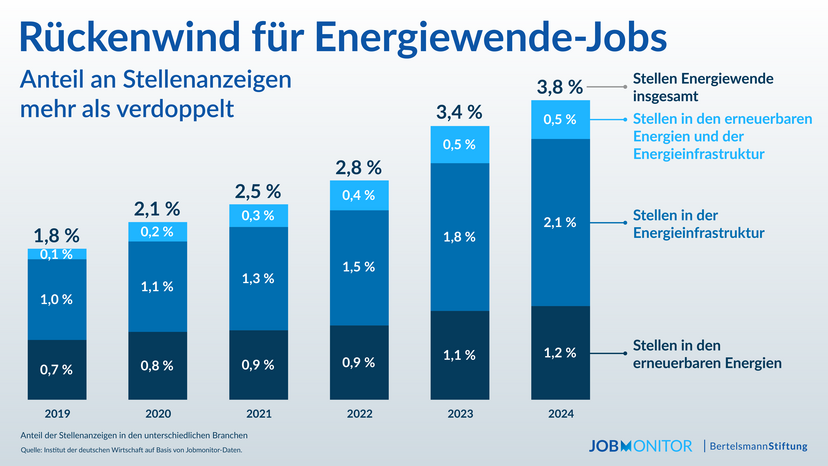
The energy transition sector in Germany continues to be a ‘jobs engine’ in an otherwise challenging economic environment, with job postings in the sector more than doubling since 2019, a new study by Bertelsmann Stiftung has found.
Last year, 372,500 jobs were posted for positions related to the energy transition, up from 173,000 jobs in 2019, it noted.
Jobs related to renewable energies and associated infrastructure currently account for around 4% of the 10 million jobs nationwide. In addition, while the total number of job vacancies in Germany declined by 16% last year, the energy transition sector only saw an 8% drop.
Demand for workers
“While jobs are being cut on a large scale in industry, additional jobs are still being created in the energy transition sector,” said Jana Fingerhut, labour market expert, Bertelsmann Foundation. “With the record number of wind turbine approvals in 2024, the need for workers for the energy transition is likely to increase in the coming years.”
Solar energy has been a major driver of employment, the study noted, with job postings increasing from 41,500 in 2019 to 102,000 in 2024. In the wind energy sector, job postings have risen by around 70%, to 53,000.
The demand for workers in the area of energy infrastructure has also grown significantly, with grid infrastructure, energy storage, and the hydrogen industry seeing the biggest increases – in hydrogen, for example, jobs have risen nearly fivefold in the past six years.
“Without the expansion of infrastructure, the energy transition will not progress,” added Bertelsmann Stiftung‘s Gunvald Herdin. “It is a question of resilience if we want to become even more independent of gas and oil.”
Shortage of skilled workers
At the same time, the energy transition sector faces a shortage of skilled workers, the study noted, with several key professions, such as electrical engineers, heating and climate technology specialists, and pipeline construction workers, in high demand but lacking enough qualified applicants.
‘According to the Federal Employment Agency, five of the ten occupations that are important for the expansion of renewable energies are shortage occupations for which there is a high demand for workers, but far from enough applicants,’ Bertelsmann Stiftung noted.
‘In the area of energy infrastructure, six of the top ten occupations are shortage occupations, and specialists in pipeline construction and specialists and experts in electrical engineering are also urgently needed here.’ Read more here.