SustainabilityOnline recently published its inaugural ‘Ambition Into Action’ report, featuring interviews with senior leaders about how they are turning sustainability vision into business reality at the mid-point of the decade.
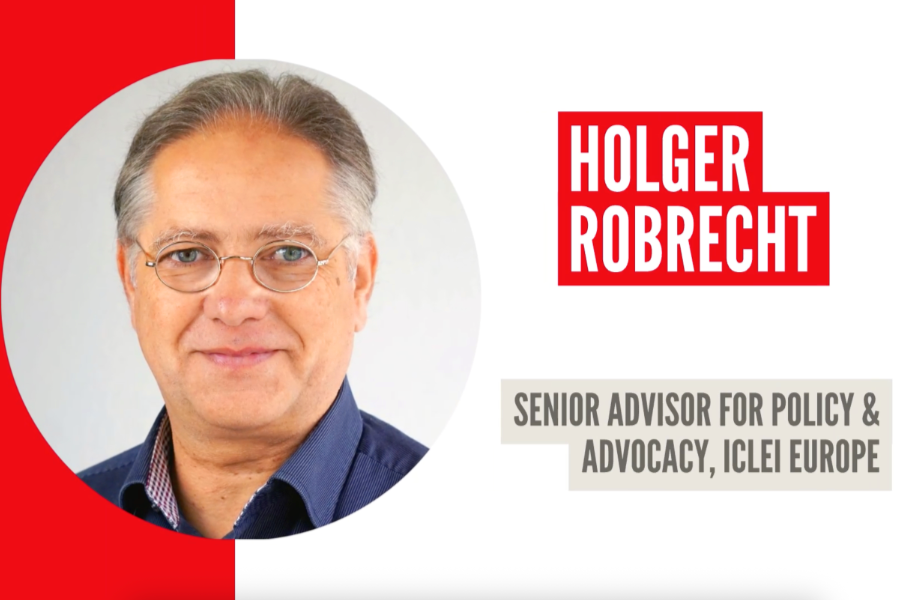
Holger Robrecht is Senior Advisor for Policy and Advocacy at ICLEI Europe, where he leads work on policy development and advocacy linked to sustainable cities and communities. ICLEI Europe is a network of local and regional governments focused on urban and regional transformation, particularly around climate resilience and carbon neutrality.
How does ICLEI Europe support businesses to move from ‘ambition to action’ in terms of turning sustainability into a core value driver – in other words, how have you made sustainability ‘good for business’?
As hubs of economic activity and innovation, local governments play a crucial role in implementing EU priorities, from climate resilience and energy security to AI-driven public services. At the same time, their aggregate demand for clean and low-carbon materials and products, particularly in the transport, buildings and energy sectors, represents a huge demand and market potential for clean industries.
To leverage this potential, ICLEI Europe is actively positioning its members, local governments across Europe, as key strategic partners in boosting the competitiveness of European industry, while accelerating their own climate neutrality goals. Alongside Climate-KIC and the World Business Council for Sustainable Development, ICLEI Europe is organising City-Industry Dialogues across EU Member States.
These dialogues aim to unlock the framework conditions for climate-neutral markets by matching the demand for clean products embedded in urban transition plans with the production pipelines of European industry.
This can enable companies to plan industrial production more effectively, fostering a mutually beneficial dynamic that advances economic, social and environmental goals together.
We’re now at the midpoint of the decade. What do you see as the single biggest barrier for businesses in moving from ambition to measurable action – and how can it be overcome?
Since the Paris Agreement, many leading industries have set ambitious 1.5°C-aligned targets and developed roadmaps to achieve net-zero emissions and climate resilience. While these commitments send a very important signal to stakeholders, companies still need to make their green products profitable and scalable.
The aggregated demand for clean, low-carbon materials, technologies, and services, embedded in sectoral decarbonisation and cities’ investment plans worldwide, represents an untapped opportunity for industry to build a strong economic case for decarbonisation.
Capturing this potential requires a whole-of-value chain approach, addressing decarbonisation not only in production but also in procurement, logistics, end-use, and circularity.
City-Industry Dialogues provide an opportunity to bridge the collaboration gap between local governments and industry leaders, helping them form a unified voice to advocate for better financial and regulatory conditions, accelerate the creation of markets for clean and low-carbon products and scale innovative solutions.
This could include new financial mechanisms to de-risk investment in large infrastructure projects, faster and fairer permitting processes, a more streamlined approach to joint procurement, and fewer but more reliable standards supporting strategic procurement, such as digital product passports.
What role can (and should) leadership play in ensuring sustainability commitments actually deliver results, rather than remaining aspirational? And how can you ensure buy-in from all stakeholders?
Whether you are a Mayor or a CEO, your responsibility is to define an ambitious pathway for the sustainable development of your community or organisation – one that delivers tangible, positive impacts and that is supported by key stakeholders.
One of the most effective ways to achieve this is through strong public–private partnerships, which can accelerate and complement the impact of your climate action as a company but also as a municipality.
Second, while corporate climate action may often be initiated within a company, its effects are very local. Things like energy efficiency, circularity measures, or green infrastructure directly support the sustainable development of the community, enhancing citizens’ quality of life and creating attractive conditions for companies and investors.
Third, closer collaboration between companies and public administrations can support implementation. Early and continuous communication helps shape, understand and plan processes like permitting or pre-commercial procurement, helping climate initiatives move faster and more effectively.
Innovative governance instruments such as Climate City Contracts, which help cities collaboratively overcome barriers, accelerate transformative action and achieve climate neutrality by 2030, embody these features and foster greater stakeholder buy-in and co-ownership.
Learn more about ICLEI Europe at www.iclei-europe.org/