SustainabilityOnline recently published its inaugural ‘Ambition Into Action’ report, featuring interviews with senior leaders about how they are turning sustainability vision into business reality at the mid-point of the decade.
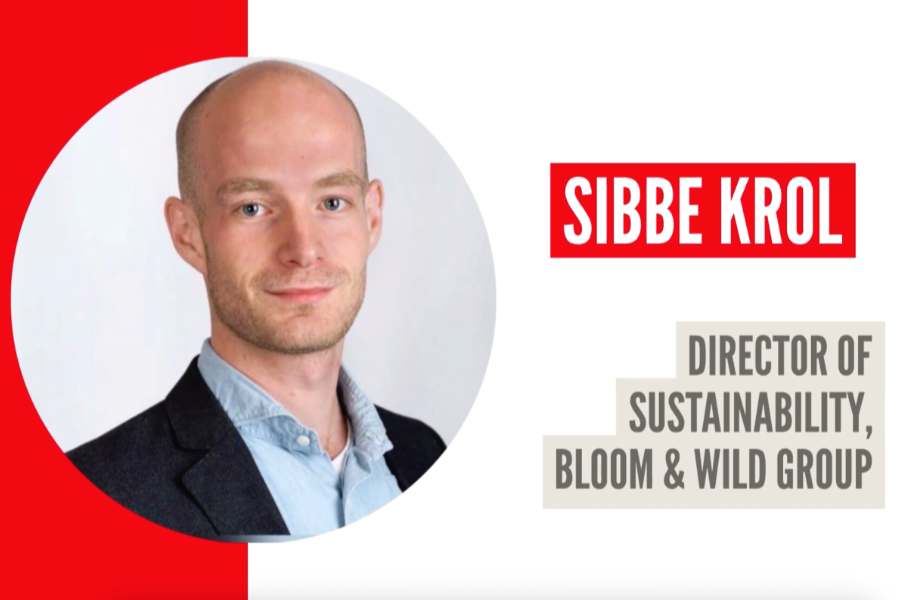
Sibbe Krol has been Director of Sustainability at Bloom & Wild Group since November 2023 and has worked at the company for four years. Bloom & Wild Group operates as a direct-to-consumer flower company serving multiple European markets. The company was founded in 2013 and since launch, it has raised £126 million in venture capital and private equity funding, making it Europe’s largest D2C florist.
How has Bloom & Wild moved from ‘ambition to action’ in terms of turning sustainability into a core value driver?
The short answer – we don’t treat sustainability as a side project and have worked to integrate it into all of our business functions. Two main examples that drive our business are product design and waste reduction.
We introduced ‘carbon budgets’ alongside financial budgets for every bouquet. Designers use granular data to swap high-carbon stems for lower-impact ones. This drives product innovation and makes us a more resilient business considering risks like future energy price volatility.
This also has led us to pioneer new products and supply chains. We are scaling sea freight for stems and even full bouquets from Kenya and Colombia, achieving an up to 90% reduction in carbon intensity compared to air, and even more when compared to a flower from a heated greenhouse in Europe.
Elsewhere, waste is a massive cost in the floriculture sector at large. We utilised smart forecasting and launched products like ‘The Lovely Leftovers’ to sell surplus stems rather than composting them. This has saved nearly 28,000 bouquets, turning a potential loss into a revenue stream and deepening customer loyalty through affordable, eco-conscious options.
We’re now at the mid point of the decade. What do you see as the single biggest barrier for businesses in moving from ambition to measurable action?
The biggest barrier is strategic indecision. In a landscape defined by global uncertainty and shifting legislation, many businesses stall, waiting for perfect standardised data or finalised regulations before taking any action.
We overcome this by refusing to let the perfect be the enemy of the good. Instead of waiting for the finalised EU methodology to be rolled out, we use the current best-available datasets (Ecoinvent) to map our supply chain now. This allows us to launch innovative carbon budgets and start reducing emissions immediately, rather than losing years to inaction.
By acting on the data we have today, we build the necessary infrastructure and organisational muscle. When legislation inevitably tightens, we won’t be starting from scratch; we will simply be refining a working system.
This proactive approach protects us from compliance shock later in the decade and allows us to lead the conversation on industry standards rather than just reacting to them.
What role can leadership play in ensuring sustainability commitments deliver results? And how can you ensure buy-in?
Leadership must shift sustainability from ‘compliance’ to ‘governance’. We joined the Better Business Act Coalition to lobby for changing laws to align shareholder interests with environmental impact, proving this is a core business strategy, not PR.
To ensure buy-in, we focus on shared value. For employees, we set quarterly OKRs for the organisation as a whole, where we can identify and line up resources for big bets. But we also always allow for bottom up projects and encourage teams to develop their own sustainability targets.
Sustainability is everybody’s business. We want everybody to feel engaged, and so we embed DEI and sustainability into our culture, which helps us beat industry averages for talent retention and diversity.
For suppliers, we don’t just demand compliance; we invest. By co-funding projects like river restoration in Kenya to boost climate change resilience and hosting skill-sharing workshops, we build stronger, longer-term supplier relationships.
Finally, for customers, we use clear labelling (Fairtrade, Organic) and admit our challenges openly. This transparency builds trust, distinguishing our brand in a crowded market.
Learn more about Bloom & Wild Group’s sustainability commitments at www.bloomandwild.com/sustainability.