Op-ed by Damien Derouene, global director, circular economy and innovation, GEODIS.
When people talk about the circular economy, the conversation often starts at the point where a product is no longer wanted. Can it be recycled? Can its metals be recovered? Can its components be separated and put to another use? Those questions matter, but they come rather late in the story.
A laptop, for example, contains valuable materials, but it also contains the energy, labour, engineering and resources that went into making it in the first place. Once it has been recycled, much of that value has already been lost. The better question is often a simpler one: can the product be used again?
That shift – from thinking about selling a product as a standalone item to thinking about continued use – is changing the way companies design their businesses. It is also changing the role of logistics. The circular economy is not only about what happens at the end of a product’s life. It is about building the systems that allow products to come back, be assessed, repaired, upgraded, refurbished and placed in the hands of another user.
From selling products to providing them as a service
One of the clearest signs of this change is the growth of product-as-a-service models. In IT, the term device as a service is widely used. In other sectors, companies may talk about equipment as a service.
The wording varies, but the underlying idea is similar: the customer pays for access to a product and the service around it, rather than simply buying the product outright and taking responsibility for everything that happens afterwards.
For many companies, this is still the beginning of the journey. IT equipment is probably the most advanced example. Most of us use a laptop at work, but we may not own it personally. It may have been leased or provided through a service arrangement.
We use it for as long as we need it, and when it is replaced, it should not simply disappear into a cupboard, a warehouse or a drawer.
There is a whole operation behind that apparently simple experience. The device has to be collected, its data securely erased, its condition checked and its next destination decided.
It may need a repair, an upgrade, a replacement part or nothing more than a clean and a new package. It may go back to the same organisation, to another user, to a resale channel or, if it has reached the end of its useful life, to a responsible recycling process.
That is the difference between selling a product and providing it as a service. The transaction does not end when the product leaves the manufacturer. The manufacturer remains connected to the product and, in many cases, retains ownership of it. This makes it much easier to bring the product back into the circular economy.
A major shift in business models
For manufacturers that have spent decades focused on selling products, this is a major change in the business model.
It can make products more accessible to customers, create a more predictable stream of revenue and build a longer-term relationship between the manufacturer and the user. It also gives manufacturers a clearer route back to their own products.
If a phone or laptop is sold outright, recovering it later can be difficult. The manufacturer may have to persuade the customer to return it, often through a trade-in scheme or a recycling incentive. If the product is provided as a service, the return is part of the arrangement from the beginning.
The manufacturer knows where the product is, when it is likely to come back and what needs to happen next.
This makes the logistics and workflow elements critical. The service depends on deployment, collection, inspection, repair, refurbishment, secure data erasure, packaging, storage and redeployment all working together. If one part of that chain is unreliable, the customer experience suffers and the economics of the model become much harder to manage.
The same idea is beginning to move into consumer goods. Subscription and upgrade models for smartphones are becoming more familiar. Retailers are looking at ways to provide products such as bicycles as a service.
A child may outgrow a bicycle after two years even though the bicycle itself is still perfectly usable. A service model gives the retailer a way to take it back, prepare it for another child and provide a larger one to the original customer.
That is a very different proposition from selling a bicycle and leaving the customer to decide what to do with it later. It is also a very practical example of how a product can remain in use for longer.
Circularity means managing different routes at the same time
At GEODIS, our experience of these models has been built largely around IT equipment over the past 15 years. We have developed the operational and digital capabilities needed to manage devices through their different stages: deployment, return, assessment, repair, refurbishment, redeployment, resale and, where there is no further useful life, recycling.
In 2025, we refurbished more than 45,000 laptops. That is a useful indication of the scale we can handle, but the number itself is not the most important point. The real challenge is making sure that every device is assessed properly and sent down the right route.
But circular logistics is not simply forward logistics in reverse. In a conventional delivery operation, the destination is usually known before the product is collected. You know what is being picked up, where it is going and, broadly, when it needs to arrive. With returned products, the situation is much less predictable.
You may have some information about the condition of a device before it comes back, but you cannot always rely on it. The product has to be inspected. Its condition has to be recorded. Its data has to be removed securely. Only then can you decide what happens next.
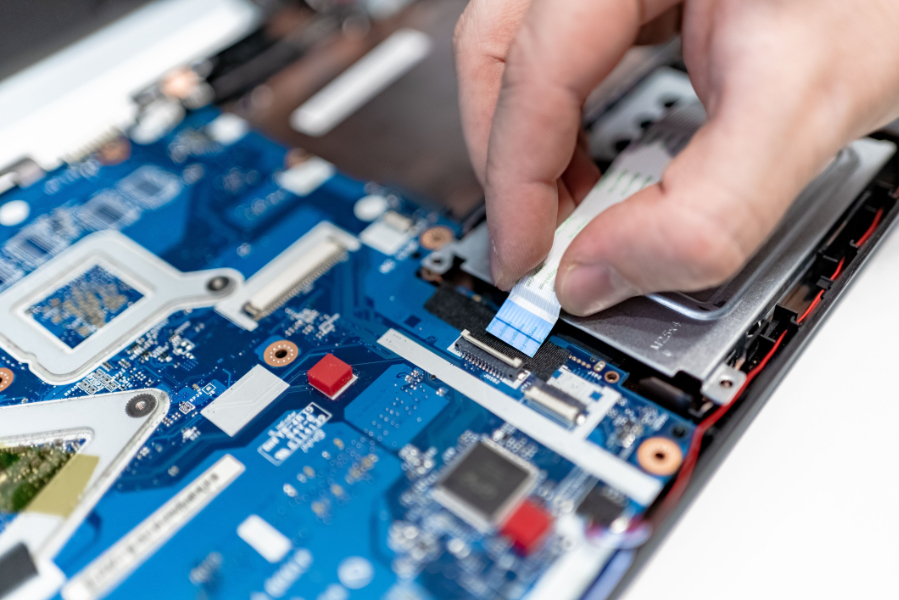
One laptop may be in excellent condition and need only testing, cleaning and repackaging. Another may need a new battery or a replacement screen. A third may be too damaged to repair economically but may still contain parts that can be recovered. Another may have no remaining value beyond its materials.
Dynamic workflows at scale
The operation has to be able to manage all of those possibilities at once. That is what makes the workflow dynamic. Products are not all moving through the same sequence at the same speed. They are being assessed and directed according to what is found when they arrive.
GEODIS has developed its own workflow-management system to support this. The system is built into the operation and guides the technicians and operators through the process. It asks the questions that need to be answered, records the results and uses that information to determine the next step.
The person working on the device does not have to make every decision from scratch. The system helps them understand what to check, what information to record and where the product should go next. If the device passes the relevant tests, it can move towards repackaging and redeployment. If it fails a test, the system can direct it towards repair, parts recovery or recycling.
That may sound straightforward, but it is essential when the operation grows. At small volumes, people can often manage exceptions informally. They can remember what needs to happen and solve problems as they appear. That approach becomes much less reliable when hundreds or thousands of products are moving through the operation.
This is the point at which many customers face their biggest challenge: moving from a proof of concept or pilot to something genuinely industrial. It is relatively easy to demonstrate that a product can be repaired or refurbished. It is much harder to build a process that can handle growing volumes consistently, with the right controls, records and turnaround times.
The system is not there to replace the people doing the work. It is there to give them a clear, repeatable process and to make sure that the right information stays with the product throughout its journey. That combination of people, process and technology is what gives circular operations the capacity to scale.
A global solution that works locally
The next question is how to scale across countries and regions. Our circular operations began in the Americas, including the United States, Canada, Mexico, Brazil and Colombia. We have also developed operations in Europe and have started expanding in Asia Pacific, including India and China, with Japan and Singapore among the next steps.
The important point is that a global solution does not mean moving every product around the world. When we operate in China, for example, the devices are returned in China, processed in China and redeployed in the Chinese market. They are not sent from Europe to China for refurbishment and then shipped back again. The same principle applies elsewhere: the operation is local, even though the capabilities, standards and technology are part of a wider global model.
That matters for several reasons. It reduces unnecessary transport, helps us respond to local requirements and keeps products closer to the markets where they will be used next. It also means that the solution has to be adaptable. Different countries have different regulations, customer expectations and operating conditions.
We have learned that scaling is not a matter of taking one process and copying it without change. The core principles need to remain consistent, but the operation has to work in the local context. A solution developed in the United States may need to be adjusted for India or China, for example, while still providing the same level of visibility and control.
For customers with operations in several regions, that combination is important. They want one coherent approach, but they also need a partner that understands how to make it work in each market.
Building the model with customers and partners
There is also a limit to what any one company can do alone. A circular service may involve the manufacturer, the logistics provider, repair specialists, technology providers, resale channels, recyclers and other partners. The right combination will depend on the product, the market and the customer’s objectives.
Our role as a logistics provider is not necessarily to perform every activity ourselves. It is to coordinate the solution and make sure that the different parts work together. Customers should not have to manage a series of disconnected suppliers if what they need is one reliable service.
That is why co-creation is so important. We do not want to suggest that every customer can arrive with a requirement and receive a finished circular solution from a catalogue. In many cases, the customer is still working out what the model should look like. The most useful work happens when we start early, understand the customer’s product and service proposition, and design the operation together.
Sometimes that means adapting our own processes. Sometimes it means bringing in a specialist partner. Sometimes the customer already has relationships or capabilities that need to be incorporated into the model. The answer is not always to build everything ourselves. The answer is to create a solution that works for the customer and can grow with them.
This is particularly true as we move into new product categories. The requirements for a laptop are not the same as those for a medical device, a bicycle, a piece of industrial equipment or a luxury fashion item. The principles of visibility, assessment, repair and redeployment may be similar, but the details matter.
The earlier we work with customers, the more effectively we can address those details. Circularity is not a one-off project. It is a journey, and the operating model will usually develop as the customer learns more about its products, users and markets.
The next stage is already taking shape
We are continuing to expand the geographic reach of the service, but that is only one part of the roadmap. The digital platform is also evolving, with new features being developed in response to customer demand and changes in the market.
You never really stop improving a circular operation. There is always another process to make clearer, another source of data to connect, another decision to support or another way to improve the experience for the customer and the person using the system.
Some developments will come directly from customer requirements. Others will come from our own view of where the market is heading. We do not want to wait for every change to arrive before responding to it. We need to anticipate what customers will need as product-as-a-service models become more established.
Our experience so far has been built around IT equipment, but the underlying knowledge can be applied much more widely. We understand how to manage returns, how to assess condition, how to guide repair and refurbishment, how to maintain traceability and how to coordinate different partners around a single service.
Those capabilities are relevant to medical devices, where more equipment is becoming connected and increasingly used outside hospitals. They are relevant to retailers exploring rental, subscription, repair and resale. They are relevant to industrial and automotive companies looking for ways to extend the life of expensive equipment.
Fashion and luxury are also interesting areas, particularly where products retain significant value after their first use. A high-value jacket, bag or accessory may be suitable for authentication, cleaning, repair and resale.
The economics are different from those of a low-cost garment, but that is precisely why the model can be attractive. There is enough value in the product to justify the work needed to prepare it for another owner.
The fashion industry has historically had a difficult relationship with unsold or returned stock. In some cases, products have been destroyed rather than allowed to enter a secondary market. That is beginning to change. Brands and retailers are recognising that resale is happening with or without them, and that they need to understand how to participate in it without compromising quality or brand value.
Circularity is a commercial advantage
The same pattern is visible across other sectors. Companies are realising that circularity is not only an environmental issue. It can also be a way to reach customers, create new revenue streams and make better use of products that already exist.
The move from product to service will not happen in exactly the same way everywhere. Some sectors are further ahead than others, and some products will be easier to manage than others. But the direction is clear.
To my mind, what we’ve learnt so far is all about thinking beyond the initial sale, and working in true partnership with the logistics chain. A product-as-a-service proposition is only as good as the operation supporting it.
At GEODIS, we are continuing to build that operation with our customers and partners. We have a strong base in IT equipment, a growing global footprint and a roadmap that will take us into new products and new markets. The next phase will not be about applying one fixed solution everywhere.
It will be about taking what we have learned, adapting it in partnership with each customer and continuing to improve it as the circular economy develops.
Learn more about GEODIS at www.geodis.com.