Fashion house 4NML is built around the idea that animals can share in the economic value created by luxury. SustainabilityOnline spoke to founder Anya Oleynik about building a commercial model in which business growth can translate into greater support for animals.
Much of the conversation around sustainable fashion focuses on reducing harm: using fewer resources, producing less waste and lowering emissions. But what if the value a business creates could also be returned to the living world?
That is part of the premise behind 4NML, a luxury fashion house that allocates at least half of its profits to sponsorship support for animal charities. Or, as a recent Newsweek feature on the business put it, the aim is to create an environment where “luxury can create value for animals, rather than only extracting value from them”.
Founded by Anya Oleynik in 2025, 4NML uses no animal-derived materials, instead selecting materials according to their performance, quality and impact, including alternatives such as AppleSkin. The company also primarily produces garments to order, rather than manufacturing large speculative quantities.
Its model raises a broader question: can a luxury business grow substantially while creating value for others without requiring its physical footprint to increase at the same rate?
SustainabilityOnline caught up with Oleynik to find out more about 4NML.

Hi Anya, thanks for talking to us. How did 4NML come together, and what was the spark that turned it from an idea/concept into a business?
4NML means ‘For Animal’, and helping animals was the reason I started it.
I wanted to create a business that could generate meaningful, ongoing resources for animals, rather than relying only on individual donations. Fashion was the vehicle because it was something I already loved, and I wanted to build a real fashion house whose commercial success could translate into greater support for animals.
As I began developing the company, though, I realised the mission could not exist only at the end of the business model, in what we did with the profits. It also had to influence how those profits were created.
It would make little sense to build a company to help animals while producing huge quantities of inexpensive clothing that might never be sold, using toxic or unnecessarily damaging materials, generating avoidable waste, or keeping prices low through exploitative labour. Those practices affect people and the environment, and ultimately animals are part of that same environment.
That realisation shaped what 4NML became. We chose a primarily made-to-order model so that, wherever possible, a garment exists because somebody actually wants it. We work with skilled atelier production in Romania, choose materials deliberately, avoid animal-derived materials, and preserve production scraps rather than automatically treating them as waste.
Those choices create a higher cost per garment than mass-market production, which is one reason the sustainability model and the luxury positioning became connected. Rather than depending on high volumes and low unit costs, 4NML has to create enough value in each piece to support a slower, more deliberate way of making it.
The original purpose is still very simple: help animals. Sustainability became important because I realised we could not credibly pursue that purpose by creating new harm somewhere else.
You’ve spoken about sustainability as not only being about reducing the harm a business causes, but also about where the value it creates ultimately goes. To what degree do you think that the latter is missing from the fashion industry?
I think we spend a great deal of time asking what our purchases are made from, but surprisingly little time asking what our purchases ultimately fund.
Sustainability usually examines the negative side of a company’s activity: emissions, waste, water, materials, labour conditions and supply chains. Those questions are essential.
But once the sale has happened and a company has created economic value, we rarely follow the money any further. Where do the profits go? What industries, lobbying efforts, investments or other activities does the larger company support? Consumers may know a great deal about the material in a product while knowing almost nothing about what the parent company does with the money that product helps generate.
With 4NML, I want both sides to be visible: what goes into creating value, and what that value goes on to support.

At least half of 4NML’s profits are allocated to sponsorship support for animal charities, and this commitment is built into the commercial model. Why did you decide to structure the company in this way?
I considered making 4NML a nonprofit at the beginning because I wanted to build something capable of generating substantial, continuing resources for animals. However, a nonprofit structure would have made it much more difficult to operate 4NML as the kind of fashion house I wanted to build.
A nonprofit has a different governance structure and purpose, with ultimate oversight residing in a board rather than an owner. I wanted the ability to make creative and commercial decisions quickly, reinvest in the company, develop products and enter markets in the way a fashion business needs to.
So 4NML became a C-corporation, but I still wanted the commitment to animals to be something permanent, rather than a charitable decision I could change from year to year. I initially thought about allocating closer to 100% of the profits to animals. The problem is that a company also needs retained capital to survive and grow. It has to develop new products, purchase materials, improve production, hire people, enter new markets and withstand periods when business is more difficult.
If everything left the company, we could limit its ability to become large enough to create the kind of impact I want it to have.
That is how I arrived at the 50% minimum. At least half of the profits are committed to sponsorship support for animal charities, while the remainder can be reinvested into strengthening and expanding 4NML. A stronger company should ultimately be able to provide more support for animals.
Most importantly, I don’t want that commitment to depend indefinitely on who happens to be running the company. I am interested in eventually placing the ownership or control of 4NML into a trust or another durable structure that can preserve its purpose across generations.
I still need to determine the right legal mechanism for doing that, but the goal is very clear to me: if 4NML still exists decades or even centuries from now, when I am no longer here, ‘For Animal’ should still describe what the company is built to do.
Fashion necessarily involves producing physical objects, while sustainability asks businesses to reduce unnecessary resource use and waste. How do you think about growing 4NML without simply tying growth to ever-increasing production volume?
I don’t think the honest answer is to pretend fashion can exist without consumption. We make physical objects and we need people to buy them. The question is what kind of growth we build around that reality.
4NML is primarily made to order. We manufacture because somebody has chosen a garment, rather than producing large speculative quantities and then creating pressure to sell through them. It is slower and more expensive per piece, but it changes the incentive to overproduce.
Luxury also has an advantage that I think is sometimes overlooked in sustainability discussions. Economic value can come from the quality, design, construction, scarcity and significance of an individual object, rather than simply from selling the greatest possible number of units.
Longer term, fashion can remain the foundation of the house while 4NML expands into other categories, potentially including digital products, experiences or other forms of creative value that require far less physical material to create and distribute.
Digital activity has an environmental footprint too, so I would never describe it as impact-free. But I am interested in whether the economic value of a company can grow much faster than its consumption of physical resources. Sustainability, to me, should not mean making 4NML less ambitious. It should challenge us to think differently about what that ambition requires.

4NML avoids animal-derived materials, selects materials according to their performance and impact, and primarily produces garments to order. Those choices can be cost-intensive. How do you make that model work commercially?
It is cost-intensive, but I would first clarify that we don’t operate according to a rule that natural materials are inherently good and synthetic materials are inherently bad. That distinction can become too simplistic.
We avoid animal-derived materials, but after that, we choose materials according to what the product actually requires. We use cotton and Candiani raw denim, as well as newer alternatives such as AppleSkin, which incorporates apple-industry waste and is 66% bio-based. We also use synthetics such as polyester where their performance characteristics make them appropriate.
A material has to be considered in context: what resources went into it, how it performs, its durability, how much is needed, what alternatives exist, and what happens to it afterward.
We also save our production scraps rather than treating them automatically as waste. I want us to develop uses for them in future products or other applications as the company grows. Something being left over from one garment does not necessarily mean it has reached the end of its useful life.
Our garments are made by skilled atelier workers in Romania, and we are not trying to reach a target price by finding the cheapest labour available. We primarily produce to order, work in small quantities and use materials selected for the needs of each piece.
Those choices raise the cost of an individual garment, and that is reflected in our prices. But a cheap garment can hide costs somewhere else: in excess inventory, environmental damage, poor working conditions or enormous quantities of product that nobody actually needed.
That is why luxury makes sense economically for 4NML. The business has to create enough value in each object to support the way we believe it should be made, rather than recovering margin through maximum volume.
Sustainability messaging can sometimes become moralising or ask consumers to adopt a particular identity. How does 4NML communicate its values without taking that approach?
I don’t want 4NML to tell people that they have to become someone else before they are allowed to participate. You don’t have to be perfect. You don’t have to be vegan. You don’t have to adopt a particular identity or agree with me about every choice you make in your life.
We deliberately don’t use activist tactics, graphic imagery, guilt or shame to sell clothing. I would much rather introduce someone to a genuinely good piece of fashion and let them discover that choosing it also helps animals. The garment therefore has to earn its place on design, quality, material and construction. Someone should not have to convince themselves to like something simply because it is the more ethical option.
Then there is additional meaning behind it: it was made by skilled people, the material decisions were considered, it was not produced as part of a huge speculative run, and if the business generates profit, at least half of that profit is allocated to supporting animals.
Lowering the threshold for participation matters to me. Someone may still eat meat, own leather shoes or disagree with me about another issue and choose a 4NML garment because they love it. I am perfectly comfortable with that. The purchase can still do something good.
I would rather create an opportunity for many different kinds of people to participate than build a brand that only speaks to people who already live according to a particular set of rules. Traditional luxury often asks what an object says about the person who owns it. 4NML asks what the object does beyond the person who owns it.

What does success look like for you at 4NML: financial growth, the amount returned to animal charities, reductions in environmental impact, changes in consumer behaviour, or something else?
For me, success would be seeing those outcomes reinforce one another. The most obvious measure would be whether the support reaching animals becomes genuinely significant. That requires a financially strong company, so revenue and profitability matter.
I would also look at whether we can improve the company as it grows: better materials where they become available, more uses for scraps and other potential waste, better production knowledge, stronger relationships with skilled makers, and more efficient ways of producing only what is actually needed.
But there is another measure that is harder to put on a spreadsheet. I would like 4NML to help make the idea of a non-human stakeholder feel less unusual. Animals cannot become customers, shareholders or board members. They cannot negotiate their interests with the companies whose activities affect them. But businesses can still choose to consider those interests and allocate economic value accordingly.
If 4NML can demonstrate that this works within a commercially successful company, then the idea becomes much more powerful than if it exists only as an ideal.
What are your growth aspirations for 4NML over the medium and long term?
In the medium term, I want to establish 4NML as a recognisable luxury house and prove the model commercially. That means building a meaningful customer base, continuing to refine the collection and its fit, strengthening our production process with the atelier in Romania, exploring better materials, and putting the work in front of the right customers, retailers, stylists and creative partners internationally.
Long term, the ambition is much larger. I want to see what happens when these principles are tested at meaningful scale. As a company grows, there are strong incentives to make things faster, cheaper and in greater quantities.
I want to know whether we can use scale differently: whether greater purchasing power can give us access to better materials and technologies, whether scraps and other resources can become inputs for new products, whether new categories can allow us to create value with less physical consumption, and whether our contribution to animals can become substantial rather than symbolic.
I also want the purpose of the company to become durable beyond me. If 4NML truly means ‘For Animal’, I don’t want that to remain true indefinitely only because its founder personally chooses to keep it true.
Ultimately, I want to build something large enough to demonstrate that caring about how value is created, what it affects, and where that value ultimately goes does not have to limit commercial ambition. It can be the foundation of it.
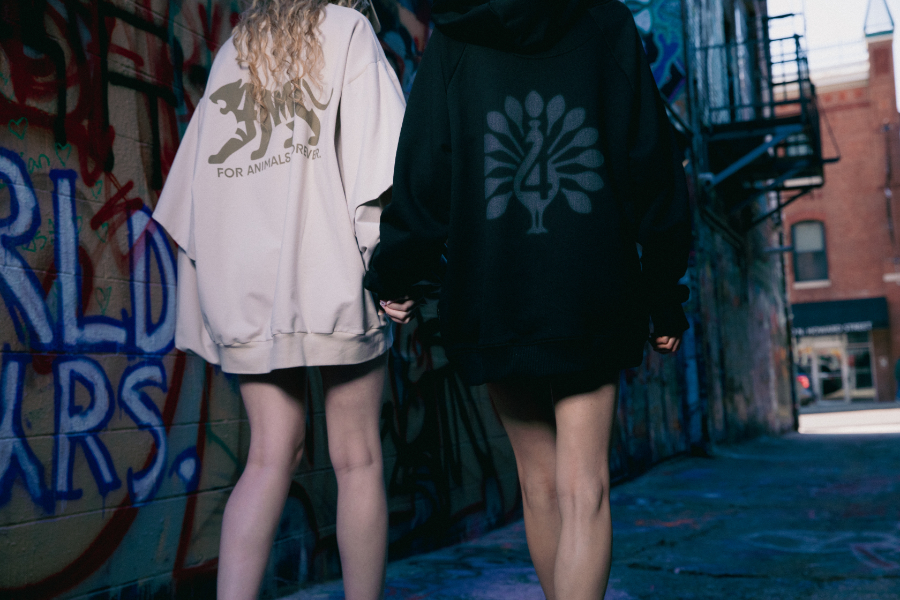
Learn more about 4NML at 4nml.com. Main image pictures models Serena Hammond and Anya Oleynik of Kiss Model Management wearing the 4NML Big Cat Crew and Shadow Hoodie. Photographed by Josh Thomas.