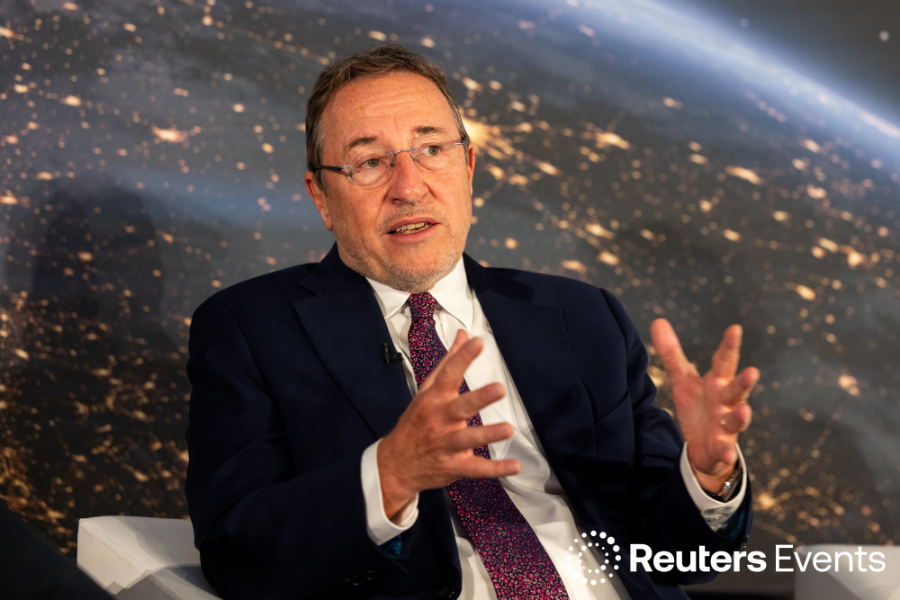
Sustainability has move from “trying to aspire to doing something better to actually driving strategy”, Achim Steiner, former administrator of the United Nations Development Programme (UNDP) and chair of the Hamburg Sustainability Conference, told the Reuters Events Sustainability Europe conference earlier this week.
In conversation with Reuters editor Axel Threlfall, Steiner said corporate sustainability leaders should move beyond monitoring performance and instead make sustainable thinking a core function of their work.
“How do we stop monitoring performance? How do we start becoming strategists?” he asked. “How do we define risk analysis as being the core function of a sustainability agenda within a corporation?”
Geopolitical tension
Steiner argued that this shift is taking place against a backdrop of growing geopolitical tension, weaker international cooperation and uncertainty over climate policy. He said the dismantling of international cooperation mechanisms was making it harder to address issues including climate change, artificial intelligence and future pandemics.
“We are, at the moment, dismantling the very architecture that we actually need more than ever in order to be able to cooperate,” he said.
However, he added the underlying transition towards cleaner energy and mobility remained a source of optimism.
Global transition
Steiner pointed to China, India and other emerging markets as evidence that the global transition is continuing, arguing that the clean energy infrastructure being developed is already reshaping markets.
“On renewables, the mobility transition, battery and storage, China is doing something that we in Europe often talk about and just don’t seem to get right,” he added, noting that the country is planning trillions of yuan of investment in systemic network initiatives through to 2030.
Elsewhere, Steiner acknowledged that established companies can struggle to respond quickly enough to structural changes. As an example, he cited the automotive industry’s failure to anticipate the speed of the electric vehicle transition, saying that “reality has overtaken ignorance”.
Stepping back
Steiner also criticised parts of the financial sector for rolling back from sustainability commitments made several years ago.
“I find it really quite sad to watch how financial institutions that four or five years ago in Davos – and many other fora – presented themselves as the great drivers of a future economy,” he said.
However, he noted that beneath the change in public positioning, many financial institutions were continuing to build their capabilities around sustainability-driven investment.
In summary, Steiner argued that corporate leadership had fallen short in some sectors over the past three to four years, with companies that previously presented themselves as drivers of transition stepping back from their commitments. At the same time, however, sustainability professionals should not be discouraged, with the longer-term direction steadfastly pointing towards a more sustainability-driven economy.
“Watch the capital markets,” he said. “They are drivers of the future.”