Global geological CO₂ storage has reached a total of 421.7 million tonnes, with a record 43.6 million tonnes stored in 2024, a new report from the London Register of Subsurface CO₂ Storage, led by researchers at Imperial College London, has found.
The Register’s 2026 Annual Report tracks the annual rates of CO₂ stored by operational projects worldwide, with this year’s edition seeing it expand to 70 projects across 17 countries.
‘A global enterprise’
“Our latest report shows that geological CO₂ storage has become a global enterprise, with annual reported storage more than doubling between 2016 and 2024, and the Register itself now covering 69 individual projects around the world,” said Professor Samuel Krevor, of the Department of Earth Science and Engineering (ESE) at Imperial College London.
“The consistency of these operations, and the fact that new countries and projects continue to join the Register, shows that geological storage is demonstrated as a large-scale mitigation technology.”
The United States boasts the largest number of projects in the Register, with 23 projects reporting a combined 20.2 million tonnes of storage, while Brazil’s Petrobras Santos Basin Pre-Salt Oil Field is the largest individual project, reporting 14.2 million tonnes of storage. This is approximately one-third of the global total.
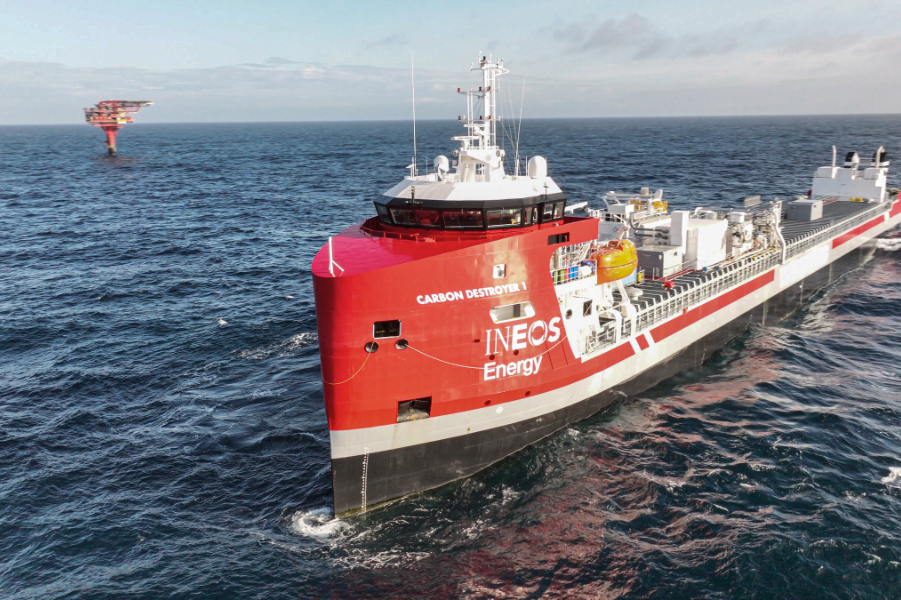
In China, storage increased to 1.7 million tonnes in 2024, driven primarily by the Shengli Oilfield and Daqing Aonan Oilfield, while Australia also reported 1.7 million tonnes and New Zealand and Italy entered the Register for the first time. Elsewhere, Norway’s Northern Lights project (pictured) commenced operations in August 2025.
2025 data
Storage data for 2025 remains incomplete, however at the time of publication, 29 projects across 12 countries had reported 36.2 million tonnes of storage.
Brazil’s Petrobras Santos Basin project reported 19.6 million tonnes for 2025, projects in China reported 2.6 million tonnes across seven projects, while six US projects reported 8.9 million tonnes.
“To meet the 1.5°C target pledged by the Paris Agreement, all projections indicate that geological CO₂ storage must scale up to one billion tonnes of CO₂ storage or more per year by 2050,” Professor Krevor added.
“The more precisely we can trace every tonne of CO₂ from injection to permanent storage, the stronger the evidence base we can provide as the technology grows to the scale that climate targets demand.” Read more here.