Earlier this month, eBay unveiled its first Climate Transition Plan, which outlines how the online giant plans to meet its climate-related commitments while also strengthening the long-term resilience and competitiveness of its business.
The plan details eBay’s efforts across several areas, including emissions reduction, the adoption of renewable energy, accelerating sustainable commerce, scaling low-carbon logistics and shipping solutions, and the pursuit of a just transition, among other targets.
Climate Transition Plan
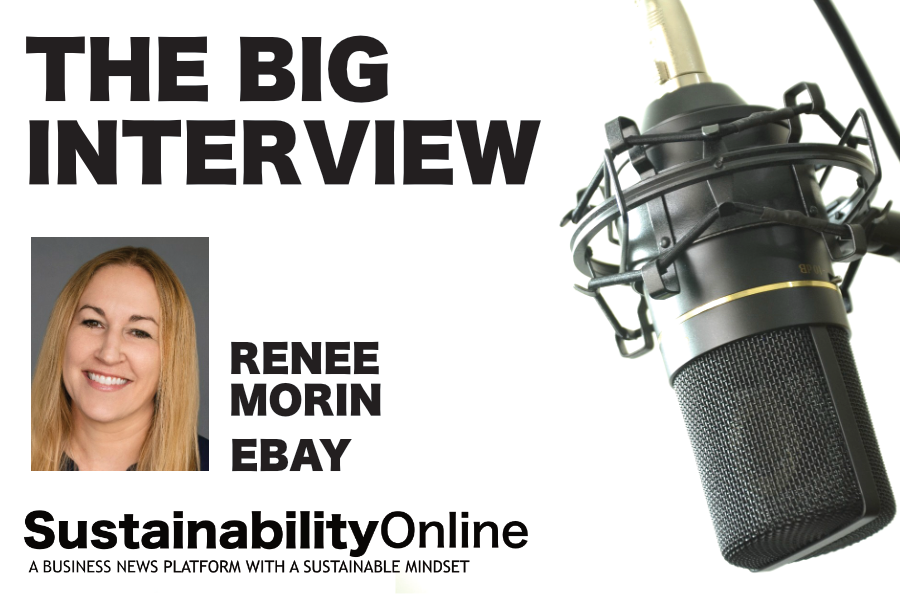
Following the plan’s publication, SustainabilityOnline caught up with Renee Morin, chief sustainability officer at eBay, to discuss the level to which sustainability has been embedded in the company’s business strategy. We started by asking her why now was a good time for eBay to publish its Climate Transition Plan.
“It has been a journey,” she explains. “The first thing that was sold on eBay, back in 1995, was a broken laser pointer that was given a second life. So, recommerce has been part of what we do since the beginning. Then, about 15 years ago, we started reporting on our carbon emissions – which was quite early days for most corporations.
“Over the years, we sought to elevate that and ask ourselves, ‘how do you set good climate targets?’ It’s not just a case of achieving a ‘20% reduction by 2020’ – numbers floating in the air. It’s about working out what’s going to keep us in alignment with the Paris Climate Agreement, as well as keeping global warming to below 1.5 degrees Celsius.”
eBay’s science-based targets for Scope 1, 2 and 3 were approved by the SBTi back in 2021, which prompted the development of detailed transition modelling to determine how targets would be achieved – a process that led to the Climate Transition Plan.
“We didn’t want to just set a goal that looked like ‘great, you’ve set a target – how are you going to get there?’ she adds. “This plan really helps answer that. It lays out how we’ll achieve our goals, while also preparing us to understand how future climate changes could impact the business.”
Business synergy
Based in Washington DC, Morin has worked with eBay since 2018, and has held the role of CSO since 2018. Prior to joining eBay, she worked at Aligned Incentives, Hewlett Packard Enterprise, PRé, Deloitte and other firms, with many of her previous roles incorporating sustainability to some degree.
At eBay, the sustainability functions sit within the finance department, with Morin reporting directly to the investor relations team.
“That has created a really strong synergy – particularly in shaping the trajectory of initiatives like our Climate Transition Plan,” she says.
Making progress
Notable progress has been made in some areas. eBay has already achieved its 2030 science-based targets for Scope 1 and 2 emissions – a 92% decrease in Scope 1 and 2 emissions compared to 2019 – although Morin stresses the need to maintain this standard through to 2045 to fully satisfy SBTi requirements.
“We haven’t fully achieved it until we maintain it, which we absolutely aspire to do,” she says.
Renewable energy has been another quick win, with renewable energy supporting all eBay-owned operations as of 2024, one year ahead of schedule, which was a “good internal learning process” for the business.
“Entering into a virtual power purchase agreement involves a new type of contract, so it meant educating the legal team and working through how the accounting would be handled internally,” she says. “There were many internal touchpoints that weren’t just about the renewable energy itself, but building relationships between sustainability and core functions within the business.
“I think that was a really great stepping stone for us, not only to reduce emissions, but also to educate the key stakeholders, and bring them on the journey.”
The Scope 3 challenge
As most businesses are discovering, however, Scope 3 is a more difficult nut to crack. eBay achieved a 21% reduction in Scope 3 downstream transportation and distribution emissions in 2024, compared to a 2019 baseline, and has set a target of 27.5% by the end of the decade.
“We’re not dissimilar from any other company with a Scope 3 footprint – they are the most challenging to address because they’re not under our direct control,” says Morin. “What we’ve spent a lot of time on over the past five or six years is, first of all, putting our arms around what that footprint looks like.
“Shipping is the largest part of our footprint, so we need to work with carriers to get better data and clarity, because if we don’t have a good idea of what we’re measuring, we can’t manage it, as the saying goes.”
The transition plan also assesses future climate risks, such as extreme weather, that could disrupt transportation networks.
“What this plan has been great at uncovering is not just what our emissions are, but looking into these forward-looking climate scenarios,” she adds. “What are the potential disruptions from weather events like typhoons and heat waves, and other factors that could impact transportation? These would impact us as a business, but they will certainly also affect our carriers’ businesses.”
The power of recommerce
More than 40% of eBay’s gross merchandise volume comes from the sale of pre-owned and refurbished goods, which has made the business a template-setter when it comes to promoting recommerce – “it would be a disservice for us not to lean into the sustainability benefits of recommerce,” says Morin.
eBay recently published its latest Recommerce Report – its fifth to date – which indicated that close to nine in ten consumers plan to either maintain or increase their spend on pre-loved goods, and more than two thirds (68%) saying they ‘feel good’ about giving items a second life. In financially-chastened times, the ability to save money is also a benefit, cited by 81% of respondents.
“Recommerce is here to stay, especially when you consider who participates – younger generations are really leaning into it,” says Morin. “It’s good for business and great for the environment.”
Emerging technologies
Given that eBay’s Climate Transition Plan projects forward to 2045, it also cites as yet ‘unidentified actions and emerging technologies‘ that are likely to content to its goals, including the large scale rollout of low-carbon fuels, and carbon removal solutions. On the latter, the company has pledged to prioritise carbon removals in offset purchases over the next five years, however, given the nascent nature of the carbon removal market, Morin is understandably cautious.
“We want to make sure that we’re thoughtful about it, and don’t run into potential pitfalls,” she says. “These projects have a long runway, so while you can start the discussions now, you might not reap the benefits of those investments for three, four, five years down the road, potentially.”
She sees parallels between this and the growth of electrified transportation, which also took time to reach the penetration levels needed to become a viable option.
“We want to make sure we’re doing a like-for-like wherever we can,” she says. “A lot of our footprint comes from transportation. So, how do we select projects that make sense and help to really make impact alongside how we operate?”
The geopolitical game
Given the current geopolitical situation, eBay’s government relations team have understandably been busy of late – “engaging with policymakers on a plethora of issues,” says Morin – and the Climate Transition Plan has been developed to take account of these shifts, as well as evolving standards and regulatory requirements.
“Our climate strategy is really based on business resiliency and value creation,” she says. “That’s not going to go away. So as policy ebbs and flows in different jurisdictions, we can keep our true north and figure out solutions that make sense in those different operating conditions.
“It’s an evergreen process. It’s not one-and-done. So we’ll continue to refine and align with global standards.”
All while continuing to integrate sustainability deeper into eBay’s operations, supporting business continuity, resilience, and value creation, she adds, “Anytime we have the ability for a sustainability function to embed even further into the business, it’s a win-win.”
Learn more about eBay’s Climate Transition Plan here.