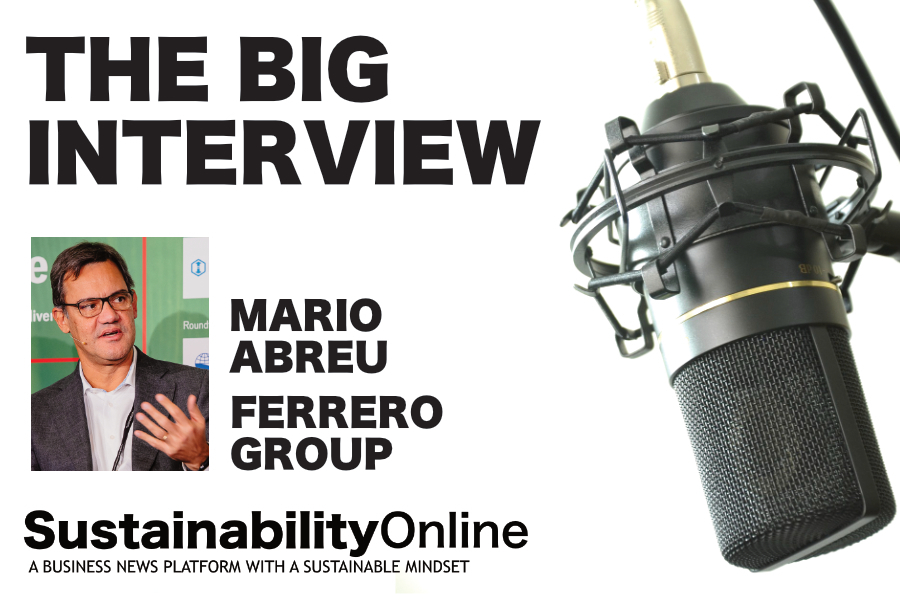
Mario Abreu has held the role of vice president of sustainability at confectionery giant Ferrero Group since April 2020, where he is responsible for integrating sustainability into the Nutella and Kinder owner’s long-term strategy.
In July, Ferrero published its latest sustainability report, highlighting its progress in responsible sourcing, supply chain visibility, human rights, and decarbonisation. Among its recent achievements are that some 97% of its cocoa and palm oil and 94% of its hazelnuts are now traced to origin, 90% of its electricity comes from renewable sources, and it has reduced its Scope 1 and 2 emissions by more than a fifth (21.7%) compared to a 2017/18 baseline.
As Abreu tells SustainabilityOnline, the company’s sustainability efforts, particularly around traceability, provide business value by ensuring consistency of supply even during market disruptions – such as the recent cocoa price spikes.
“The fact that we have a closer relationship with the farmers producing the goods, and can trace back the goods to those farmers, creates a level of commitment,” he says. “We try to build long-term relationships. We know where our products are coming from, and they know that their products are coming to us. That creates a consistency of supply.”
Such relationships effectively function as an insurance mechanism of sorts, enabling Ferrero to secure supply and maintain consistent production despite fluctuations in global commodity markets.
“If you play heavily in the futures market, you can become hostage to it,” Abreu adds. “Prices tend to rise whether you buy or not, because demand often outstrips what producing countries communicate they will supply. But if you know where you are sourcing from and have real contracts with farmers or local traders, you can achieve a degree of stability.”
EU Deforestation Regulation
In recent months, Ferrero was an active campaigner seeking to prevent the European Commission from postponing the implementation of the EU Deforestation Regulation (EUDR) – in October, it joined Nestlé, Mars and others to pen an open letter to the Commission, warning that a delay would undermine trust in Europe’s regulatory commitments, as well as increase uncertainty and compliance costs for businesses.
“We have supported the EUDR from the very beginning, because we believe in the intent of the regulation, which is to prevent commodities linked to deforestation from entering the European market,” says Abreu. “Issues like sustainable palm oil are difficult to communicate to consumers, so it makes sense to have an EU-wide mechanism that prevents palm oil associated with deforestation from being sold in Europe. That way, consumers don’t have to worry about it.”
Earlier this month, the European Commission announced a one year postponement to the implementation of the EUDR (to 30 December 2026), as well as streamlining obligations on downstream operators and traders. Micro and small operators will have an additional six months to comply with the regulation.
“In deciding to postpone for one more year, our fear is that some people in the industry are going to say ‘ok, let’s stop what we’re doing’, rather than letting the process start, letting the documents flow, and encouraging firms to make incremental improvements,” says Abreu.
It’s not the only source of frustration when it comes to EU legislation, with Abreu also pointing to the Packaging and Packaging Waste Regulation (PPWR) as another area where legislative delays are hindering decision-making.
“It’s disappointing that we still have to wait until 2027 for the secondary legislation process,” he says. “Ideally, having packaging regulation in place now in Europe would create a level playing field, allowing collection systems to be built around packaging that is properly designed for recycling. That would make things easier for everyone.”
Technology integration
Ferrero has integrated technology into its traceability systems through Sourcemap, a provider of supply chain mapping, traceability, and transparency services, and Starling, a geospatial solution developed by Airbus and Earthworm Foundation that uses satellite data to measure deforestation and forest conversion at scale.
“SourceMap gives us a high-level tool to understand sourcing at the level of farming areas, without needing access to details about individual farmers, which aligns with GDPR,” says Abreu. “Starlink allows us to frequently monitor satellite imagery against our GPS locations and warns us about any signs of deforestation near those areas. That means we can intervene and prevent it from happening.”
Both solutions provide an independent verification layer, enabling Ferrero to maintain its sustainability commitments without impacting farmer livelihoods. When it comes to palm oil, for example, the company works with both major producers and “hundreds of thousands of smallholders”, which rely on palm oil to support their communities.
“So it’s not a matter of saying, ‘let’s stop using palm oil’,” says Abreu. “We would be affecting the livelihoods of so many people who have done nothing wrong.”
Supporting communities
Working alongside the Roundtable on Sustainable Palm Oil (RSPO), as Ferrero has done since 2015, ensures that farmers can earn higher prices for committing to sustainable certification. Some 97% of the company’s palm oil is now certified.
As to whether 100% certification is achievable, Abreu adds, “Every time we acquire a business, it may bring uncertified or non-segregated palm oil into our value chain. We then upgrade it, which is a good thing, but it backtracks our overall performance a bit. The challenge for us is to keep moving towards 100%.”
With regard to other commodities, such as cocoa from Côte d’Ivoire, Ferrero is taking a direct role to support communities.
“Education has only been mandatory in Côte d’Ivoire for a few years now, and the infrastructure is not really there yet,” says Abreu. “For many families, the nearest school might be 10 kilometres away, on roads that are unpaved.
“So, working in collaboration with Save the Children, we have established small schools within cocoa-growing communities, known as écoles passerelles. These help children become accustomed to attending school, learning and playing with others, while also helping parents see the value of education for themselves and their children. This has been very successful.”
Maintaining momentum
Through social sustainability initiatives, enhanced traceability, technology integration, and a longstanding commitment to placing the planet and communities ‘at the heart of [its] family culture’, as it noted in its recent sustainability report, Abreu is confident that Ferrero can continue to maintain a successful balance between responsible practices and business performance.
“We have the momentum, and that’s helping a lot to ensure that we bring sustainability as part of the decision-making process in our business strategy,” he says.
SustainabilityOnline spoke to Mario Abreu at the Economist Impact Sustainability Week Europe Summit, which took place in October 2025. For more information on Ferrero’s sustainability agenda, visit www.ferrero.com/int/en/people-planet.