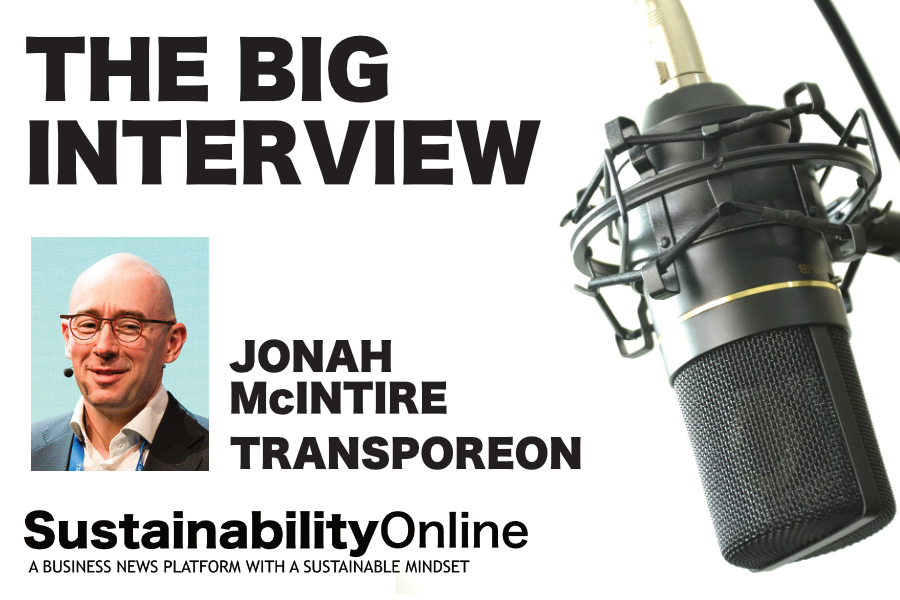
At the Transporeon Summit in Amsterdam at the end of September, the transportation management firm launched a new AI-powered transport planning tool developed to optimise logistics operations for shippers and carriers.
As SustainabilityOnline, which was present at the Summit, discovered, most of the presentations and exhibitors were focused on driving optimisation and greater efficiency into the logistics industry – at the same time improving the sector’s sustainability footprint.
SustainabilityOnline caught up with Jonah McIntire, Transporeon’s chief product and technology officer, to discuss the role that technology – particularly AI – will play in the future of supply chain optimisation, as well as Transporeon’s recent Green Freight Report on the decarbonisation of freight transport.
The impact of AI
“When we talk about AI, we’re really talking about decision-making,” he explains, adding that artificial intelligence offers “little bursts of light speed” when it comes to everyday tasks, such as customer engagement.
Over time, this is likely to expand to department level – “where the entire accounting department, say, becomes automated” – requiring the integration of multiple AI-driven tasks. This, in turn helps to streamline processes, as businesses move from incremental automation to fully integrated AI-driven operations. As was discussed at length at the Transporeon Summit, this will necessitate a re-evaluation of personnel management, requiring upskilling and, inevitably, the loss of some jobs.
“A good analogy here is if you go back 250 years, to around the founding of the United States, 98% of the population were agricultural workers. If you skip forward to today, about 2% of the population works in agriculture, and yet they produce tremendously more than the 98% used to. That’s due to tractors, machinery, seed banks, fertilisers, precision agriculture – technology, in other words.
“But if you were to go back in time and say to those people, ‘hey, 96% of your population are going to lose their jobs’, the only thing they could imagine is mass unemployment. They couldn’t imagine the kinds of jobs that we have today. And because they couldn’t imagine them, you couldn’t train for them either – at least not right away. It has to be an incremental process, whereby as roles change incrementally, human creativity kicks in.
“For businesses, it’s a question of practicality. You know you are going to have to train people for this new environment, so you might as well train the people that you trust in your business.”
Freight decarbonisation
Transporeon’s most recent Green Freight Report, subtitled ‘Is Transportation On Track‘, assessed the road freight industry’s decarbonisation efforts, and found that modal shift was the most cited (21.8%) opportunity to drive freight decarbonisation, followed by load and routing optimisation (18.2%), and carrier optimisation (13.8%).
The report also found that despite a growing hunger to decarbonise, a gap was evident between intention and execution, with more than half (56.9%) of respondents ‘not aware’ that their company had a freight decarbonisation strategy in place, and just 16% certain that their company had implemented targets and/or a strategy.
“I think the uncomfortable truth with sustainability and logistics is that emissions, from, for example, diesel fuels, are considered an externality – in other words, the cost of the emissions does not fall on the party burning the diesel fuel,” says McIntire. “Sustainability will require, at some level, internalising the costs of the future climate impact into present day decisions. But there’s a significant operational hurdle to get there.”
Logistics firms operate on very thin margins, making early investments risky, particularly if the chosen technology lacks sufficient supporting infrastructure or market demand.
“For example, let’s say you invested only in hydrogen trucks, but then realised that the infrastructure network you need is not there,” he adds. “So you’re restricted with hydrogen vehicles, restricted to a certain number of lanes in Europe, and, let’s say, you can’t find business on those lanes. You may end up insolvent. And that’s not exactly helpful for the future.”
Driving collaboration
As the Green Freight Report notes, collaboration between logistics operators is key to supporting decarbonisation, yet close to half (46.8%) of respondents say that they are not willing to share their primary data with others to calculate their CO2 emissions – suggesting a lack of trust between shippers and carriers.
This is changing, McIntire explains, with shippers, carriers and forwarders increasingly sharing practical insights about transitioning to sustainable solutions like intermodal transport, electric or hydrogen vehicles. Formalised data sharing remains limited, however, and in many cases, change is being prompted by intervention rather than voluntary coordination.
“Where change is happening, it is being driven by regulation,” he says. “I’m a quite free-market, libertarian mindset kind of person, but at the moment I just don’t see a market mechanism that takes costs that will happen 20 or 30 years from now and brings them forward.
“I really think that government regulation is the only entity we have that thinks in these half-century or more time horizons – a carbon tax or some other form that attempts to take the externality of future costs and brings it into today. And then, once you put a cost on something, the market mechanisms kick in.”
According to McIntire, the move to sustainable freight will involve short-term cost increases, which could be necessary to internalise the environmental impact of transportation, “It doesn’t mean that we shouldn’t do it. But we shouldn’t shy away from the fact that it is simply more expensive.”
At the same time, he cautions against mandating specific technologies, such as hydrogen-powered trucks, as fixed solutions can limit innovation and prevent the market from adopting potentially superior alternatives.
“You could have other regulatory pushes – like saying everyone has to use hydrogen vehicles – but that locks us into a particular solution path and doesn’t allow market dynamics to kick in. It may be that a new generation of battery technology arrives that makes long-distance electric vehicles operate better. Or some other solution that makes electric vehicles more viable.
“If you set a price mechanism, that’s fine – the market figures it out. But if you set a fixed solution, you forego the ability to innovate in other directions.”
Learn more about Transporeon at www.transporeon.com. The Green Freight Report can be found here.