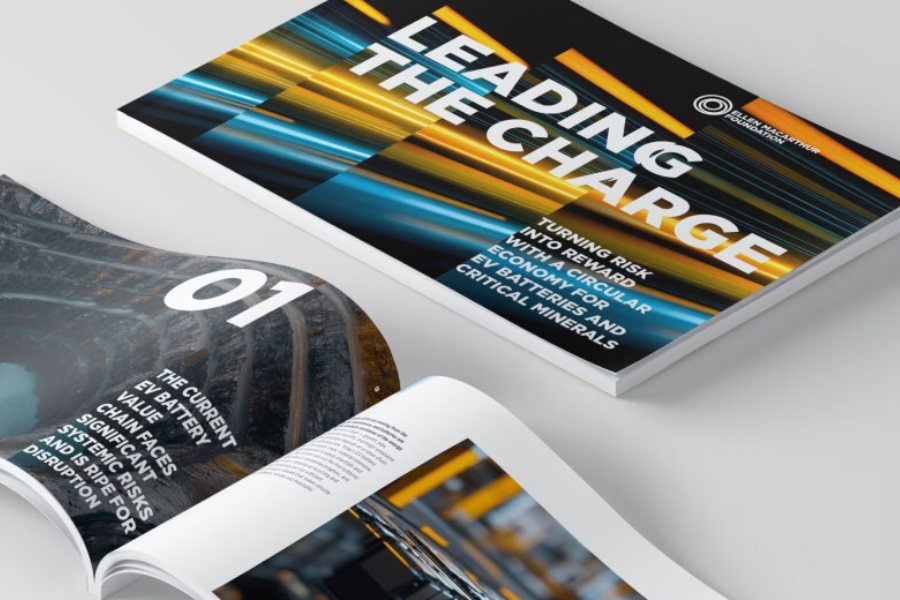
Chinese battery manufacturer CATL and the Ellen MacArthur Foundation have released a white paper outlining a circular value-chain roadmap for EV batteries.
The two partners published the whitepaper, entitled Leading The Charge: Turning Risk into Reward with a Circular Economy for EV Batteries and Critical Minerals, at the World Economic Forum annual meeting in Davos last week.
It incorporates input from more than 30 organisations across the EV battery ecosystem, including DHL, Volvo, and Jaguar Land Rover, as well as research institutions and NGOs.
According to CATL, the report ‘sets out a clear, industry-informed direction for how EV batteries must be designed, used, recovered, and reintegrated to maximise value and reduce systemic risk across the value chain’.
‘A major milestone’
“This report marks a major milestone in the global journey towards a circular battery economy,” commented Jiang Li, vice-chairman and board secretary of CATL. “Circular battery systems must now be scaled across regions, industries, and applications – from EVs to energy storage – and adapted to diverse market contexts.”
The whitepaper outlines five ‘bright spots’ – interdependent actions that is says will be essential to unlocking a circular EV battery system.
- Design batteries for circularity, not disposal
- Rethink battery service within optimised energy–mobility systems
- Scale circular business models that treat batteries as long-term assets
- Build and co-invest in regional circular infrastructure
- Enable a circular operating system through data, standards, and policy
CATL noted that it has already put several of these measures into practice, including separating batteries from vehicles to manage them as centrally-controlled assets, enabling high-quality recovery at scale. The group’s recycling operations report recovery rates of 99.6% for nickel, cobalt, and manganese, and 96.5% for lithium.
‘Strategic assets’
“As EV adoption accelerates, a circular economy for batteries and critical minerals is no longer optional – it is essential to affordability, resilience, and long-term growth while reducing environmental and social impacts,” added Wen-Yu Weng, executive leader for critical minerals at the Ellen MacArthur Foundation.
“EV batteries are strategic assets, and circular approaches are key to retaining their value and ensuring critical minerals never become waste. We welcome CATL’s contribution and look forward to continued collaboration to help scale a truly circular battery system and support the wider energy transition.”
The initiative supports CATL’s long-term objective to achieve carbon neutrality across its full value chain by 2035. Read more here.