Škoda Auto has been a driving force in electric vehicle adoption across Europe for several years now. As of the first half of last year, close to one in four Škoda vehicles sold in Europe boasts an electrified powertrain, while the company is on track to cut its fleet’s CO₂e emissions by over 50% by 2030.
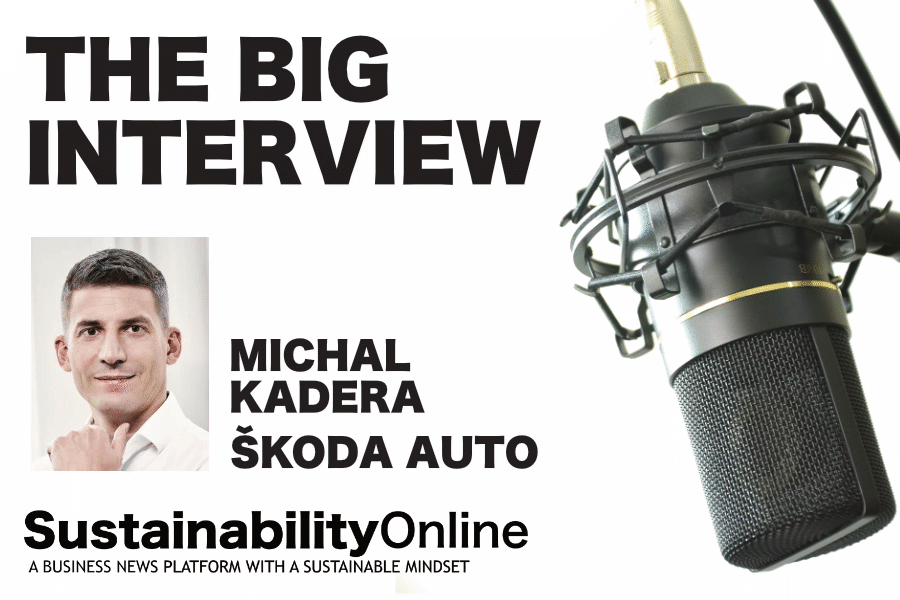
At the recent Reuters Sustainability Europe 2025 event in London, Michal Kadera, external affairs director at Škoda Auto, appeared on a panel exploring how businesses can ‘balance short term resource allocation with long term goals’ when it comes to sustainability – chiefly, how firms are overcoming the perception of sustainability being secondary to cost.
SustainabilityOnline caught up with him on the sidelines of that event, where he explained that Škoda views sustainability as a long-term commitment rooted in the company’s history and customer focus.
“We’ve just celebrated 130 years as a company – our founders, Václav Laurin and Václav Klement, started the business in Czechia in 1895 to provide an alternative to the German-made bicycles on the market,” he says. “From that, we moved on to the first motorcycle, then the first car, and nowadays, thanks to Volkswagen Group, we are supplying to almost 100 markets.
“The motto the company started with was, ‘Only the best is good enough for our customers’, and these days when it comes to the discussions we have – on sustainability, on regulation, on policies, on the future – we have to make sure we don’t forget about the customer. He or she is the one that wants to make the best choice that suits their needs – we don’t want to force anything on them. Rather, it’s our job to sell them what they want and then try to give them a little extra.”
Sustainability strategy
Kadera has worked at Škoda for close to 14 years, during which time he has been responsible for setting and implementing the sustainability strategy of the Volkswagen-owned group, which hasn’t always been a straightforward process.
“In my opinion – and it’s always easy to judge when you look backwards – there were a couple of things we did wrong,” he says. “Sustainability started to develop as an ‘aside’ to the business, and now we’re focused on how we can integrate it better. We’re trying to make sustainability an integral part of the corporate strategy, embedded in every element of it.
“Secondly, I think we – and I mean society in general – chose the less innovative approach to sustainability. What I mean is that we have regulation that the automotive sector is finding difficult to comply with. It covers everything from suppliers and materials to production, CO₂ footprint, products, emissions, recycling, and end of life. And it’s not smart regulation. To me, smart regulation should be open and motivating.
“What we have, at least in Europe, is regulation that sets targets which are often technically impossible to achieve, under threat of penalties.”
Kadera believes that sustainability should ideally be driven by innovation and inspiration, rather than through forced change linked to punitive measures.
“The positive way to tackle sustainability, in my opinion, is to provide inspiration and room for improvement – motivating companies to go beyond the minimum. It’s about creating something new, rather than just catching up with the latest regulations to remain compliant and avoid fines.”
While targets may be necessary to drive progress, challenges remain with targets are set, Kadera argues, with some regulations imposing requirements are technically unachievable, such as when it comes to the use of recycled plastics in new vehicles.
“Targets are ok, I don’t have an issue with targets – the question is around whether said targets imply technically impossible situations,” he says.
“According to the targets that have been set, the amount of recycled plastics required for cars in the coming years – under the end-of-life vehicle regulation – is higher than the amount of recycled plastic actually available on the market. This would mean we’d be obliged to purchase waste from places like Africa or other countries and bring it back to Europe. To me, that doesn’t make much sense. Europe is still a major exporter of waste, so we should first ask why we’re exporting it and focus on recycling what we already have at home.”
Total cost of ownership
While many consumers express support for sustainable mobility, high upfront costs and inadequate charging infrastructure is hampering electric vehicle adoption, Kadera notes. He frames EV adoption around total cost of ownership, including purchase price, maintenance, residual value, and energy costs, noting that high rates for fast charging undermine consumer acceptance.
“People want sustainability, but they want it at a better price,” he says. “Not the same, and certainly not more expensive. Imagine a situation where you can set a Europe-wide price of €0.30 per kilowatt hour, meaning that you would be able to run your electric vehicle for half the price of an ICE vehicle. If you were able to achieve that, it would resonate with customers.
“When it comes to charging infrastructure, there’s a very different speed of development in different European countries. What customers want – if they can’t charge at home – is fast and affordable charging. But if fast charging costs €1 or €1.10 per kWh, it completely undermines the business case.
“Suddenly, driving an electric vehicle becomes even more expensive than a conventional car, and convincing customers becomes very difficult.”
To many observers, there’s a chicken-and-egg dynamic in the relationship between electric vehicle adoption and charging infrastructure in Europe. Kadera argues that infrastructure development should come first, in order to give consumers confidence about affordable, available, and reliable charging, factors that will help to accelerate adoption.
“You need to have confidence,” he says. “If consumers can see fast, affordable charging, that makes them comfortable, and they’re more likely to invest in an electric vehicle.
Other countries could also borrow a line from Norway, which boasts near-total electric vehicle penetration due to tax policies that have made electric cars significantly cheaper than their traditional combustion alternatives.
“Norway has taken a really enlightened approach,” he adds. “They have reduced the taxation on electric vehicles, compared to combustion vehicles. The customer is smart, it’s a no brainer. But there are also countries, like Czechia, which have no taxation on mobility to begin with, which means there’s nothing there to decrease. That means there’s a gap in terms of defining the business case for the customer.”
Embracing the future
As well as his role with Škoda, Kadera is chairman of the board of Elektromobilní Platforma, the Czech E-Mobility Platform, which was launched in 2021 to promote that business case, and strengthen the development of electromobiity and the battery value chain in Czechia. It brings together experts from the automotive sector, as well as science, finance, research and education, and is working with the Czech government on its National Action Plan for Clean Mobility (NAP CM).
“I firmly believe that e-mobility is the future of mobility,” he says. “So far, I don’t see any alternative technology that measures up.
“It comes down to physics. If you look at any type of fuel – energy, oil, diesel – from the perspective of kilojoules of energy, conventional fuels lose almost 70% of their energy through heat when burned. With a battery electric vehicle, it’s the complete opposite.
“Yes, people question the ecological impact of digging up raw materials and producing battery cells. But as a long-term solution, it’s quite promising. For example, the battery in an electric vehicle typically comes with a guarantee of around 200,000 kilometres. The average European drives about 15,000 kilometres per year. After the vehicle’s life, the battery can enter a second-life phase, being repurposed outside the automotive sector for at least another 15, if not 20, years.”
A global powerhouse
When talking to anybody from the European electric vehicle sector, it would be remiss to ignore the elephant in the room – the growing dominance of China as a global powerhouse. Kadera acknowledges that Chinese models tick the box in terms of price and reliability, and that Europe has some catching up to do.
“It’s true – Chinese products in the new energy vehicle market are good, surprisingly good actually, and extremely competitively priced,” he says. “The question for Europe is, given that we’ve lost some time in development, what is the best path forward?
“I’m still a big believer in European engineering power. And I’m not ashamed to say that, yes, in the past we Europeans shared our know-how and taught the Chinese to manufacture. But now, it’s perfectly fine to admit that we have something to learn from the Chinese – for example, the expertise we don’t yet have in battery production. I’m confident that once we learn, Europe has the engineering strength to be just as competitive.”
The road ahead
In the long-term, however, accelerating the transition to electric vehicles in Europe will require policymakers to take a different approach to regulation – rather than focusing on targets, more emphasis should be placed on what customers want, and market demand. As the decade progresses, political reluctance to revisit regulations could leave European carmakers lagging behind.
“I think the biggest challenge for all of us Europeans, especially in politics, is to look in the mirror and have the courage to lead the difficult discussions now,” he says. “Unfortunately, my expectations regarding regulatory changes aren’t very high. Hopefully, they will provide some flexibility so carmakers don’t suffer excessively, but they won’t solve the situation… or change the opinion of the customer.
“And it all starts with the customer. I believe the customer should be at the centre of everything we do. So, wouldn’t it be much smarter to find a compromise that is ambitious, yet achievable?”
Lean more about Škoda Auto’s sustainability efforts at www.skoda-storyboard.com/en/sustainability.