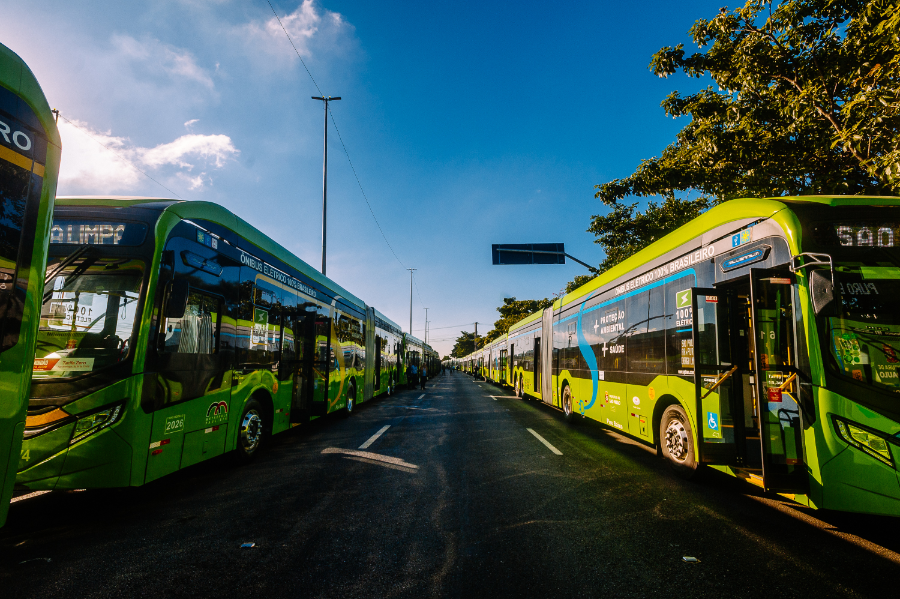
Cities across Latin America have reached a milestone in sustainable transport, with 10,000 electric buses now in operation, according to new data.
These buses are operating across 80 cities in 13 Latin American countries, with Santiago, São Paulo and Bogotá accounting for more than 7,000 electric buses between them. Across the region, the operation of electric bus fleets is estimated to avoid more than 10 million tonnes of CO2 emissions every year.
The milestone, based on data collected by E-Bus Radar, was announced by C40 Cities and the International Council on Clean Transportation (ICCT) during Lat.Bus 2026 in São Paulo, the region’s largest transport and mobility event.
‘Expanding public policy’
“Reaching 10,000 electric buses in operation shows that the transition to zero-emission transport is no longer a promise but a reality in Latin American cities,” commented Ilan Cuperstein, C40 Cities regional director for Latin America.
“What was once the exception is now an expanding public policy, delivering direct benefits for the climate, health, public transport quality and local economies. The message to other cities is clear: financing does not have to be a barrier. Tested pathways exist, and the network is ready to support those willing to take them.”
São Paulo
São Paulo itself boasts the largest electric bus fleet in Brazil, and the second-largest in Latin America, adding an additional 500 electric buses to its fleet in June of this year. Its 1,759-strong fleet has reduced diesel consumption by approximately 57 million litres, and helps to avoid an estimated 130,000 tonnes of CO₂ emissions annually.
The Brazilian megalopolis has support its transition to sustainable public transport through an investment programme worth around R$6.5 billion, backed by the Brazilian Development Bank (BNDES), the World Bank and the Inter-American Development Bank (IDB).
”We are accelerating the energy transition of the country’s largest city and consolidating a public policy that is already a national and international benchmark,” commented Ricardo Nunes, Mayor of São Paulo. “Through a single delivery of 500 new electric buses in June, the city achieved the environmental equivalent of planting 3.2 million trees per year. This avoids the emission of 45,000 metric tons of CO₂ while cutting annual diesel consumption by approximately 20 million litres.”
Other Brazilian cities, including Recife, Salvador, Belo Horizonte and Rio de Janeiro, are also in the process of rolling out electric bus projects, with support from C40 Cities and partners through the ZEBRA Alliance and Brazil Mutirão programme.
‘Together, these initiatives show that the milestone of 10,000 vehicles is only one stage in a growth curve that is expected to accelerate as new financing models and cooperation between different levels of government gain traction across the region,’ C40 Cities said in a statement. Read more here.