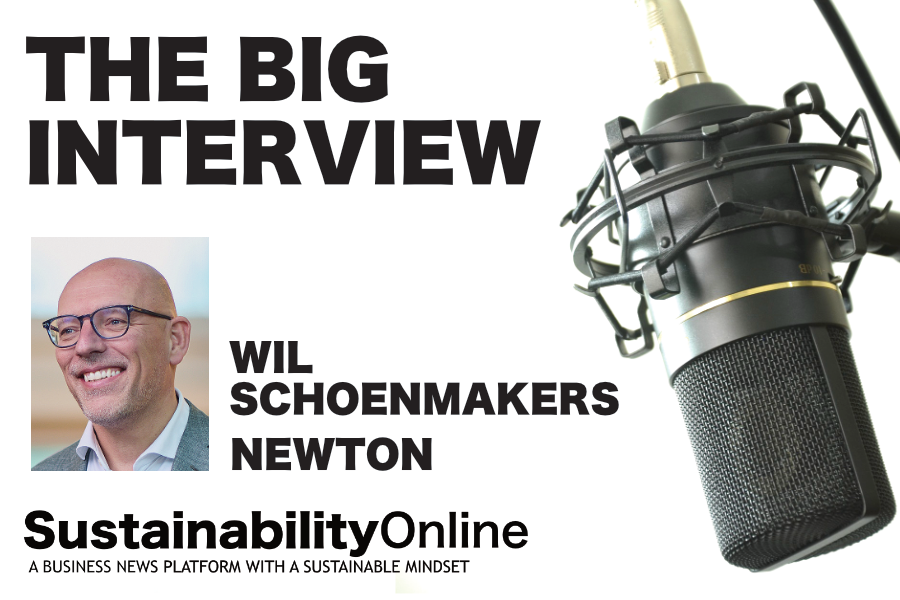
Businesses looking to build circular economy models should start by developing a commercial case, rather than relying on small pilot projects, according to Wil Schoenmakers, senior partner and global head of retail and consumer goods at strategic delivery consultancy Newton.
“There are some categories where circularity works, and others where it’s a bit more tricky, such as food, which tends to go one way: you buy it, you eat it,” he says. “But for us, a lot of the work we do with circularity starts with the business case, more than anything else. You need to understand the business case if you’re going to be able to scale.”
SustainabilityOnline caught up with Schoenmakers at The Consumer Goods Forum Global Summit in Vienna. As he explained, the barriers to circularity in the consumer goods sector are clear: many CPG companies lack a complete understanding of the true costs of their supply chains, making it difficult to compare their current structure with circular alternatives.
“I would say more than 70% of our clients in the CPG sector don’t really know what their supply chain costs,” he says. “There are a lot of elements of cost that are just hidden.
“When it comes to circularity, if you can get scale, that makes it acceptable. But if you haven’t got the scale, you can’t spread the costs, and it becomes financially unsustainable.”
Cultural acceptance
Fashion is an example of where circularity has been able to achieve sufficient scale – “there’s a cultural acceptance of it”, says Schoenmakers – with consumers actively making a personal choice to select second-hand products.
“It’s a personal thing,” he says. “With second-hand electronics, for example, it’s not as attractive. While some people will settle for an iPhone that’s three years old – and there may be a financial incentive for doing so – most people want the newest model. Fashion is different. A Chanel jacket that’s four years old is still a Chanel jacket. That’s important to consider when we look at how circularity is playing out across different categories.”
One-way system
According to Schoenmakers, many circular economy initiatives have struggled because supply chains remain designed for one-way product flows rather than reuse. Although technology can support circularity, he says it must be combined with commercially viable operating models.
“Take refill schemes, where customers come to the store with their own bottle, and you get a little discount when you refill it,” he says. “That creates issues around hygiene, because in a lot of cases, the customer turns up with a bottle, but the retailer doesn’t know what’s been in it. So then you need to install cleaning stations in stores, and it becomes a hassle for people.”
Schoenmakers believes reverse logistics can play a role in expanding circular models. Home delivery networks could collect used packaging on return journeys rather than travelling back empty, although this would require significant changes to logistics systems that are currently designed around speed and predictable product flows.
“The technology is there in many cases,” he says. “With online delivery now, there is someone who can take products back to the store. Most delivery drivers head back to stores empty handed – why is this the case? Also, that means half of the transport costs happens on an empty vehicle.
“So, is there something there that we can do to create a reverse supply chain, that brings packaging back to the source or a central collection point? Because then you can get scale.”
Such a process would inevitably create hurdles, of course – customers used to ultra-fast deliveries, for example, could face service interruptions due to products being re-loaded.
“The way logistics is structured now is so cost-optimised, that for circularity to work, it will require a fundamental rethink of how we lay out our value chain,” says Schoenmakers. “It’s optimised for one way and nothing else, and that’s the cheapest way of doing it, because you know exactly what you’re putting in to it.”
Financial benefit
As he explains, with most purchasing decisions being driven by cost and convenience – and only in some cases by environmental concerns – circular business models must offer financial benefits for both businesses and consumers. He compares circularity to the used car market, where the condition of a returned vehicle provides an incentive for owners to maintain it.
“When you trade in your car, that’s a circular process,” he says. “If you don’t care, and you don’t look after it, you’ll lose value on the trade-in. Whereas other people will polish it, and wax it, and get more money for it.
“The question is, how do we incentivise people to engage in circularity enough so that there is a financial incentive for them to do so? For 95% of the population, it’s not a priority – they’re trying to feed their family, educate their children.”
Reverse logistics
Newton is working on technologies to improve reverse logistics, including systems that identify, sort and process returned products more efficiently. One area of development involves using AI and sensors to assess reusable glass bottles individually and determine the level of cleaning required, rather than applying the same process to every bottle.
“Washing bottles is quite an unecological solution – it’s fairly carbon intensive, and you use caustic hot water, so that requires a lot of energy,” says Schoenmakers. “And every bottle is washed to deal with the worst possible level of contamination.
“We’ve all been to late night parties, and we know the sort of things that can end up in a beer bottle. But you might have other bottles that just have a little dried beer in them. So now, with technology, you can scan a bottle at high speed, as it’s coming down the line, and determine whether it needs a full caustic wash or a quick steam jump. That can both save costs and minimise the impact on the environment.”
Newton is also working with the Ellen MacArthur Foundation on circular initiatives in the fashion sector, where repair, rental and resale models are becoming more common.
“That can also be tricky for retailers, because where do you draw the line on what people can bring back?” he says. “If you’re H&M, for example, do you only take H&M clothes back, or everybody’s? Do you have to go back to the specific retailer you bought it in? Because that’s inconvenient too – most people don’t shop at one fashion retailer, they shop at various fashion retailers.
“That said, I think we’re increasingly living in a society where people – particularly younger generations – understand that using clothes rather than owning them is much more acceptable.”
In closing, Schoenmakers says that Newton plans to step up its efforts in analysing where operational savings can offset the costs of circular business models, allowing companies to pursue sustainability objectives without relying on higher prices for consumers.
“We’re doing a lot of work at the moment on cost excellence for our clients, and we’re now looking at it through a circularity and sustainability lens, because we’re going into such granular detail,” he says. “That allows us to define business models that are informed by data rather than ideology.”
Learn more at www.newtonimpact.com.