For major consumer goods manufacturers, the cost of brand development can run into the tens – or even hundreds – of thousands, to develop a product that, once consumed, leaves packaging that is ultimately discarded and, hopefully, recycled.
As Greyparrot, a firm harnessing AI and computer vision to develop what it calls ‘waste intelligence’, explains, most brands have no visibility on what happens to their products’ packaging after use, despite materials such as aluminium retaining their intrinsic value after disposal.
Greyparrot tracks around 2.7 billion waste objects moving through recycling facilities every day, analysing the content of said waste in milliseconds. It’s essentially an MRI scan of the waste value chain, which can provide valuable real-world insights, and, ultimately save businesses money.
Unlocking value
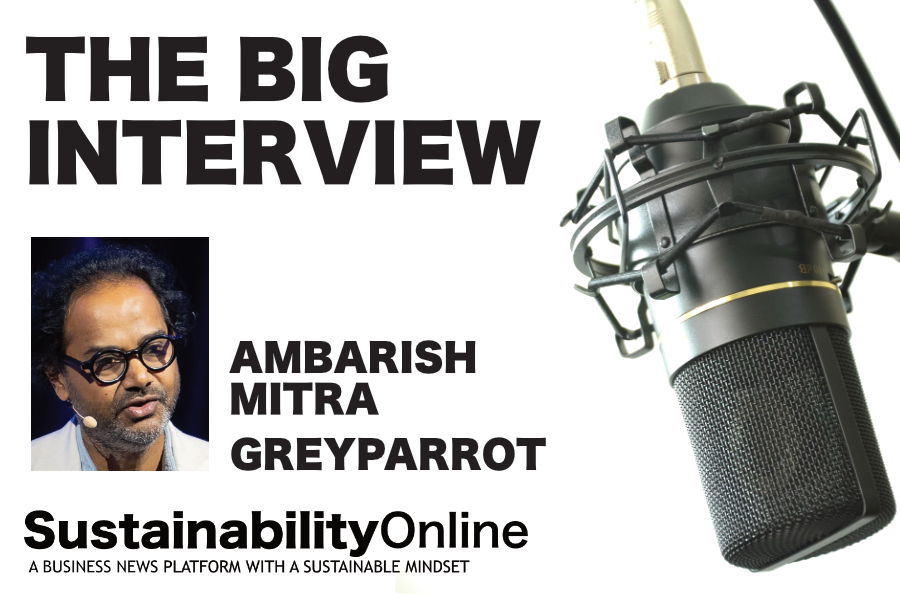
At the recent Consumer Goods Forum Global Summit in Vienna, SustainabilityOnline had the chance to speak to Ambarish Mitra, co-founder of Greyparrot, about how waste intelligence can unlock value for businesses.
“People think of waste as a negative commodity because it costs money to dispose of it,” he says. “The word ‘waste’ itself means it has no value. What we’re trying to say is, if every waste object could tell you a story – what it’s made of, who made it, what materials it uses, and what the secondary market price is – then there would be a whole marketplace for it.
“Waste intelligence is the idea of unlocking waste and seeing it as a material asset rather than just waste.”
Mitra is a longstanding tech entrepreneur – in 2010, he was part of the team that founded Blippar, a game-changer in augmented reality and computer vision. The learnings taken from this process, where the team used visual search technology to classify certain objects, informed the development of Greyparrot.
“At Blippar, we categorised and classified everything into 69 categories – every brand, every car, every building, every plant, every animal, etc,” he says. “But then we realised that actually, what we were saying was everything was not everything, because we aren’t looking at waste. We’re not giving it an identity. We don’t think of it as something of value.
“So, when we dived a little deep into that economy, we realised there was no digitisation, no investment, no Silicon Valley flair… despite the many billions of dollars spent trying to encourage people to consume.”
While consumer goods firms generate extensive data sets around the development, production and sale of products, little information exists once products enter waste streams.
“It’s like someone switches off the light, and the waste journey starts,” he adds. “And then we ask, why is there so much waste? Why is it all in the ocean? And guess what, there’s no data to prove anything.
“Every human creates at least half a plastic bag of waste every day. We felt we could map it. And what I mean by that is that we can digitise it and bring transparency. We basically took this shadow economy – it was invisible, it was a blind spot – and we made it visible.”
Business models
Greyparrot operates two business models – firstly, its Analyzer technology scans waste in real time and provides data to waste processing companies to improve sorting efficiency.
“With waste infrastructure people, you don’t need to preach waste to them – they paved the way, and built the facilities to deal with waste,” says Mitra. “Of course, most of the facilities were built in an era where newspapers were the biggest source of waste, whereas you now have polycarbonates and so many new materials. You almost need to be a scientist to understand it.
“So, at scale, we are showing them that actually there’s a lot left on the table; that you can unlock and make half a million, a million, two million more without having to introduce more complex machinery. You can use your existing machinery, and just tweak the recipe of how you sort it.”
Allied to this, its Packaging Intelligence service uses data from waste streams to show manufacturers how their packaging performs in recycling facilities. Greyparrot’s Deepnest tool can evaluate whether packaging reaches and successfully moves through material recovery facilities as intended, prompting major manufacturers to make design changes that improve recovery rates.
“We don’t want to dictate to companies what their waste recovery goals should be, but we can present them with the truth, and enable them to tweak things to deliver an outcome that’s best for them” says Mitra. “Different brands are in different phases of that journey. Some brands are very involved, 100% sustainability focused, and others are doing basic minimum compliance. We can feed both agendas.”
Small changes, big difference
During his presentation at the Summit, Mitra noted how small changes to the colour palette used on packaging can have a significant difference in terms of recovery rates.
“Male products in the hygiene sector don’t recover as well as female products, despite using the exact same material. You know why? The colour scheme – male products are typically darker in colour. Female products tend to be sage, beige, white, light pink, and the cameras, lasers and infrared are a lot better at detecting lighter colours. They’re blind to dark colours.”
Machine-based analysis, he adds, can identify these patterns without the “selection bias” found in manual testing.
For Greyparrot, the objective is to connect data on product creation with information about what happens after disposal, giving companies more information to assess and improve packaging recovery. According to Mitra, packaging development should be modified to both allow brands to maintain their visual identity while improving how products are detected and sorted by recycling systems.
“We all saw the new Ferrari electric vehicle, right?” he says. “It received a huge pushback, because it didn’t look like a Ferrari. There was too much of a change.
“We believe that it’s possible to make changes so that a product looks like part of the same family, but it fulfils the needs of all stakeholders. The sustainability stakeholder is happy, the marketing and sales stakeholder is happy, and the material scientist is happy too. I think things need to be seen as a recipe, rather than an absolute.”
Learn more about Greyparrot at www.greyparrot.ai.