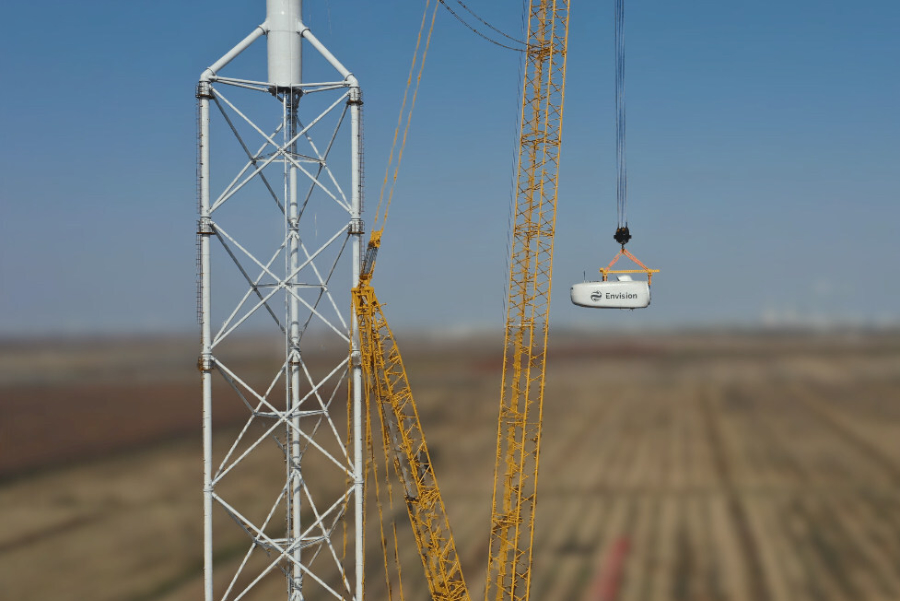
Envision Energy has grid-connected its first AI wind turbine prototype at its inaugural project in Australia – Fortescue’s Nullagine Wind Project in the Pilbara region of Western Australia.
The project, which marks Envision’s first entry into Australia’s renewable energy market, will feature 17 Envision EN182-7.8MW wind turbines, which have been designed to operate in Australia’s mining and desert environments, local wind conditions, and stringent grid requirements. With a hub height of 188 metres, Envision said that the turbines will unlock higher energy yield.
Dubhe Energy Foundation Model
At the core of the operation is the Dubhe Energy Foundation Model, an AI system designed to manage renewable energy generation, storage, and grid interaction.
The Dubhe model, which was unveiled by Envision founder and CEO Lei Zhang at Abu Dhabi Sustainability Week, works alongside Envision’s Tianji Weather Foundation Model to analyse real-time data related to weather patterns, grid demand and energy output, and coordinates renewable energy assets to adjust generation and delivery.
“The grid connection validates the power of Envision’s Physical AI approach – proving that our AI wind turbines meet the world’s most demanding grid while maximising returns,” commented Kane Xu, SVP and president of international product line of Envision Energy. “Nullagine is more than a project; it is a scalable blueprint for industrial decarbonisation and sustainable prosperity.”
Replacing fossil fuels
Fortescue, the fourth largest iron ore producer in the world, added that the Nullagine Wind Project will play a role in replacing fossil fuels in use in its operations.
“Delivering Real Zero requires replacing diesel and gas with reliable, industrial-scale renewable energy,” commented Dino Otranto, Fortescue Metals and Operations chief executive officer. “Wind – alongside solar and batteries – provides the dependable, low-cost power we need to electrify our haul trucks, drills, processing plants and rail across the Pilbara.
“The Nullagine Wind Project will feed directly into Pilbara Energy Connect, strengthening supply by balancing daytime solar with strong night-time and seasonal wind generation.” Read more here.