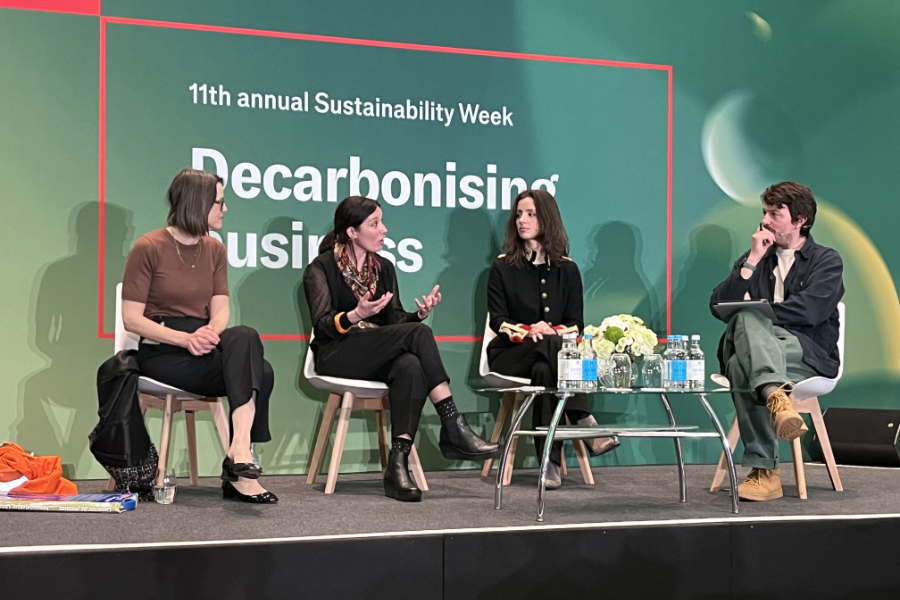
While Gen Z consumers report anxiety about environmental issues, more immediate concerns such as financial pressure, job security, and work stress rank higher, a discussion panel at the Economist Impact Sustainability Week summit explored.
The panel, entitled Future-proof or flawed? Bridging the gap between Gen Z passion and commercial capability, featured input from Maë Faugere, co-founder, Climate Fresk UK; Maria Coronado Robles, head of sustainability, Sustainability Unlocked; and Michelle Horsfield, executive director of ESG, Sumitomo Mitsui Banking Corporation (SMBC). It was hosted by Oliver Pickup, founder and director at Pickup Media Limited.
Sustainable behaviour
As Pickup noted in his introduction to the panel, recent data from Deloitte indicates that 65% of Gen Z globally have felt worried or anxious about the environment in the past month, however a separate UK poll placed climate change and environmental concerns well down the list of immediate concerns for this cohort.
According to Climate Fresk UK’s Faugere, the Gen Z cohort includes several distinct profiles rather than a single set of attitudes, defined by different motivations, including political engagement, financial goals, and other interests. This diverse makeup “doesn’t necessarily translate into sustainable behaviour”, she noted.
“Gen Z as a generation is not acting more sustainably than other generations,” she said. “But they do bring things to the table that are interesting to work with – an entrepreneurial mindset, a willingness to do things differently.”
‘Fake fluency’
Sustainability Unlocked’s Robles pointed to the widespread adoption of social media as an information source as an influencing factor. While perceptions of Gen Z are that they are “digitally fluent and environmentally fluent”, given their immersion in a digital-first world, in many cases they are only getting a surface understanding of often-complex topics – a form of ‘fake fluency’.
“If you go to TikTok or YouTube to learn something, we all know that those places might not be completely accurate, depending on what you’re watching,” she noted. “They might not have a professional context.”
This in turn, “might not necessarily translate into undertaking a role in a complex environment, such as business,” she added.
Sense of scale
Michelle Horsfield of SMBC drew on her experience in the energy sector to highlight the value of practical experience in Gen Z’s career development, with hands-on work helping employees understand operational systems and the scale of environmental challenges.
“It’s about a sense of scale,” she noted. “What I see most among young people is an inability to get an idea of ‘does it matter’, or not?”
Panelists also discussed the ‘say-do gap’ when it comes to behaviour, with Pickup referencing a recent study that suggested that 91% of Gen Z consumers want to buy from sustainable companies, and that 77% would pay more for the privilege. This, however, contradicts a separate study, which found that 56% of European Gen Z consumers cite higher prices as the main barrier to sustainable purchasing.
The panellists suggested this reflects economic constraints rather than a lack of concern, with Horsfield noting that wealthier Gen Z consumers – those that have benefited from intergenerational wealth – are “insisting” that the money they have is invested responsibly.
Environmental skills
The conversation also touched upon the broader shortage of environmental and technical skills across the workforce, with Robles describing this as more of a structural problem than a generational issue.
“Unless companies start investing more in upskilling employees, by 2030 maybe one in five roles will not be able to be filled with qualified people,” she said. “It’s quite worrying at the moment we are in, because we are at a point where the pressure on companies is tighter to deliver, but they don’t have the people who can do it.”
As regards the broader, existential climate situation, Faugere noted that the challenge lies with those who “care about climate change but don’t feel they have the tools to do anything about it”, calling for greater collaboration and group assessment of where the ambition should lie.
“This is the moment in the sci-fi movie where the resistance gets together and says, ‘hey, let’s take ownership of this problem and do what we can about it’,” she added. Read more here.