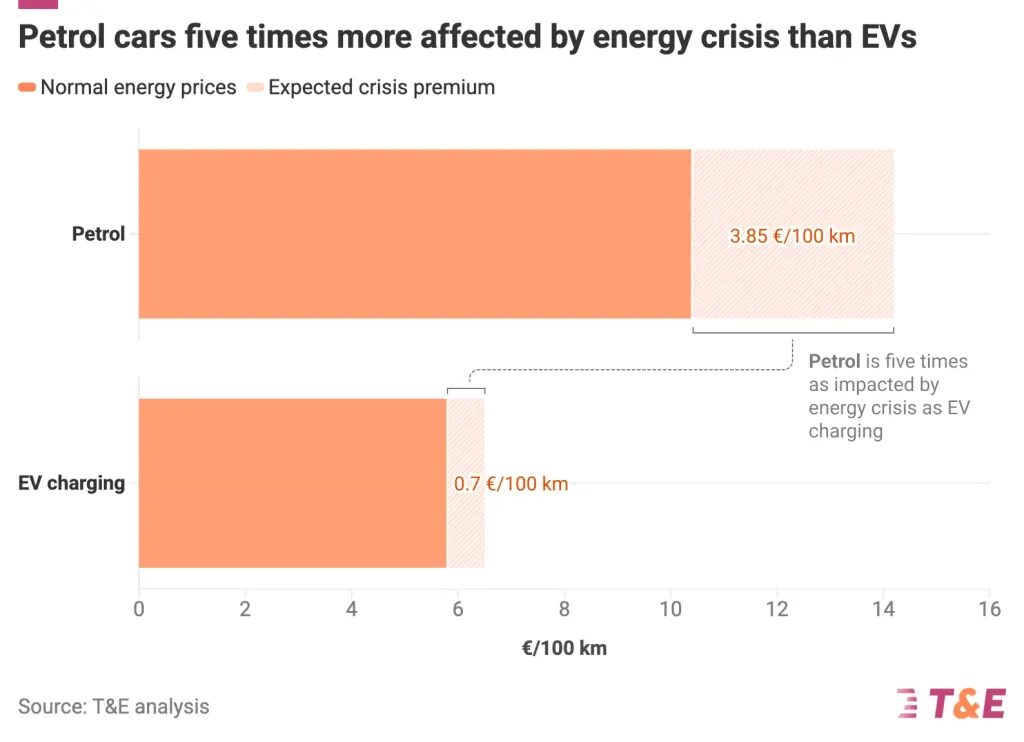
The ongoing conflict in Iran could mean that the cost of fuelling a petrol car could be five times more than the cost of charging an electric vehicle, according to research by Transport & Environment (T&E).
As T&E noted, with oil prices surpassing $100 a barrel, the resulting impact on fuel prices is likely to see petrol costs increase to €14.20 per 100 kilometres (a rise of €3.80), while the average cost of charging an EV would be €6.50 per 100 kilometres (a rise of €0.70).
In the case of company cars, meanwhile, this increase could be even more significant, T&E noted – an extra €89 per month for every petrol car in a company’s fleet, compared to €16 extra per month for EVs.
EVs ‘the best bet’
“Petrol drivers get hammered at the pump every time we face an oil shock,” commented Lucien Mathieu, cars director at T&E. “Electric cars are the best bet to ensure this never happens again. But Chancellor Merz and Prime Minister Meloni want to slow down the transition to EVs, which will only prolong our dependence on oil.
“A Trump or an Ayatollah can control the oil taps, but they can’t control the wind and the sun.”
In 2025, the European Union imported around one billion barrels of oil for fuel, at a cost of €67 billion, T&E noted. At the same time, the eight million EVs already on Europe’s roads saved the bloc a further 46 million barrels of oil imports last year, worth €2.9 billion.
Were the European Commission to weaken existing EU emissions targets for cars, as well as roll back on electrification targets for large company car fleets, this would delay the switch to EVs across Europe, maintaining the bloc’s dependence on oil.
Ambitious standards
T&E has called on policymakers to maintain ambitious CO₂ standards, and ‘put pressure’ on car manufacturers to invest more in EVs, particularly as the average price of an EV is falling due to the emergence of more affordable models. In addition, policymakers, should strengthen measures to electrify company car fleets, it added.
“Lawmakers have it in their power to speed up the roll-out of EVs and protect more of their citizens from oil shocks,” Mathieu added. “Car CO2 standards require manufacturers to provide increasing amounts of affordable electric cars for the mass-market. An ambitious EV fleets law will accelerate electrification and guarantee the supply of cheap EVs for used-car buyers.” Read more here.