Renewable energy now accounts for 44.7% of electricity production in the European Union, new data from Eurostat has found, with renewables generating 1.21 million GWh in 2023.
This is an increase of 12.4% on 2022, the data showed.
The supply of renewable energies increased by 4.4% compared to the previous year. This growth brought the total renewable energy supply to approximately 10.9 million terajoules (TJ).
Fossil fuel declines
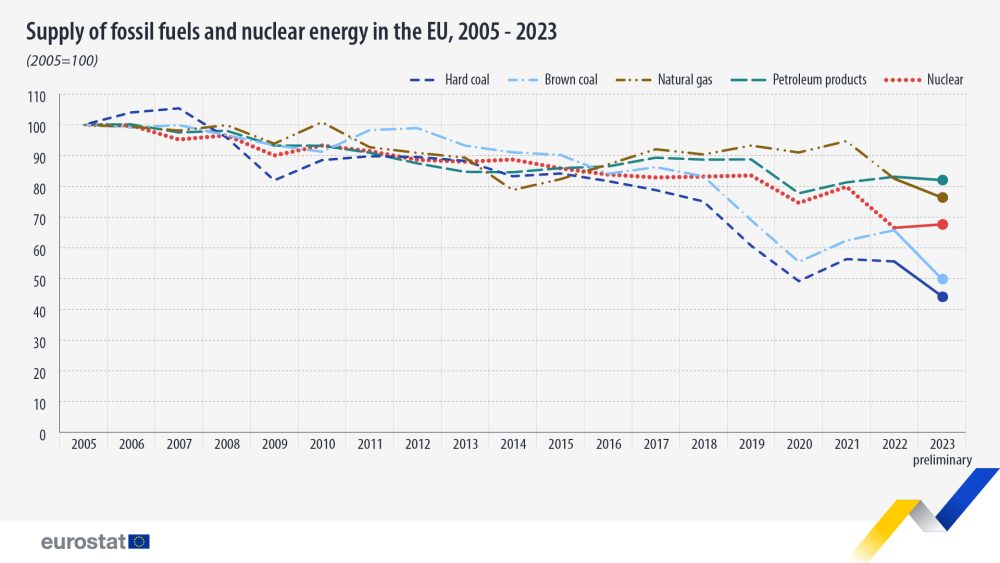
At the same time, the electricity generated from fossil fuels decreased by 19.7% in the same period, which now contribute 0.88 million GWh, or 32.5% of the total electricity production in the EU.
This means that renewables account for the highest percentage of electricity production in the bloc.
Elsewhere, nuclear plants produced 0.62 million GWh, or 22.8%, of EU energy production in 2023, which is a 1.2% increase on the previous year.
Natural gas
The data also showed that traditional hydrocarbon based sources of energy are in decline – the EU’s natural gas supply decreased to 12.8 million terajoules (TJ) in 2023, a 7.4% decline compared with 2022.
This is the lowest level for natural gas in the EU for nearly three decades, dating back to 1995, Eurostat said.
Elsewhere, oil and petroleum supply was down 1.5%, year-on-year, while brown coal supply decreased by 24.2% and hard coal supply dropped by 20.4%.
A recent study by EY found that despite significant global investment in clean energy last year, including approximately $660 billion earmarked for renewables, the goal of tripling renewable energy capacity by 2030, as outlined at COP28, is unlikely to be met.
EY suggests that network gridlock and high capital costs are likely to delay progress just when acceleration is needed.