Researchers at Virginia Tech’s College of Agriculture and Life Sciences are exploring methods to develop affordable, effective bioplastics from food waste.
According to the researchers, this first-of-its kind pilot project will develop and demonstrate an affordable modular bioprocessing system to produce biodegradable bioplastics from food waste.
As part of this process, microorganisms will convert food waste into fats, which are then processed into bioplastics. This process, which is similar to fermentation in the brewing industry, ensures that the bioplastics that are developed can be easily composted, mitigating the effect on marine pollution.
Microplastics affect nearly 88 percent of all marine species, according to the World Wildlife Fund.
Feasibility and scalability
The project aims to demonstrate the feasibility and scalability of this bioprocessing system on both national and global levels, the researchers said.
“By creating cost-effective bioplastics that naturally decompose, we can reduce plastic pollution on land and in oceans and address significant issues such as greenhouse gas emissions and economic losses associated with food waste,” commented lead researcher Zhiwu ‘Drew’ Wang, associate professor in the Department of Biological Systems Engineering and director of the Center for Applied Water Research and Innovation.
“By creating environmentally sustainable plastics, we hope to benefit people, companies, waste management systems, and communities worldwide.”
Read more: Households waste more than one billion meals a day, says UNEP
Project funding
The U.S. Department of Agriculture is funding this research with a $2.4 million grant.
The project, now over a year old, involves several student researchers who are committed to finding sustainable packaging solutions.
“It inspired me to pursue graduate studies because traditional plastics are unsustainable,” commented Chloe Taylor, a senior in sustainable biomaterials. “We aim to create bioplastics that are viable alternatives and can be used in everyday products without harming the environment.”
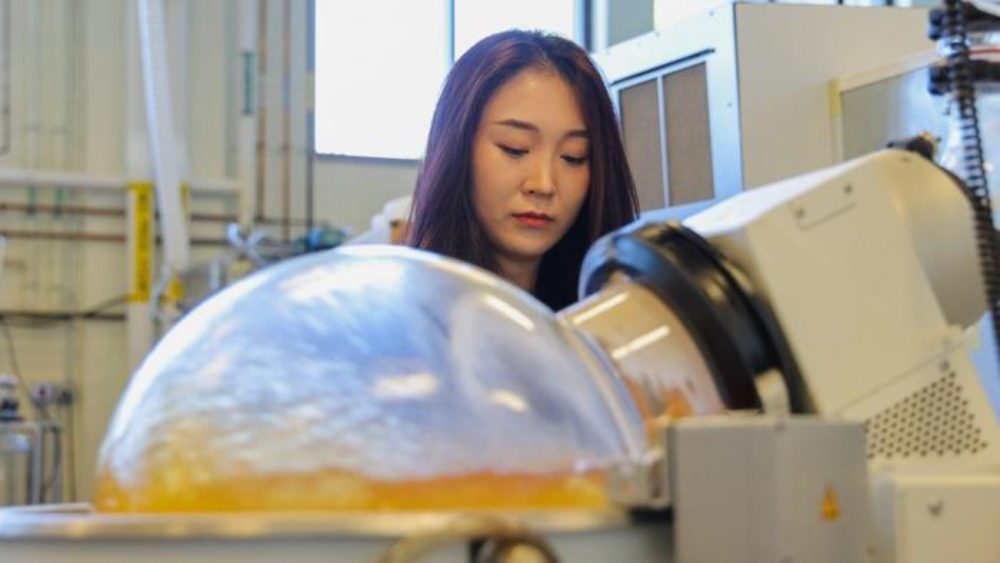
Photo: Fujunzhu Zhao, a Ph.D. student, works in Zhiwu ‘Drew’ Wang’s lab. Photo by Luke Hayes for Virginia Tech.