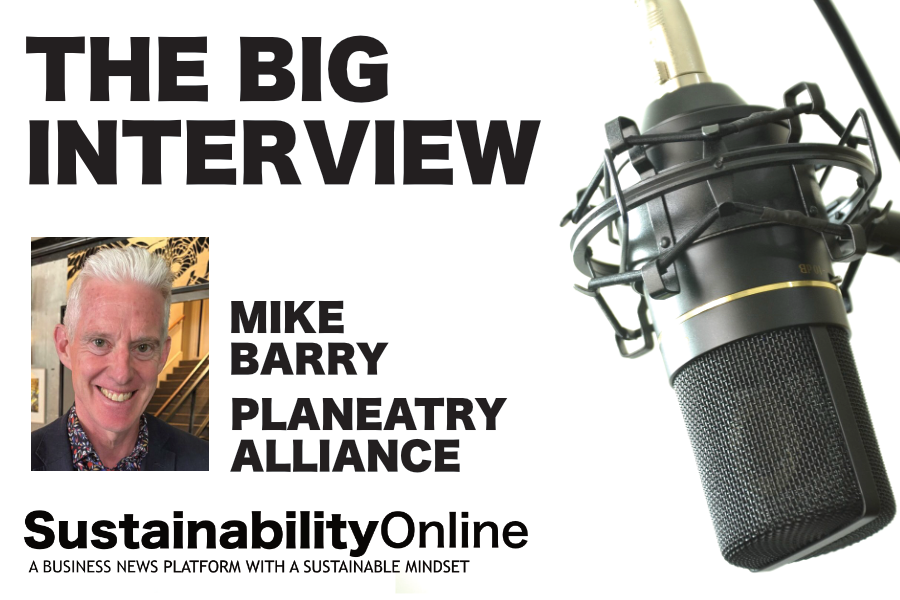
As the director of sustainable business at Marks & Spencer, Mike Barry helped launch the pioneering ‘Plan A’ sustainability programme in 2007 – an initiative that delivered £750 million in operational efficiencies in its first decade, and set a benchmark for what a business-friendly sustainability strategy could achieve.
Barry has maintained a close relationship with the food industry in the years since – as well as running his own sustainability consultancy, Mikebarryeco, in January 2025 he teamed up with nutritionist Ali Morpeth to launch Planeatry Alliance (www.planeatryalliance.com), an organisation that aims to ‘build a better food system for business, people and planet’, as its website declares.
It’s a simple manifesto on paper, but a far more complex proposition in practice –and one that Barry is eager to embrace.
“We all understand that the energy sector and the automotive sector are undergoing forms of sustainability-driven transition,” he explains. “Diesel to electric. Fossil to renewable. It’s tough and complicated, but we broadly know what we’re trying to control.
“The food system is different. If you and I had two hours, we still wouldn’t get to the bottom of all its problems or all the places it needs to go. I fundamentally believe the food system needs to transition just as completely as the car industry – the equivalent of diesel to electric – but across a much broader range of issues: social, environmental, and human health, and towards a destination that doesn’t necessarily have a neat end point.
“There is no single end point for the food system. How do we benchmark where Tesco or Nestlé needs to be, compared with where a local farm shop or a café needs to be?”
Defining the agenda
Last October saw the publication of the latest report by the EAT-Lancet Commission on Healthy, Sustainable and Just Food Systems, building on the 2019 report that coined the term ‘planetary health diet’. EAT-Lancet 2.0, as it has been dubbed, spells out in no uncertain terms the economics of both action and inaction when it comes to transforming the food system.
“The report was clear – we turn over $10 trillion a year collectively in the global food system,” says Barry. “In doing so, we create $15 trillion in damage to society, human health, and the planet. That is literally unsustainable. And no government is going to sit there too much longer and say, ‘Yeah, we’ll keep picking up the tab for ill health’.”
While he believes that no actors in the food supply chain are currently doing enough to address the issue at hand, given that its scale and structure are difficult to define – “it’s hard to nail jelly to the wall”, says Barry – there are signs of an emerging business case.
Faced with rising health costs, governments are moving towards stronger regulation of food – “as much as they don’t want to regulate, they’re going to have to,” says Barry. In addition, as climate impacts increasingly disrupt supply, food actors are seeking to boost supply chain resilience.
Addressing the say-do gap
Building on this, retailers and manufacturers have the opportunity to address the ‘say-do’ gap between consumer intentions and behaviour, he adds.
“80% of people say, ‘of course I want to eat a more sustainable, healthier diet’, but less than 20% actually do that. Why? Because it’s bloody hard.”
Barry has been working with retailers on harnessing the power of their online platforms to enable customers to adjust their baskets based on carbon, health, or nutrition preferences.
“If you’re walking around a store, you’re less likely to do it, but online, the algorithm can do all the work,” he says. “It can ask you whether you want a high-, medium-, or low-carbon basket. You choose ‘medium’, and in a split second the algorithm can swap six products for lower-carbon alternatives that match your eating preferences, based on your history.
“You could also say, ‘I’m a bit concerned about my salt intake.’ Fine – here are three replacement products with a lower salt content. I think there’s a race to simplify the food and choice environment so that, with the click of a button, people can move from being part of the 80% to being among the 20% who actively participate.
“There’s a massive opportunity out there for retailers or manufacturers to ‘crack the code’ and make this accessible to all.”
Regulation or incentives
As to whether he favours regulation over incentives – a stick or carrot approach – Barry adds that neither has worked well to date. While voluntary initiatives have motivated some to act, others have sat on their hands. At the same time, industry resistance to increased regulation has led to limited progress.
“We know the truth lies somewhere in between,” he says. “If you were to ask me, where would I see the most potential progress in terms of policy? I think there’s so much to be said for transparency – to put me on my toes as a big food business and tell me to report where I stand, transparently.
“I then need to justify why I have high carbon, high impact on salt, sugar. If I can get away with that, fine, but I doubt I will. That will force me to find innovative solutions to drive down that footprint, to keep my customer on board.”
This is an abridged version of an interview that first appeared in ESM: European Supermarket Magazine. The full interview can be found here.