SustainabilityOnline recently published its inaugural ‘Ambition Into Action’ report, featuring interviews with senior leaders about how they are turning sustainability vision into business reality at the mid-point of the decade.
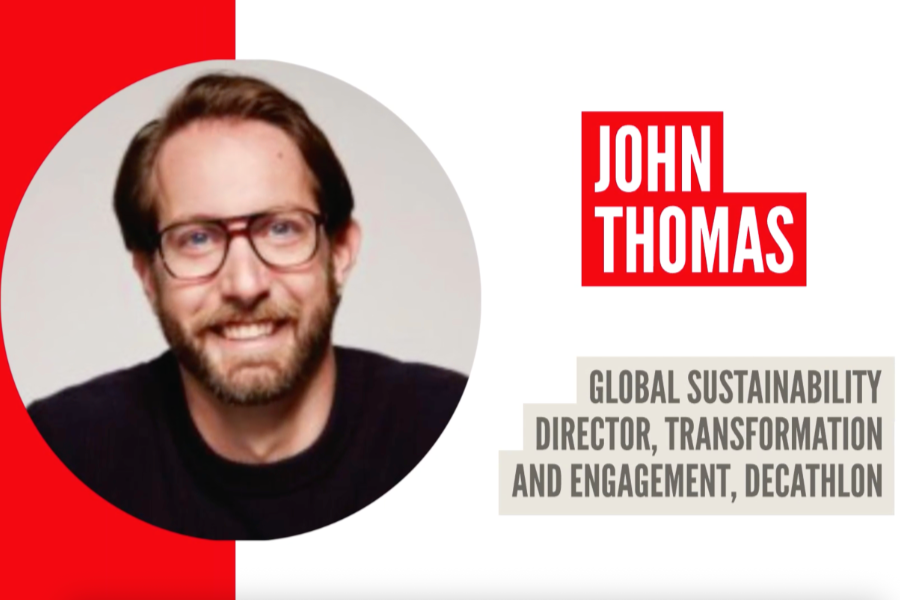
John Thomas leads Sustainability Transformation and Engagement at Decathlon, the world’s largest sporting goods retailer. where he is responsible for setting sustainability goals and ambitions, supporting their integration into the business, and overseeing delivery across the organisation.
Prior to assuming his current position in October 2025, he served as Global Sustainability Strategy Director and Chief of Staff at the France-based business. Before joining Decathlon, he held sustainability and advisory roles at several organisations, including Lululemon, CEA Consulting and The Rockefeller Foundation.
How has Decathlon moved from ‘ambition to action’ in terms of turning sustainability into a core value driver – in other words, how have you made sustainability ‘good for business’?
A good example is that we set an SBTi-approved goal to reduce absolute carbon emissions by 20% by 2026 compared with 2021. That really spurred the business to ask, ‘How do we get there?’ It touched products, energy and circularity, and it sparked a wave of innovation across projects and initiatives to explore solutions.
That’s what we’re seeing the benefits of today. I have to give credit to the team for their foresight and ambition. Ambitious targets carry risk: without a plan, they can look like greenwashing. But without ambition, you won’t go anywhere – if you don’t shoot for the stars, you might not even hit the moon.
Having that ambitious target – what we called our plan de transition, in French – really motivated the business to think about how to get behind it and solve it. That momentum continues: 100,000 of our teammates have carbon performance integrated into their bonuses. Everyone is aware of how we’re performing on this topic, which drives them to push further because it’s directly linked to their own performance.
We’re now at the mid point of the decade. What do you see as the single biggest barrier for businesses in moving from ambition to measurable action – and how can it be overcome?
I think there’s what’s happening within companies and then there’s what’s happening in the world as a whole. Within companies, frankly, there’s often a lack of leadership and courage. It’s easy for me to say that working for a French company performing well on these topics, but if you look at the current situation in the States, you don’t necessarily see retrenchment, but there isn’t a lot of ambition or inspiration either.
Now is not the time to step back. If sustainability is integrated into your strategy, continue with it. If it’s not, then some soul-searching is required. Leadership and courage are essential – but that doesn’t mean you’re alone. The more people speak up, the more progress we can make collectively.
For us, and across the industry, it’s about figuring out technological innovations – electrification, for example, is a very specific challenge. Financing the transition is another: we can incentivise it, but does that move us fast enough? These are areas where harmonised policy becomes really important.
Learn more about Decathlon’s sustainability commitments at www.sustainability.decathlon.com.