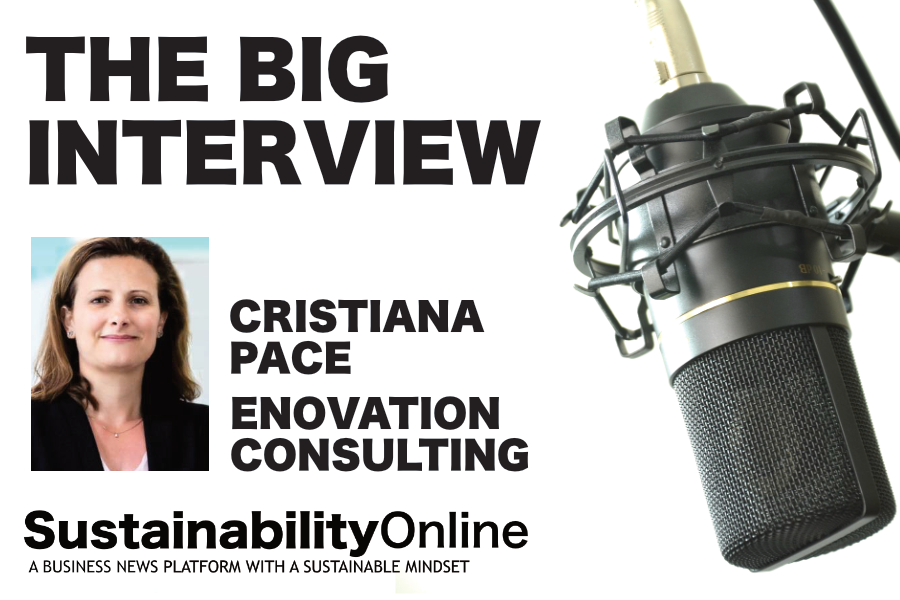
Cristiana Pace has built a rare career at the intersection of motorsport, engineering and sustainability. As the founder and CEO of Enovation Consulting, she works with sports and motorsport organisations to turn environmental targets into measurable action, from carbon footprinting and supply chain standards to biodiversity, circularity and social impact.
An environment and sustainability expert with deep Formula 1 experience, Cristiana became the first woman to work trackside for the FIA’s technical departments in Formula 1. Her work spans sustainability strategy, technology transfer, e-mobility and ESG, with a focus on practical change inside high-performance organisations.
In this exclusive interview with the Motivational Speakers Agency, Cristiana Pace discusses how motorsport teams can reduce their climate impact, why supply chain data matters, and how organisations can identify the areas of their operations that contribute most to climate change.
How have you supported motorsport organisations, including Formula 1 teams, in translating sustainability ambitions into practical environmental, social and governance outcomes?
We work with a number of clients, including Formula 1 teams, and we see sustainability as holistic for them.
We work in different ways with different Formula 1 teams. For some of them, we have helped them achieve accreditation that is very similar to the ISO 14001 framework for corporates. We look at their Environmental Management System, how employees travel to and from work, and the standard areas you would expect in a corporate company.
For others, we look after innovation projects. Recycling carbon fibre has been quite a big area that we have been trying to help them with in order to achieve circularity within the car or within some of the marketing material.
We have also looked at other aspects, such as biodiversity. For example, Williams F1 is located in a very green area through which a protected chalk river runs. There are only 212 in the world. We are looking at how we could enhance the biodiversity around that, but also how they could protect the river that runs through their grounds.
We look at social projects for them as well. For some of the F1 teams, and also some of the World Endurance teams, we have looked at how they could help schools and girls get into STEM by organising days at the track and coding activities.
We have helped them with every part of environmental, social and governance. What we do is a very bespoke service. We get into the team and see where they have got to. Some of them may already have a corporate social responsibility strategy, so we develop that into a sustainability strategy, embedding the environmental and governance elements.
Others may already have the environmental part because they may have already achieved ISO 14001, so we look at other aspects, such as carbon fibre materials or their social responsibility.
It is very bespoke, and over the years we have developed a very big portfolio of specific projects that we undertake with Formula 1 teams, as well as with other teams.
What is the most effective way for businesses to communicate sustainability standards across complex motorsport supply chains?
Supply chain is a very difficult subject to tackle, and it is one that needs to be tackled well if companies, including motorsport companies, want to reach their net zero targets.
There is a lot of work that we have done within Formula 1 teams, for example, in terms of procurement and supply chain. We have built a code of conduct and surveys, and as we are a very quantitative, data-driven company, we really make use of the data to assess the supply chain.
That data is a bit like strategy data in an F1 race. You have a lot of data, and you need to make sure the strategy you apply will help you win the race. That is how we see the supply chain – lots of information from suppliers, trying to tier them by who has already started the road to net zero and who has not, and then giving them the tools to achieve those targets.
One thing we often forget is that, in motorsport, some of the supply chain is made up of very small companies, sometimes with only two or three people. For these companies, it can be very difficult to tackle those specific targets and reach net zero. But if they do not do it, then the corporates, the big companies and the F1 teams cannot do it either.
Giving them the tools to do that is important, but it is also a great testament to how corporations or F1 teams can drive transformation through the wider sustainable world.
Data is important because it shows what everybody is doing in the supply chain. It allows companies to engage, rather than simply dictate what others need to do.
What we have done in motorsport is much fairer, specifically because we have really small companies involved. We start with data collection and a questionnaire, see where they are, and then decide how we can map out the road for them.
We tier them by who has already started and who has not. For those who have not started, it is about going back to the beginning and giving them the tools to understand why they need to do it.
How should organisations identify the areas of their operations that contribute most to climate change?
The easiest thing to do is data gathering through what is called carbon footprinting. That means calculating a carbon footprint across Scope 1, Scope 2 and Scope 3, and paying particular attention to all the categories within Scope 3.
From that data, companies can identify hotspots, see where they can improve, and create a carbon reduction roadmap. Once they know what they can reduce, they also know what they cannot reduce, and then they have to mitigate.
Again, it is the usual piece on data. Motorsport is very good at analysing data and finding solutions to achieve the goals it wants to achieve.
This is one of the fantastic pillars of Enovation Consulting. We are a data-driven company, and everything should be based on data: assessing data through carbon footprinting and identifying where the biggest impact and contribution lie for each company.
This exclusive interview with Cristiana Pace was conducted by Tabish Ali of the Motivational Speakers Agency.