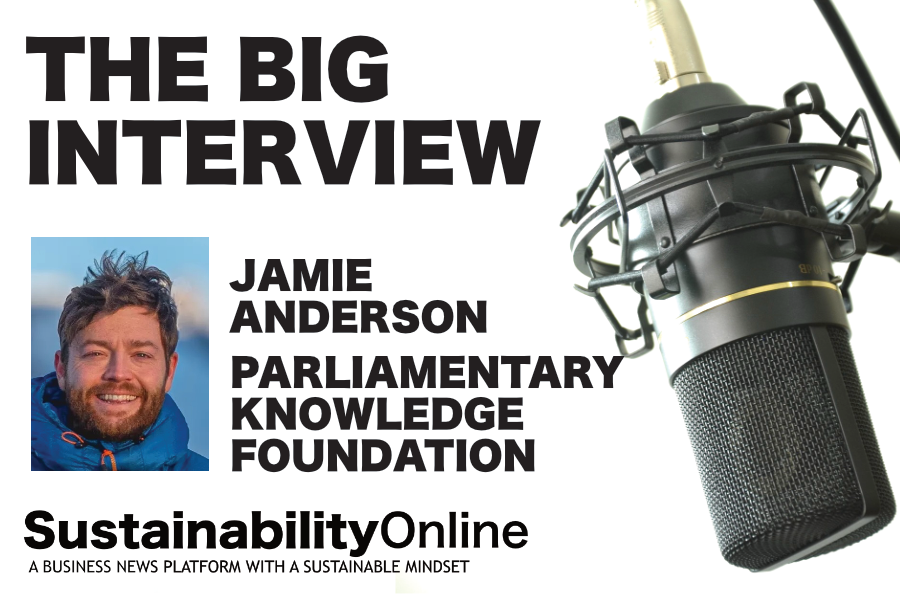
Jamie Anderson is an environment and sustainability expert, crisis responder and CEO of the UK’s Parliamentary Knowledge Foundation. His career has moved from disaster response and military service to environmental policy, polar research and responsible business.
A former Royal Marines Commando, Jamie has worked in global disaster response, mountain rescue, flood risk, oil spill response and food crisis logistics. He later became Director of the All-Party Parliamentary Group for the Polar Regions, served as a Special Advisor to the Environmental Audit Select Committee, and now works to improve how policymakers access real-world knowledge.
In this exclusive interview with the Sustainability Speakers Agency, Jamie discusses why responsible business must sit at the core of an organisation, how companies can choose credible green initiatives, and why stronger links between business, Parliament and frontline experience are needed to drive practical change.
How should businesses embed responsible practice so it becomes part of the organisation rather than a separate initiative?
Responsible business is something that encompasses everything across sustainability, social value, your impact in the community and your impact globally.
Now, especially those businesses right on the front foot, are understanding that these aren’t individual elements. Everything has to sit together.
The most powerful thing is that you are now starting to see those businesses that do it well have better stories to tell. They’re better engaged with the clients and customers they want to target, and people are choosing them over other organisations that aren’t as successful.
It’s quite nice to see this shift now, especially as more and more market research shows that community value, social value, sustainability and staff welfare are all things that matter to consumers. Therefore, consumers are choosing to use those brands that live those values.
Living those values, embedding them within your organisation so they become an integral part of what you do, and then telling people about it, is where you’re starting to see that change come.
I find that so positive, because it’s easier to explain or get businesses on board when they’re going to make more money from it. There’s nothing wrong with that. We live in a capitalist world. Businesses need to make profit to survive.
If you can say you do these things better and communicate them in a better way, you’re going to make more money. Then actually everyone wins.
Why does responsible business now matter as much for staff retention and recruitment as it does for customers?
A huge organisation I’ve been working with recently said one of their key drivers is staff retention and recruitment. It hadn’t really occurred to me that much until we started talking through why being seen as a responsible business and a value to society beyond just the tax you pay was critical to them.
It was because they needed to keep the highly trained, incredibly valuable workforce they’d built up. So, maintaining that workforce and being able to recruit the next wave of people was equally as important to them as telling their customers they’re really good at this stuff.
I thought it was such a nice way to approach it because they’re saying we need to live our values because the people who are us value it.
That, to me, was such a great encapsulation of why this stuff is now going beyond surface level. Companies are starting to understand that – for a whole host of reasons, it’s got to sit right at the core of who you are.
With so many green schemes in the market, how can companies choose initiatives that are credible and commercially relevant?
It’s a Wild West. It’s been quite a long process over probably the last 25 years, and there are definitely a lot of schemes out there that are rubbish. The issue with that is it hits the credibility of the schemes that are good.
My advice to businesses or institutions is always: do stuff that you actually care about, that is relevant to you as a business.
This is very rarely someone’s primary goal and primary business focus. We shouldn’t ever think that it needs to be because if you are a manufacturing company, your primary goal is to manufacture whatever it is you do. If you’re a financial services company, your primary goal is to deliver those financial services – because without that, you don’t exist.
So with responsible business practices, tying into something that matters to you as an organisation means that you’re more likely to care about it and understand what good looks like.
Whereas this has sat for a long time in the ‘just chuck some money at it’ box and maybe it will go away or we can tick it, that’s not good enough anymore.
Not only from a holistic point of view, but also from a customer or staff point of view. People can smell it if it’s not good enough now.
Doing stuff that speaks to you as an organisation, speaks to you as a board, and speaks to you as an employee base is way more powerful. You’re much more likely to understand what good looks like and what doesn’t.
That’s one of the things we’ve done with Expedition Science, to try and create really credible options for businesses to work directly with researchers from credible institutions, so they’re proud to tell those stories – the last thing you want is to back something that comes back to bite you because it wasn’t very good.
So, live your values. Find stuff that you personally and the organisation care about, and therefore you can be the judge of whether it’s good or not.
What has working in the UK Parliament taught you about the relationship between business, policy and real-world change?
I moved into Parliament from a very operational background – responding to big disasters, the military, big expeditions – and it was a real sidestep for me, and one that I’ve enjoyed way more than I thought I would actually.
It’s something that I genuinely thought would probably be interesting for a little bit and then I’d quickly get bored, but learning about how politics fits together, how politics fits with the rest of the world and UK business and institutions, and starting to join the dots as to where businesses and politics should be converging more, being closer and discussing things more, has been something I’ve really enjoyed.
It’s something now I’m very passionate about because we have a lot of assumptions around politicians, how Parliament works and the types of people that are there. My experiences have just not reflected that in the slightest.
One of the things I always keep coming back to is how open politicians are to learning and gaining more knowledge.
I’ve set up a series of schemes linking businesses and politicians so MPs can gain more knowledge through experiences outside Westminster – seeing how stuff is done, meeting people delivering on the frontline at the coalface.
It’s something I would encourage businesses and institutions to do more of: engage with the political process. Because when you’re outside Westminster looking in, things can often look like a bit of a shower and not good enough.
Actually, I’ve found there are definitely elements of that which are true, but there are also large chunks that aren’t.
Being more politically engaged as a business or institution is only going to help you. You’d be amazed at the breadth of knowledge, experience and range of people you find in and around Westminster. It’s something that’s really surprised me.
It’s definitely one of those places where change happens. And if there are things you want to change, it’s the place to try and influence and communicate why something’s not right.
This exclusive interview with Jamie Anderson was conducted by Tabish Ali of the Sustainability Speakers Agency.