LocalDutch is on a mission to bring healthy produce to food deserts in the United States, as well as locations highly-reliant on food imports and lengthy fresh produce supply chains.
At the heart of the concept are what The Hague-based company calls Urban Farm Shops – stores that combine hydroponic food production, retail sales, and local delivery from a single location.
Intended for regions where access to fresh produce is limited, franchised outlets will utilise automated climate management systems to optimise production and ensure each store’s range is tailored to the needs of its customer base.
As Maurice van der Knaap, CEO and co-founder of LocalDutch, tells SustainabilityOnline, the concept has its roots in Dry Hydroponics, which he also co-founded in 2009.
Through the rollout of projects across Europe, the US, Korea, Singapore, and Australia, van der Knaap became increasingly focused on the role – and cost – of logistics within the fresh food supply chain. An enforced sabbatical during the COVID-19 pandemic provided the opportunity to develop the concept that would eventually become LocalDutch.
“More and more, it was getting into my brain that we always try to solve a problem with what we know, and in my case, that was the growing system,” he says. “But I’m not the problem. The problem is logistics.
“If 75% to 80% of the cost of food isn’t going to the farmer, then it probably makes more sense to cut out the logistics and supply chain and grow food right under the consumer’s nose. And with that rule of thumb, we began developing the engineering and business model.”
The business model
A direct-to-consumer model, LocalDutch aims to reduce transportation, storage and distribution costs in the fresh produce supply chain – “with zero food miles,” as van der Knaap explains – as well as ensuring longer shelf availability. Production will primarily focus on leafy greens and herbs, with each store intended to function as a local food hub, supporting consumers and local businesses with consistent, year-round supply.
The use of hydroponics – a method of growing plants in which roots absorb nutrients directly from water rather than soil – ensures that produce can be developed in a controlled environment, free from contaminants, and not requiring the use of pesticides.
van der Knaap, who describes himself as an ‘eco-modernist’, says that LocalDutch has not been designed to compete primarily on price, focusing instead on health, freshness, shelf-life and quality. He believes that the strongest business case for the concept is in regions where food travels long distances, rather than in countries with highly-efficient food systems.
“In the Netherlands, there’s no business case at all, because there is so much supply close by,” he says. “But if you go to Boston, where most produce travels more than 3,000 miles, there we have a story to tell. Or the Caribbean – I’ve seen lettuce there that was driven from California to Miami, and then went from Miami by boat to one island, and then another island. It was more than two weeks old.” [As well as the US, LocalDutch is also considering expansion to the Caribbean islands of Bonaire and Curaçao].
Site selection for LocalDutch outlets will be driven by factors such as the availability of fresh produce, water availability and low-impact environmental locations – with the firm also planning to collect rainwater from the roofs of its facilities, which, once filtered for contaminants, can be used in its hydroponic systems.
In addition, locations will be determined by traffic patterns, population density and integration into existing daily routines – particularly in car-dependent regions such as the United States – with the goal to locate stores where customers can shop without taking significant detours.
Range anxiety
Visiting the Dry Hydroponics facility in Schipluiden, on the outskirts of The Hague, it’s clear that the quality of the produce isn’t up for debate – giant heads of lettuce cabbages, radishes and turnips abound – but beyond that, the offering is somewhat scant. In an era where time-poor consumers are keen to consolidate their shopping where possible, is range likely to be an issue for LocalDutch?
“It’s a fair question,” he says. “In general, most people like to do one-stop shopping. I myself shop at different locations for my bakery items, my poultry, my vegetables, my dairy – so there are people out there that like to go for something that is worth the extra trip.
“Of course, if we only did lettuce, it would be game over. Nobody will make an extra stop for one product. Our goal is to be as diverse as possible within our sustainable boundaries.”
To meet this shortfall, LocalDutch plans to supplement its own, hydroponic-grown crops with produce from nearby farmers, balancing its focus on in-house production with customer expectations for variety.
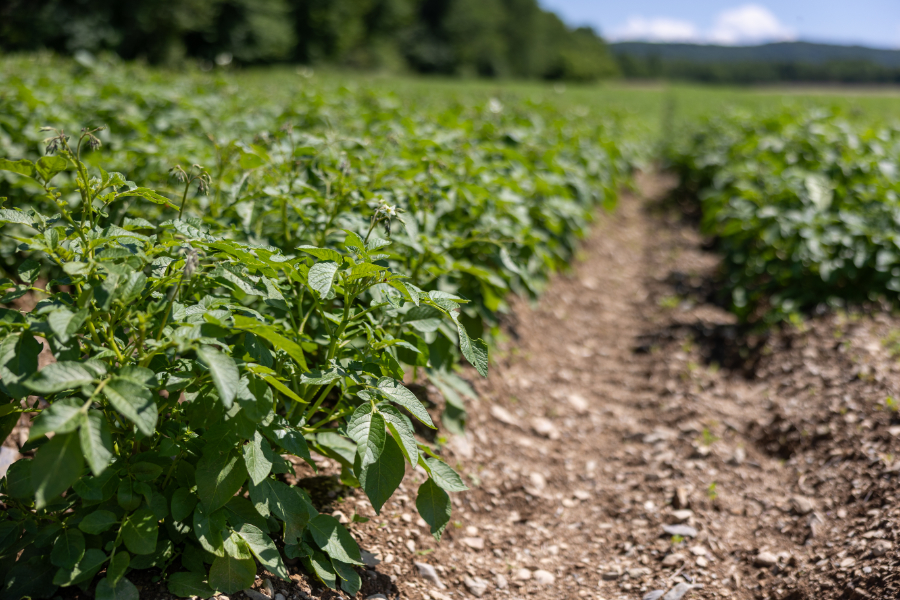
“It’s completely logical for us to add locally-grown potatoes, onions or carrots, those kind of things,” he says. “When a local farmer in the neighbourhood has tomatoes, strawberries or pumpkins, why not sell it also from the shop?
“There are a lot of possibilities with what we can do – with greens, with herbs etc – but you’re right, we’re not going to start growing oranges. We’re not going to grow an apple. This is going to be a debate for us as we grow. I hope we can stay as close as possible to our core objectives, but if we are forced to sell peaches because it is a game changer in our traffic to the shop, we have to do that as well. We need to be flexible.”

Getting started
While the first fully-realised LocalDutch site has not yet opened, the firm has acquired a site and gained planning approval for a location in Harrisburg, Pennsylvania, for which it is currently seeking final funding.
A separate project within the Bidwell Training Center near Pittsburgh will serve as an educational initiative rather than a commercial LocalDutch outlet, teaching students about hydroponic growing, crop management and greenhouse operations, as well as enabling the firm to test its proprietary technologies.
“It’s really about agricultural education, but as a side effect, we can learn how robust our solution is,” says van der Knaap.
The development of LocalDuch also seeks to address the lack of experienced growers in horticulture at present – “the whole industry has to move on to the next chapter,” he says – with its platform backed by software that automates climate control, crop planning and production schedules, as well as optimising energy use.
While franchise operators would still be free to make businesses decisions based on the needs of their local community, said software enables growing conditions to to be amended according to changing purchasing patterns – stores typically sell more salads on summer days, for example.
“I think that’s one of the unique selling points of this concept – we are in contact with the end consumer,” says van der Knaap. “That’s a problem with the whole sector; there are always a lot of layers in between. So, if you’re an open-field grower, what can you do? Your plants are already ordered months ago, and you just have to do what you do, and hope the climate will give you the yields that you get. With a controlled greenhouse, we have a lot more steering capacity.”
LocalDutch plans to introduce a subscription model whereby shoppers pay a monthly fee and receive a set basket of products each week, enabling the business to align production more closely with consumer demand.
“That’s great, because then you know exactly what is expected this week, next week and the week after,” he adds. “Our algorithm is looking at that all the time. Of course, we will not be spot on all the time, but because we harvest what we sell, there is flexibility. There is resilience in the system. We can speed up production, and we can slow it down, and sometimes we will have a little bit too much, and sometimes a little less.
“With a subscription model, we can tell our customers, this is your box. You have your six favourite items. And by the way, in the summer period, we will give you two items for free – those will be products that are just 5% over in production. So it’s that combination of tooling, know-how and planning up front that enables us to be so predictable.”

Cooperative expansion
In terms of the financial viability of the concept for franchise holders, van der Knaap describes LocalDutch’s expansion model as being closer to a cooperative structure than a traditional franchise. Rather than requiring upfront investment from franchisees, LocalDutch will finance, develop and manage the infrastructure centrally, with store operators focusing on running the site, managing staff, engaging with customers and overseeing production.
“It’s based on the Chick-fil-A model – one of the most popular franchises in the US at the moment,” he says. “We choose the best location. We develop the property. We do the back office work. Everything that makes sense to do centralised, we do centralised. Profits are split 50-50: 50% for the franchise holder, and 50% for us. So it’s really about finding the right people.”
As to whether LocalDutch may go down the road of Ocado, and licence its technology for use in mainstream retail – a ‘bolt-on’ hydroponic greenhouse in a traditional retailer’s fresh section, for example – the company hasn’t ruled it out, but it’s not an immediate priority.
“We’re always looking at alternatives,” says van der Knaap. “In-store is quite complicated, because we need 2,000 square metres of space, so we’re not going to fit in many stores. On the other hand, you have an awful lot of shopping malls in the US, and giving up a little bit of parking space to make a shopping mall more attractive could be a fantastic business deal for a developer.”
Another potential avenue, he suggests, could be healthcare, with LocalDutch partnering with hospital networks to improve diets and health outcomes.
“In some neighbourhoods of the US, the difference in life expectancy can vary by as much as 20 years,” he says. “That is partly to do with food. We have some talks with hospital chains to find out if there’s a business case to help their customers develop better eating habits and, in turn, save healthcare costs.”
While promising, such possibilities remain largely hypothetical for now, with LocalDutch focused on demonstrating the viability of its concept through initial site openings. Once funding is completed, its Harrisburg site should be up and running within 18 months, following which it intends to open five locations within three years.
“With five sites, we’re confident that we can have a solid enough P&L to make the concept bankable, so we need much less capital and can speed up the process,” says van der Knaap. “So, ideally in the next five years, we would open up to 20 shops. And then within 15 years, as many as 200 shops. The focus for us – and this seems a strange thing for a European to say – is ‘America first’.”
Learn more about LocalDutch at www.localdutch.com.