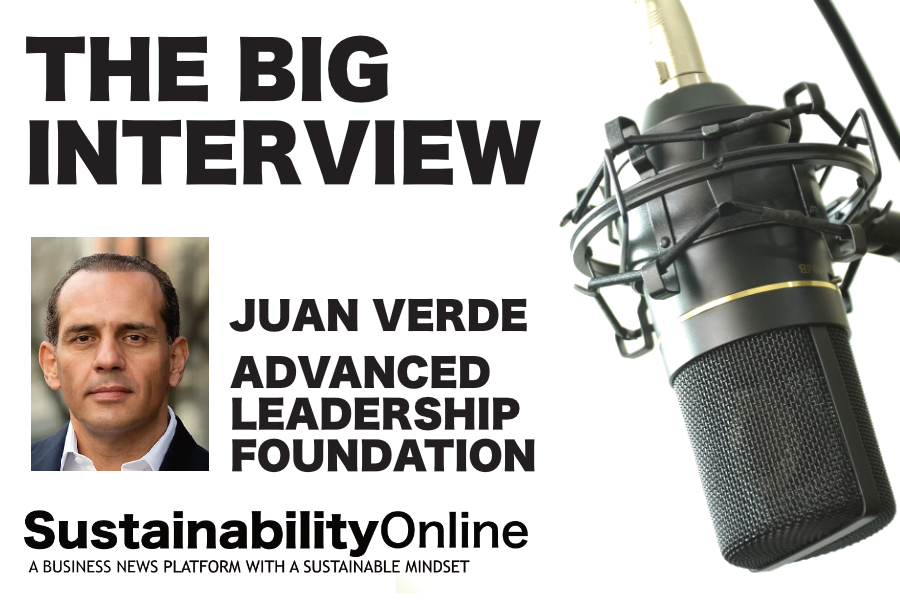
Juan Verde is an internationally-recognised climate change speaker, sustainability strategist and former government adviser. He has advised Bill Clinton and Barack Obama, and served as Deputy Assistant Secretary for Europe and Eurasia at the US Department of Commerce.
He is the founder of the Advanced Leadership Foundation and Alamo Solutions, and has spoken at the United Nations, World Economic Forum, World Bank, Google and Cisco. His work focuses on making sustainability central to business competitiveness, not separate from it.
In this exclusive interview with the Sustainability Speakers Agency, Verde explains why climate impact starts with leadership, how sustainability drives profit, and why the climate transition is one of the biggest economic opportunities of this generation.
Where should organisations begin if they want climate impact reduction to move from corporate social responsibility into core business strategy?
Reducing climate impact begins with a mindset shift. The greatest challenge is not necessarily technological. It is cultural. Organisations must first recognise that climate action is an ongoing activity. It has to become part of the company’s DNA, not just part of corporate social responsibility.
For an organisation to reduce its climate impact, it must recognise that it has to make economic and business sense. It has to become closely related to remaining competitive. It is about risk management, reputation, credibility and remaining competitive in a constantly changing business environment.
The journey starts with measuring and understanding your carbon footprint, then setting targets. Only what is measurable can be improved.
You have to understand your base, understand where you want to be, and then go through that transition within the company by optimising energy efficiency and reducing costs.
It is not only about reducing your carbon footprint. It is also about reducing costs, becoming more efficient, identifying new business opportunities, finding new ways to sell and appealing to your potential customer base.
In a nutshell, this has to become central to the leadership of the company and an absolute priority. If you reduce your climate impact, you will also become more competitive and more efficient.
How can business leaders make the commercial case that sustainability improves competitiveness rather than simply adding cost?
For decades, business leaders and top executives viewed sustainability as an afterthought, something that was nice to do. They understood it as an ethical or moral decision they had to make. Many saw it as corporate social responsibility or philanthropy. That perception is now obsolete because the data is clear.
Companies that lead in ESG performance understand sustainability as a comparative advantage tend to outperform their peers in profitability, market valuation, employee engagement, access to better financing terms and identifying new business opportunities.
My message is that sustainability drives profit because it makes economic sense. It is not about ideology. It is not about doing the right thing. It is about strategy and remaining competitive.
Companies that bet on sustainability understand that this is about capturing market share, attracting and retaining talent, and building trust with shareholders, stakeholders, customers and employees.
What does the corporate climate transition require from companies that want to remain competitive in a low-emissions economy?
We are currently living through one of the greatest economic transformations in human history: the green climate revolution. Just as the Industrial Revolution reshaped society and the world economic order, this new era is redefining how value is created, measured and sustained.
This transformation demands that businesses align profit with purpose. They need to replace the old way of thinking, based on extractive models, and transition to a different understanding of our economic model. It has to be based more on the circular economy, moving from linear take-and-dispose systems to regeneration and social capital.
Companies need to understand that this new economic model is not only the right thing to do, but also makes economic sense.
It is a completely new paradigm where companies understand that success is no longer measured only by quarterly earnings, but by long-term impact and contributions to collective wellbeing.
As long as companies understand that this climate revolution is not a threat but an opportunity, they can benefit from it. I would argue it is the opportunity of a generation. It is driving innovation in clean energy, mobility, better finance and digital technologies. It allows companies to bring innovation into the business and generate greater efficiency.
The winners will be those that adapt fastest and incorporate sustainability into their DNA. It is about attracting talent and positioning themselves as trusted companies and trusted leaders in this green transition.
The message is one of optimism. The future belongs to the companies that help build it, and the future is going to be greener. I am absolutely convinced that we will live in a low-emissions economy. It makes sense.
This exclusive interview with Juan Verde was conducted by Tabish Ali of the Motivational Speakers Agency.