Op-ed by Alastair Collier, chief R&D officer of A Healthier Earth, the R&D subsidiary of Pure Data Centres Group.
For years, carbon removal has been defined by innovation. New technologies, bold startups and growing pools of capital have created the impression of a sector on the cusp of breakthrough. The challenge now is not invention, it’s scale. And while the market is beginning to move, deployment remains too fragmented, small-scale and slow to meet the challenge ahead.
To turn momentum into meaningful impact, industry and policymakers will play a vital role in creating the market conditions that allow high-integrity carbon dioxide removal (CDR) to scale with confidence.
The foundations for scale
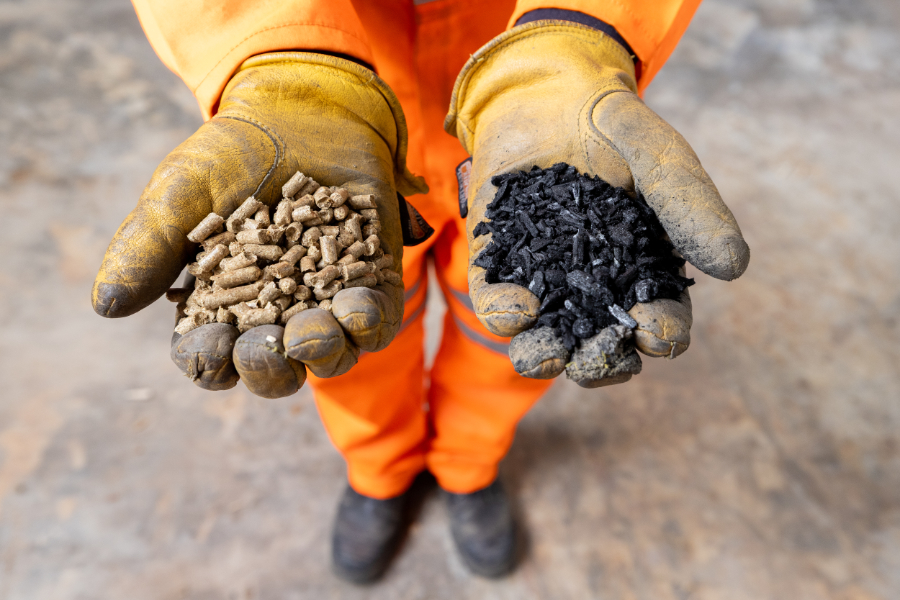
Across the CDR landscape, pathways are maturing. Biochar, in particular, has emerged as one of the most reliable and scalable approaches available today, delivering measurable, durable carbon removal using widely available biomass. Yet even here, where delivery is already happening, the market is still on a precipice, awaiting the critical move from early adoption to systemic scale.
The bottlenecks are structural. CDR credit buyers face a fragmented market, with supply distributed across projects using different methodologies, standards and assumptions.
Comparing one credit with another remains difficult, traceability is improving but inconsistent and high-integrity credits remain scarce, often secured early through bilateral, long-term agreements. A small number of buyers and suppliers still dominate transactions, creating concentration risk in what should become a broad, resilient ecosystem.
This is not a failure of ambition. Corporate climate targets have multiplied and many now explicitly require carbon removal to address residual emissions. However, demand remains uneven, short-term and disconnected from developers’ long-term financing needs; developers struggle to secure capital without contracted demand while buyers hesitate to commit without proven delivery at scale. To break this cycle, carbon removal needs to move beyond one-off purchasing towards structured, long-term procurement.
Early signs of this shift are already visible. Buyers are moving from spot purchases towards multi-year offtake agreements that provide supply security and price stability. These agreements are not just commercial instruments; they are the foundations of scalable infrastructure, creating the predictable revenues needed to unlock investment, build facilities and expand capacity.
Building trust in the market
But procurement alone is not enough. The next phase of market development will be defined by governance.
Buyers are becoming more sophisticated, and rightly so. The question is no longer simply how many tonnes can be purchased, but whether those tonnes will be delivered, verified and maintained over time, and what co-benefits they offer. Delivery risk, permanence, provenance and verification are now central to procurement decisions.
This is a positive evolution. It reflects a market moving from experimentation to maturity. But it also raises the bar for participation.
Projects should demonstrate not only technical viability, but operational resilience and transparent reporting. Buyers, in turn, should build internal capabilities to assess, manage and monitor their carbon removal portfolios.
That same logic underpins A Healthier Earth’s integrated biochar platform, which brings production, partner-developed projects, shared standards and digital verification into one operating model to support more reliable, financeable supply.
At the system level, this shift demands clearer standards and stronger integration with policy frameworks. Carbon removal cannot remain a peripheral, voluntary activity, but rather embedded within broader climate architectures – aligned with net-zero standards, supported by certification regimes and, increasingly, underpinned by public procurement and regulatory demand.
Embedding removals into climate architecture
Encouragingly, momentum is building. Governments are exploring carbon removal procurement programmes, standards bodies are refining methodologies and buyers are adopting portfolio approaches that diversify risk. But if removals are now essential to net zero, they cannot remain adjacent to the systems designed to govern emissions. Moving beyond short-term, discretionary demand will require durable policy signals that unlock institutional investment.
Integrating high-integrity removals into mechanisms such as the UK and EU Emissions Trading Schemes (ETS) would be a decisive step. Shifting CDR from a voluntary add-on to an embedded part of the net-zero toolkit could provide the long-term demand, price discovery and policy certainty needed to move projects from pilots to infrastructure.
Right now however, one barrier repeatedly highlighted is permanence, or, how long a carbon removal keeps CO₂ locked away. Robust standards are essential, but requiring millennial-scale certainty before deployment could slow the development of a market that has an important role to play in tackling emissions from hard-to-abate sectors.
Rather than allowing debates around permanence to slow progress, ETS frameworks should focus on careful design, ensuring that only high-integrity, verifiable and durable approaches qualify and that removals do not become a licence to delay decarbonisation.
The climate challenge is immediate, so even 300 years of stable carbon storage gives us 300 years to solve a crisis that is just 120 years old.
The question is no longer whether carbon removal is needed, but whether policymakers and industry are prepared to create the conditions for it to grow at the pace required.
The time is now
Carbon removal is on the verge of a decisive shift. The next phase will not be defined by whether the industry can invent new solutions, but whether it can turn today’s momentum into a scaled, industrial future – one built on durable demand, trusted governance and the market conditions needed to make high-integrity removals part of the climate system.
Learn more at www.puredc.com/a-healthier-earth.