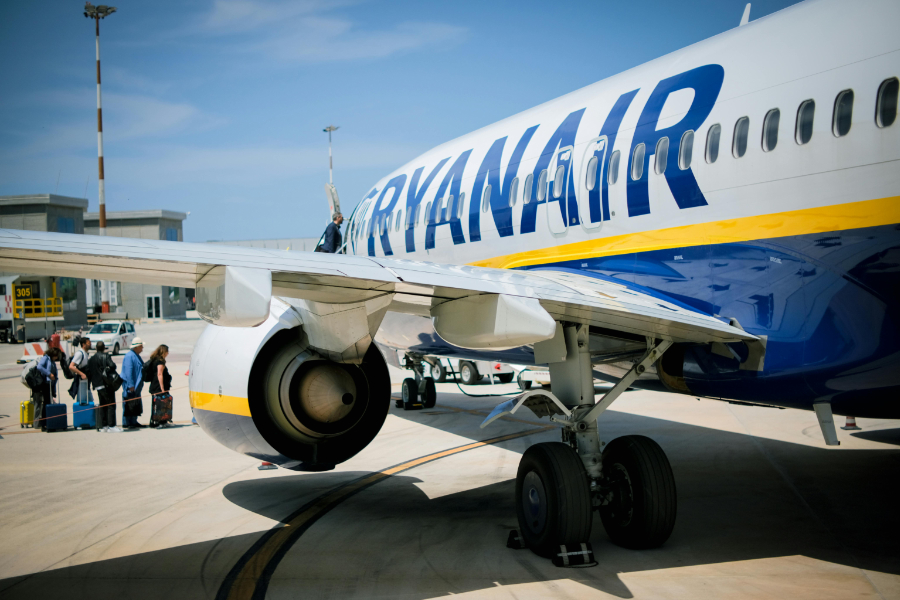
Low-cost airline Ryanair has said that it is committed to achieving its long-term target of net zero emissions by 2050, in its latest Sustainability Report.
In the report, Ryanair noted that during its 2025 financial year, it took delivery of 30 new Boeing 737-8200 ‘Gamechanger’ aircraft, which carry more passengers while consuming less fuel and producing lower emissions than earlier models.
It also accelerated the retrofit of so-called ‘scimitar’ winglets to its Boeing 737-800NG fleet, modifications that reduce fuel use as well as aircraft noise. It is targeting 409 such installations by 2026.
Elsewhere, in January of this year, Ryanair commenced the procurement of a 2% sustainable aviation fuel (SAF) blend at airports across the EU and UK.
‘Align with global efforts’
‘Ryanair is committed to ensuring that the Group’s operations align with global efforts to mitigate the impact of climate change,’ the company said in the report. ‘To facilitate this, the Group developed a comprehensive Climate Transition Plan that outlines the Group’s approach to reducing carbon emissions through fleet renewal and new technologies, promoting the scaling and use of SAF, and prioritising action on climate change across our business.’
Also in the 2025 financial year, Ryanair extended its funding partnership with Trinity College Dublin’s Sustainable Aviation Research Centre to 2030, with an additional €2.5 million commitment. The partnership supports research into SAF, zero-carbon propulsion, and non-CO₂ emissions.
During the year, Ryanair retained ESG ratings of A from MSCI, A- from CDP, and continued to rank first among global large-cap airlines by Sustainalytics. In addition, its near-term emissions reduction targets were validated by the Science Based Targets initiative (SBTi) and are classified as being in line with a 1.5ºC trajectory.
Pathway to Net Zero
Looking ahead, Ryanair noted that its board has ultimate oversight and responsibility over its climate transition plan, adding that its Pathway to Net Zero strategy remains a pillar of its overall strategy.
‘The Group recognises that transition risk costs will arise,’ it added. ‘The Group has a strong history in maintaining a young, fuel-efficient fleet. Any breakthrough in new technology engines will be procured as part of ongoing fleet renewal and is not expected to be outside the normal course of fleet renewal.
‘Additionally, while SAFs currently trade at a premium of 3x – 4x compared to the cost of normal jet kerosene, the long-term outlook is for price convergence.’
Elsewhere, in terms of safety, Ryanair launched a new five-year Safety Strategy in December of last year, focusing on managing growth across the Group’s airlines, integrating the Boeing 737 MAX-10 into operations, and aligning with new EU cybersecurity regulations. Read more here.