The global market for zero-emission trucks is set to grow at a CAGR of 31% over the next decade, a new report from IDTechEx has said, as businesses ramp up efforts to decarbonise their supply chains.
IDTechEx’s report, Electric and Fuel Cell Trucks 2024-2044: Markets, Technologies, and Forecasts, found that the global market share for zero-emission trucks was 1.6% last year, equating to around 39,000 units. The majority of these were located in China.
At the same time, the range of models has increased significantly, seeing 65% growth between 2021 and the end of last year – from 189 to 299 models globally. Heavy-duty trucks have seen the biggest growth, of 95%, in the same period, with 111 models now available, while medium-duty truck models grew 50% year-on-year.
Zero emission trucks cover vehicles powered by battery electric, plug-in hybrid, and hydrogen fuel cell technologies.
Change on the way
“The vast majority of new trucks produced today are powered by diesel engines, but this is expected to change, as with other on-road vehicle sectors,” commented Shazan Siddiqi, senior technology analyst at IDTechEx.
“The magnitude of greenhouse gas emission reductions required to reach national targets necessitates a total decarbonisation of the truck business over the next 30 years. This will only be possible if zero-emission powertrains are widely deployed. Major truck manufacturers and automotive suppliers have realised this, and the battle for future market share has already begun.”
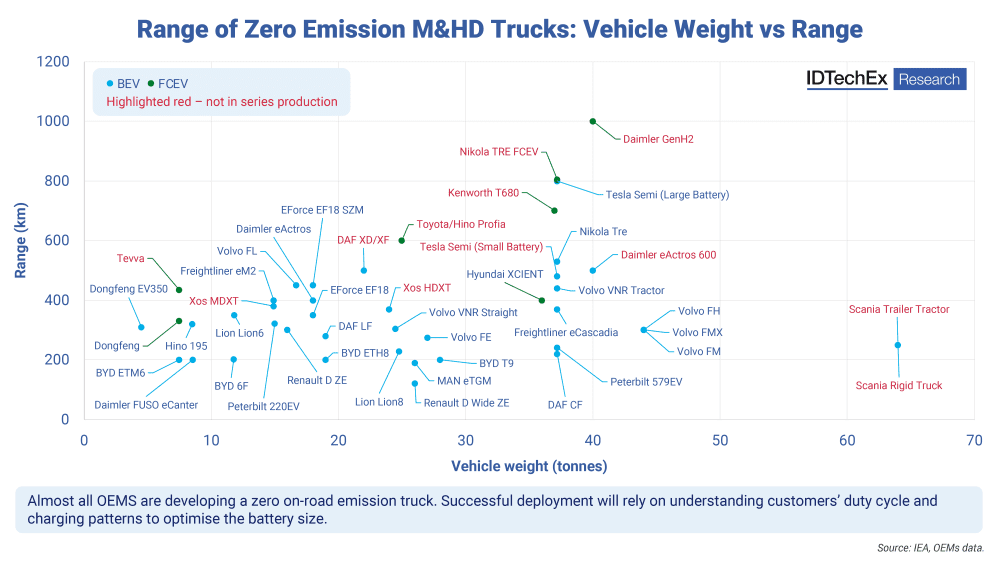
Zero-emission trucks face a challenge in their energy demand due to current limitations in li-ion batteries – popular opinion claiming that electric vehicles cannot deliver useful range because the weight and volume of today’s batteries limit the energy that can be stored onboard.
Although electric trucks may struggle with long-haul applications, urban and regional routes are currently feasible for battery electric trucks, IDTechEx said.
‘Ripe for electrification’
“The US Department of Transportation suggests that approximately 73.7% of the weight and 55.4% of the value of goods moved less than 250 miles between origin and destination in 2023, so there is, therefore, a significant share of truck operations that are ripe for electrification,” Siddiqi added.
Therefore, to extend the range of battery electric trucks for longer applications, a substantial battery capacity is necessary, requiring longer charging times, IDTechEx noted. Megawatt class charging is set to facilitate quick recharging during mandated breaks for long-haul trucking. The Megawatt Charging Standard (MCS) exceeds CCS in current and power, but implementing 1 MW chargers entails significant investment in installation and grid upgrades.