Founded in Sweden in 2015, Position Green specialises in ESG software, advisory services and e-learning tools to support businesses in accelerating their sustainability journey.
Its dynamic software platform aligns with global frameworks like CSRD, ESRS, GRI, EU Taxonomy, and HRDD, and helps firms automate data collection, enhance traceability, and simplify ESG reporting procedures.
Position Green was recently named in Deloitte’s EMEA Technology ‘Fast 500’, while in January it appointed a new Benelux managing director to accelerate its growth in what it sees as a core target region. Last year, the company grew its customer base from 495 to more than 750, and counts businesses including CITTI, Volvo, DPG Media, Bugaboo, The Irish Times and Heijmans among its client list.
Elsewhere, Position Green is currently working on a project alongside the Stockholm School of Economics to determine the links between emissions, working conditions, leadership diversity, and financial returns, the results of which are expected next year.
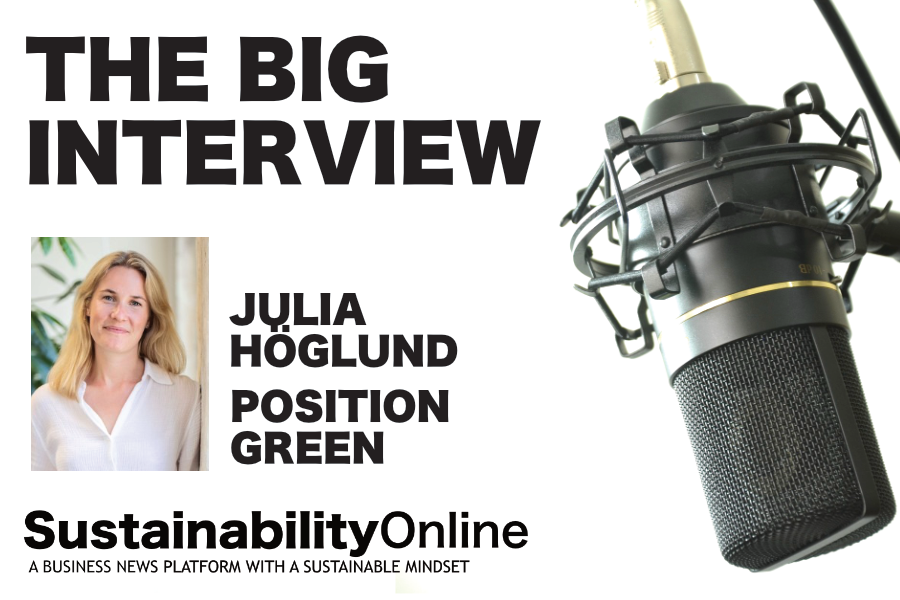
At the recent Business Post ESG Spring Summit in Dublin, SustainabilityOnline’s Stephen Wynne-Jones met Julia Höglund, managing director of Position Green UK and Ireland, to discuss how efficient, manageable data can inform business decision-making when it comes to sustainability.
“We’re a global business, but we’re very proud to be founded in the Nordics, because we take a lot of learnings from our highly-developed Scandinavian customers, who are really on the front line of sustainability,” she explains. “I think we’re learning so much from that, and really trying to implement it in the rest of our markets.”
Managing sustainability data
Höglund identifies traceability and data quality as being among the key challenges businesses have historically faced when managing sustainability data, with many firms still using outdated tools.
“When you’re working with a lot of sustainability data in a collaborative manner, it’s really hard to follow the traceability if you’re using Excel,” she says. “Having a platform where you can click from an analytical dashboard all the way through to where that data input came from, who put it in, and who approved it, is crucial. It’s really about having control over quality. If you put bad data in, you get bad analysis out.”
Position Green has sought to address this by enabling businesses to focus more on analysis and decision-making rather than data management. In turn, this means that businesses are able to transition from meeting compliance requirements to using sustainability data as a strategic asset.
“I’m not undermining the great task of compliance – for the companies who are in the grind of CSRD at the moment, it takes a lot of work and you need to spend a lot of attention on getting that absolutely right,” Höglund says. “We try to make that reporting process as easy as possible, – you can invite colleagues to the platform directly, which makes collaboration quicker and reduces emailing back and forth.
“But the second thing we try to do is build analytical dashboards based on your data so that you can see trends and spot outliers. For example, you can see your double materiality analysis in the tool, and you can work on it in real time, which turns it into a live tool in your company for managing sustainability.”
Supply chain solutions
Position Green’s platform also supports Scope 3 management by making it easier to collaborate with suppliers using either customised or standardised digital surveys, thereby reducing reliance on emails and spreadsheets. Höglund notes that effective supplier engagement begins with thorough preparation, with Position Green offering advisory services to assist with supply chain risk assessments.
“Supply chain management is so complex, so before you start sending surveys and requesting things from your suppliers, you need to do a significant amount of prioritisation work,” she says. “This includes making a risk assessment of your supply chain, prioritising where you’re going to start, who the strategic big hitters are, and where the potential risks could be.”
Shaping the future
In terms of how Position Green stays ahead of rapidly-advancing technology and regulatory trends, Höglund identifies two factors – firstly, that ESG software platforms are evolving beyond data collection to support strategic planning and forecasting.
“Strategic planning is part of our tool, so businesses can use the data to collaborate and develop roadmaps,” she says. “We’re going to be launching a decarbonisation tool shortly that outlines different scenarios for where you want to go with your decarbonisation strategy, what the levers are, and what the cost will be.
“What we want to do is enable businesses to use data to inform future actions that are better than the ones they’ve taken in the past.”
Secondly, with AI increasingly becoming integral to simplifying complexity and accelerating ESG processes, Position Green is developing AI tools that assist with compliance queries, data analysis, and generating text for reports and policies.
“For example, we offer an AI bot that you can ask for advice, either from a compliance standpoint or about your own data, such as ‘What does this data tell us about our progress?’ or ‘Where are the outliers?’,” says Höglund, adding that such tools aren’t designed to outsource sustainability responsibilities, instead fostering internal ownership and collaboration.
“Our AI tool isn’t replacing anyone; it’s making people’s lives easier so that they can focus on the right things,” she says.
As with most aspects of business these days, unlocking true value starts with making sense of data. Sustainability is no different, and Position Green is proving itself to be a powerful ally in this journey. Learn more here.