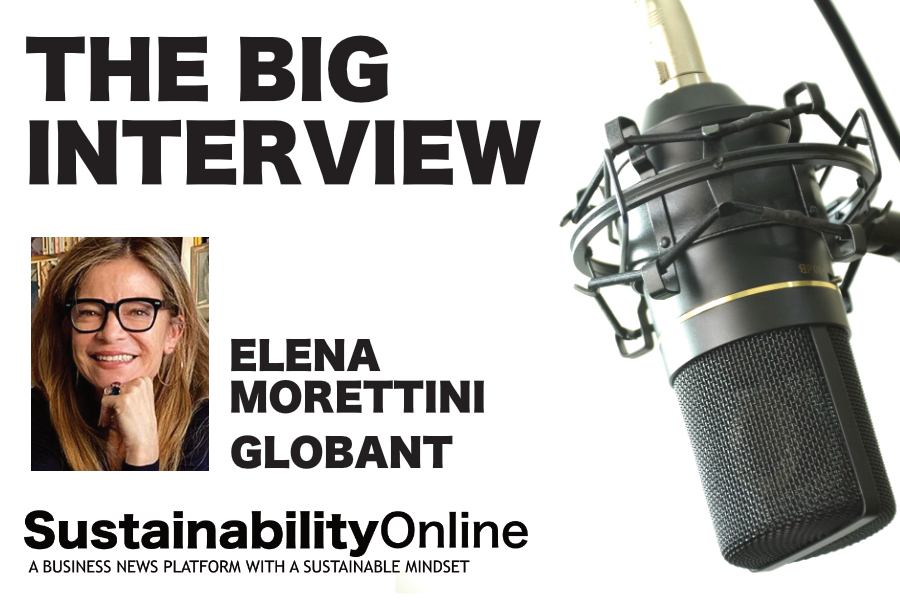
Elena Morettini is a sustainability speaker with a proven track record of turning environmental vision into high-impact action. Her journey spans from grassroots advocacy to strategic policy influencing, making her insights both grounded and forward-looking.
Currently, Morettini holds the role of global head of sustainable business at Globant, a global IT and software development specialist; is part of the leadership team at the Responsible AI Institute; sits on the global advisory board of Global Women TechLeaders; and is the founder of BecauseEnergyMatters, a consultancy that enables businesses to ‘be ready and stay relevant amidst a world in transition’.
In this interview with The Champions Speakers Agency, she outlines how businesses can embed sustainability into their core operations, navigate the complexities of ethical supply chains, and balance profit with planet.
When we talk about renewable energy, definitions often vary. How do you define it, and to what extent can it truly be considered sustainable?
The renewable world is fantastic. It has been around for a while – geothermal is one of the oldest renewable types of energy, possibly one of the purest.
All the others are very much linked to the development of technology, and the reason the past ten years have seen very increased and very fast development of that type of industry.
What I think is very important to bear in mind when we talk about renewables is that there is a life cycle for all the technology that we use. So, when we produce the technology and the tools that are necessary for developing renewable energy, we really need to be careful that our entire full life cycle is sustainable – from the mining of the critical elements and minerals all the way to when we put up a windmill or a solar panel anywhere in the world.
Many governments are pledging net zero, yet energy demand continues to rise. In your view, can renewable energy realistically meet global energy needs on its own?
I think that, being realistic, we really need a complementarity when it comes to energy, because we cannot support all the energy needs of the world only through renewables. We know very well the percentage is relatively low.
So we need to make sure that, from today, we produce cleaner energy through renewables and other energies in a complementary way. So yes, definitely, renewables is the path, but it needs to be coupled with other energies, because at the moment you cannot support and sustain all the energy needs of the world with renewables, and we will not be able to do so exponentially in the coming years.
There is a need for innovation, new technology, disruptive innovation, digitalisation, et cetera – all applied to the energy world – so that we are able to produce the clean energy that we deserve, and that the world needs.
ESG has become a boardroom buzzword, but interpretations differ widely. From your perspective, what does ESG really mean in practice?
To me, it’s a new way of doing business. To me, ESG today equals sustainability. ESG equals a new way of looking at any business in order to make it legitimate.
But the important thing is that we keep a holistic view in which we really do no harm – neither to people nor the environment. And of course, we take care of profit. The ESG concept is still the one that holds everything of what we’ve mentioned together.
Beyond regulation, how critical is ESG as a tool in driving genuine progress on climate change?
We really need to be aware and be knowledgeable, not in a sophisticated sense, but in the sense of knowing exactly what we need to tackle in every new business, in every new profession.
We need to have an eye on sustainability. We need to have an eye on the balance – the harmonious balance between people, planet and profit. And we cannot do without it. So it’s absolutely necessary that we all know what ESG is about.
There’s growing pressure from investors, regulators and consumers alike. Do you believe companies that resist sustainability risk becoming obsolete?
Much sooner than they think. This is going at such a speed, with a lot of social movement – and everybody else – behind it, from public private partnerships, to society, public organisations and private enterprises.
There is a lot of virtuous thinking in this, and whoever is reluctant to open their eyes and see what is going on, I’m afraid to say that it’s going to be the standard very soon.
This exclusive interview with Elena Morettini was conducted by Jack Hayes of The Motivational Speakers Agency.