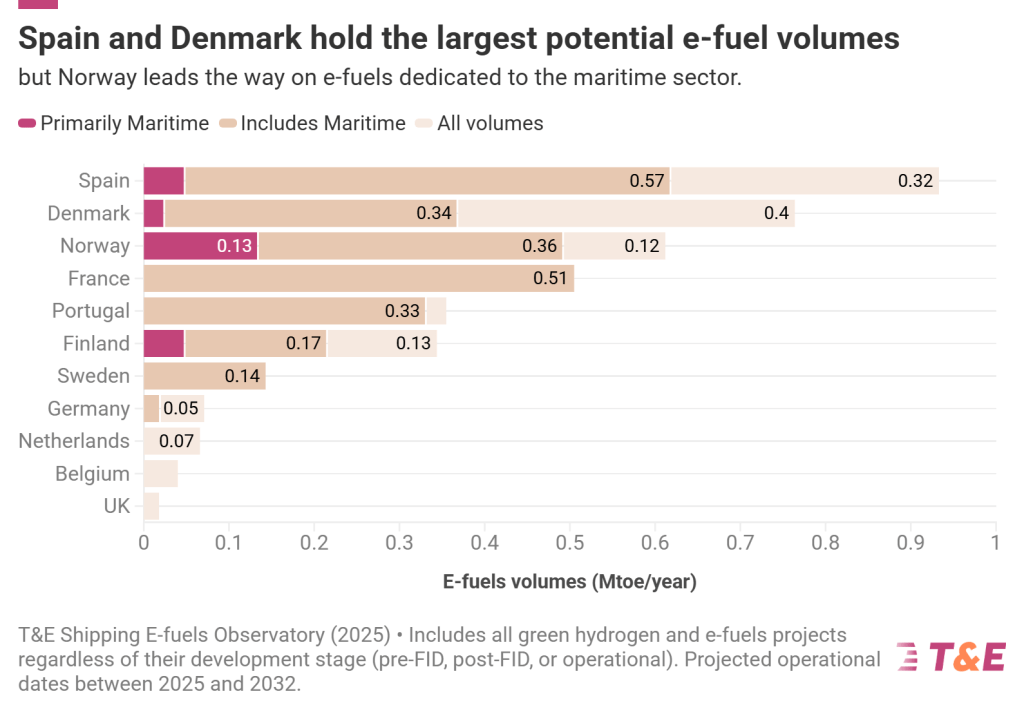
Spain, Denmark, Norway, and France are leading the development of green fuels for the maritime sector, new analysis by Transport & Environment (T&E) has found.
According to T&E’s Shipping E-fuels Observatory, other countries to report a stepping up in the production of maritime e-fuels include Portugal and Finland, followed to a lesser extent by Sweden, Germany, the Netherlands, Belgium and the UK.
Projects underway
Some 80 projects are currently underway across Europe, which have the potential to produce more than 3.6 million tonnes of oil equivalent (Mtoe) by 2032, including green hydrogen, e-methanol, and e-ammonia.
The biggest of these, the Kassø project by European Energy, which supplies e-methanol to Maersk, went on line in 2025.
However, T&E noted that only around half of these volumes are currently earmarked specifically for shipping, while several projects are yet to reach final investment decision stage, or enter into operation, due to lingering regulatory uncertainty and a slow uptake in demand.
As it stated, strong demand signals from the shipping sector are necessary to guarantee to producers that there is a ‘solid market’ for green fuels.
Scaling up
“The biggest maritime e-fuels project went on line [in 2025],” commented Constance Dijkstra, maritime policy manager at T&E. “This shows what is possible, but scaling up projects remains a challenge.
“Current shipping targets just aren’t ambitious enough to get investors to put money on the table. As well as demand incentives, fuel producers need hard cash. Fostering a strong e-fuels sector can bolster Europe’s industrial leadership and reduce the continent’s dependence on imported fossil fuels.”
T&E has called on that the European Union to strengthen its regulatory framework for green shipping fuels and reinvest revenues from the EU Emissions Trading System (ETS) into supporting these projects.
‘The EU should introduce more ambitious green fuel requirements for the shipping sector to ensure projects get off the ground, […] which would deliver jobs and improve Europe’s energy security,’ it said. Read more here.