In his last press conference of Liverpool Football Club’s title winning 2024/25 season, head coach Arne Slot reflected on the importance of the beautiful game to the red half of Merseyside.
“You play football for yourself, for your family, but definitely also for the fans,” he told reporters. “We are privileged that we can play it in front of these [fans], because these ones are special.”
The 2025/26 season hasn’t gone entirely to plan – with the club battling to retain Champions League status next year – but despite the ebbs and flows from week to week, it’s the fans that continue to make football so special in this part of the world.
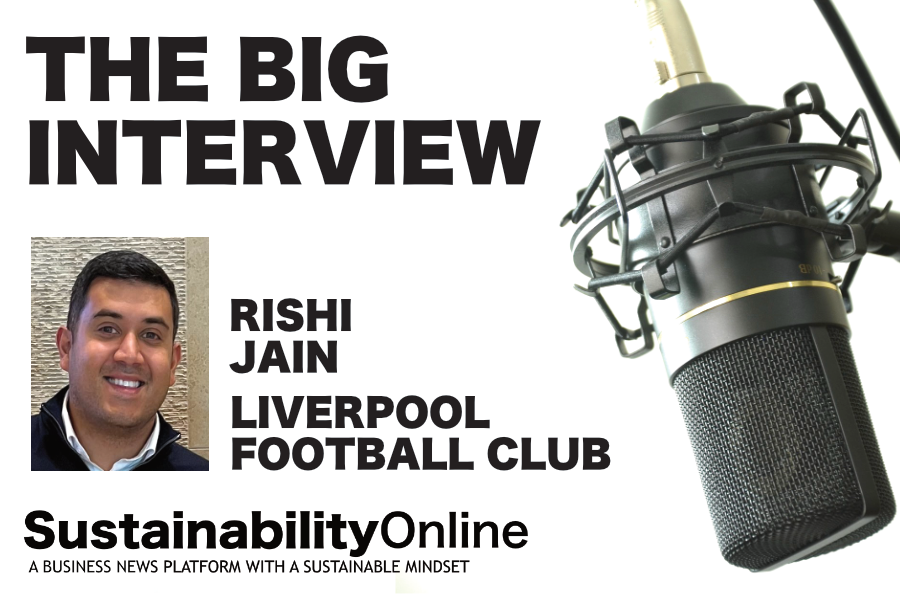
“I always say that the diversity of our fan base is one of our strongest attributes,” says Rishi Jain, director of impact at Liverpool Football Club, who is responsible for leading The Red Way, the club’s sustainability programme. “We’re blessed to be a global football club.”
The Red Way
Seeking to channel the positive energy generated on and off the pitch into environmental and social impact, Liverpool FC launched The Red Way, which is structured around three pillars – Our People, Our Planet, and Our Communities – in 2021.
“Our People is everything around diversity, inclusion, leadership and benchmarking – how the club really takes on its responsibility to lead the way,” says Jain. “Our Planet covers emissions, waste, water, circularity, food and biodiversity targets, and then finally, Our Communities is a bit of a hybrid – the LFC Foundation, the club’s official charity, has a target to work with 500,000 young people by 2030, and the top 20% underserved communities in the city region. My job is to work in partnership with these pillars, and align and engage our commercial partners with The Red Way.”
The word ‘impact’ can be defined in many different ways – for Jain, as director of impact, it’s about assessing quantitative and qualitative indicators across the club’s workforce, environmental initiatives, and community investment.
“It’s about how we are actually doing all these things – saying all these things is great, but how do we actually measure them?” says Jain. “How do we really recognise the difference that we are making in our local, national, and international communities?
“Internally, we look at really metrics around not just the diversity of our workforce, but also employee satisfaction, such as how safe do people feel to address topics like discrimination and bias in the workplace. Also, from an environmental point of view, we’ve increased our matchday recycling rates of plastic bottles in the stadium from 25% to 96% over a three year period. That’s been a really strong fan behavioural piece – it has become a learned behaviour for our supporters to get involved in that campaign, a normalised part of the match day routine.”
The importance of storytelling
Just as a football club is a different sort of ‘product’ to that which you might find in a supermarket outlet or buy online, so the engagement piece with the end user – in this case the supporter – needs to reflect their needs and values. As Jain explains, Liverpool FC communicates sustainability messaging through storytelling and bespoke content.
“One of the most important things for me is storytelling, and storytelling in a way that’s relevant to our different audiences,” he says. “The best example of that is our Red Way report, which is published every year – this year’s edition will be published on Earth Day, 22 April. We acknowledge the fact that not all of our supporters will be of a sustainable mindset, so we want to educate them and push them closer towards that mindset.”
This recently included a send-up of The US Office, which saw players participate in a humorous ‘team meeting’ designed to increase engagement and convey relevant sustainability information in an accessible way.
“Straight away, our fans love that content, and you’ve got the report next to it, so those two messages side by side,” says Jain. “So our role is to make sure that we merge that and do it in the right way.”
Sustainability at Liverpool FC is framed around a values-led approach – “when we talk about sustainability, it’s because we know it’s the right thing to do”, says Jain – and this openness has helped attract solutions providers and corporate partners aligned with its ideology.
“By having that real open and honest approach, this has then opened the doors to commercial conversations,” he says. “We’ve had brands that have come to us and said, ‘we love you as a football club, we love what you stand for in terms of your values’, but also that ‘we want to be part of The Red Way because we see what it stands for, we see what you believe in, and we see what you’re trying to achieve’.
As an example, AXA, Liverpool’s official training partner, has collaborated with the club on ocean health and advocacy initiatives, while Husqvarna has supported the transition to electrified ground maintenance. The Red Way’s influence also extends well beyond Anfield, Liverpool’s home ground, participation in New York Climate Week and COP events underpinning the club’s established role in sustainability discussions.
“We work with brands that are dong amazing work already, learn from them, and then look to tell a story while delivering really strong impact at the same time,” he says.
Net-zero target
Liverpool FC is aiming to achieve net zero emissions by 2040. However, with Scope 1 and 2 emissions accounting for less than 1% of the total, Jain notes that the club faces “the same challenges that most organisations do” in addressing Scope 3 emissions. In this context, these largely relate to its supply chain, merchandise, and – perhaps more uniquely in sport – fan travel.
“That’s the reality of the business that we’re in,” he says. “My job is to make sure we don’t shy away from that – it’s about what decisions we can make, and how we can influence and educate people’s behaviours to start to bring those numbers down.”
Efforts to date have focused on embedding sustainability into decision-making and influencing fan behaviour at Anfield, while Jain recognises the limits in controlling supporter travel patterns, particularly as the club progresses in Europe, for example.
“I think sometimes when people look at fan travel, they’re under the assumption that everyone is travelling from Liverpool to the game,” he says. “That’s not the reality.
“But we’re Liverpool Football Club – we want to play as many games as possible, and that means getting to the latter stages of the big competitions. That’s what we stand for. For me, it’s about how do we embed sustainable decision-making into those processes, and make sure that when decisions are being made about how we travel, how we communicate, what decisions we make, that sustainability is part of that decision-making process.”
Red Together
Within the ‘people’ pillar of The Red Way is Red Together, which represents “what we stand for in terms of diversity and inclusion”, says Jain. This is supported throughout the year by a range of matchday initiatives. Most recently, at the club’s February fixture against West Ham United, it included the provision of sign language services, accessibility-focused activations, and collaboration with the deaf and hard-of-hearing community.
“We’re really proud of [Red Together] and the way that it weaves into The Red Way now,” he adds. “We talk about diversity and inclusion and sustainability being side by side, because they’re really important conversations to have. For me, both personally and professionally, I think they can really complement each other.”
Ultimately, ensuring sustainability strategy remains grounded in the operational realities of running Liverpool Football Club requires focusing on execution rather than just communication, Jain notes.
“I can’t sit here and go ‘we’re doing a great job’ if we’re not actually doing the work,” he says. “We’re open in our The Red Way report about the ups and the downs, and the things that aren’t progressing as much as we’d like them to. That’s the reality of it.
“I think if we keep holding ourselves to account, which we do, then people will appreciate that and recognise that there is progress being made. Where there are opportunities to advocate and champion these efforts, we do that. But most importantly, it’s about making sure we’re actually doing the work.
“If you ask me a really specific question around circularity or energy efficiency, I could give you a top line headline, but the truth is, there are key people in our football club who’ve really embedded it into what they do. And that’s what The Red Way is all about.”
Learn more about The Red Way at www.liverpoolfc.com/theredway