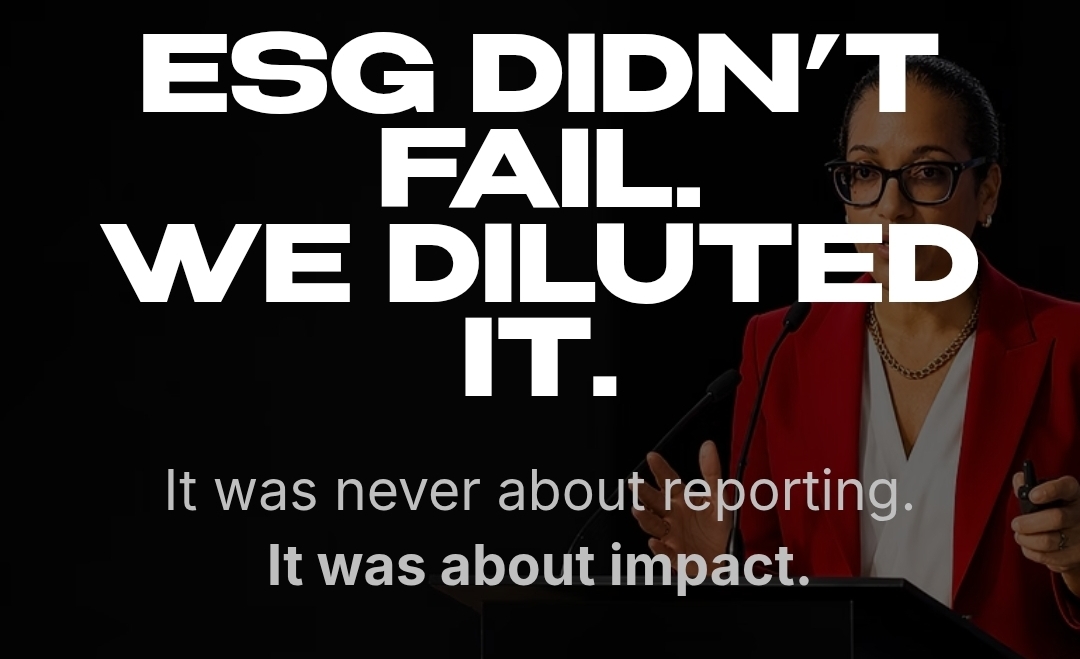
Op-ed by Therese Baptiste, CEO of BaptElis b.v. and author, Empowering Social Growth.
Somewhere between ambition and implementation, we replaced impact with optics, and in doing so, lost sight of who sustainability is meant to serve.
What began as a framework to guide responsible, sustainable decision-making has, in many cases, become an exercise in reporting, box-ticking, and branding. We shifted from outcomes to indicators. From impact to appearance. From people to paperwork.
And in doing so, we quietly stripped ESG of its most important dimension – the ‘S’.
In my work, and in my book Empowering Social Growth, I argue that ESG must be reframed. Not abandoned, not replaced, but refocused.
ESG should stand for Empowering Social Growth. Because sustainability without social impact is not sustainability at all. It is simply a more efficient version of inequality.
Today, we celebrate progress in electrification, renewable energy, and technological optimisation. These are important advances. But we rarely pause to ask a more fundamental question: Who is this progress actually serving?
Take the push toward electric vehicles. In countries like Belgium or the United Kingdom, incentives and infrastructure are accelerating adoption. But step back for a moment.
If someone switches to an electric car, can they realistically rely on it for long-distance, cross-border travel – say, from Western Europe to Eastern Europe, to countries like Romania – without disruption or compromise? If the answer is no, then what are we really doing?
Are we enabling sustainable mobility, or are we quietly reshaping behaviour in ways that push people toward alternatives like air travel for longer journeys? And if so, does that make environmental sense?
The sustainability lens
This is not an argument against electric vehicles. It is an argument against narrow thinking. Because sustainability is not about isolated solutions. It is about systems.
The same contradiction appears in our global push for hydroelectric power. Large-scale projects are celebrated as clean energy breakthroughs. Yet in many of the same regions, communities still lack access to safe drinking water.
How do we justify a world where we can power cities sustainably, but cannot provide basic human necessities sustainably? Again, the issue is not the technology. It is the lens through which we apply it.
We have become very good at designing solutions for the future. But too often, that future is accessible only to a minority. A ‘sustainable’ world that works for some, while excluding many, is not sustainable. It is selective progress. And selective progress, by definition, is unstable.
This is where ESG lost its way. The ‘E’ advanced rapidly. The ‘G’ became more structured. But the ‘S’ – the social contract between business, policy, and people – was reduced to a subset of metrics, often treated as secondary.
Yet it is precisely this ‘S’ that determines whether sustainability efforts endure or fail. If people cannot access, afford, or trust the solutions we design, they will not adopt them. And if they do not adopt them, we have not achieved sustainability – no matter how strong our reporting looks.
Reframing ESG
Reframing ESG as Empowering Social Growth forces a different conversation. It asks not just ‘Is this efficient?’ or ‘Is this compliant?’ but ‘Who benefits?’ and ‘At what scale?’ It shifts the focus from short-term achievements to long-term societal impact.
And it reminds us that sustainability is not a destination. It is a balance. A balance between innovation and inclusion. Between ambition and accessibility. Between progress and people.
If ESG is to mean anything again, we need to stop asking how well we are reporting it, and start asking who is actually benefiting from it.
Because sustainability was never meant to be a narrative. It was meant to be a shift. A shift that reaches beyond boardrooms, beyond early adopters, beyond those who can afford to participate – and into the lives of the many.
Until then, ESG will continue to look like progress on paper, while leaving reality largely unchanged. And that is not failure. That is dilution.
About the author
Therese Baptiste is the founder and CEO of BaptElis b.v., a consulting firm focused on sustainability, leadership, and social impact. A former Minister of Health and UN Ambassador for Trinidad and Tobago, she brings a global perspective to the intersection of ESG, governance, and development.
She is the author of Empowering Social Growth, in which she reframes ESG as a strategy for delivering measurable social impact at scale. The book is available on Amazon in both eBook and paperback formats. You can contact her here.