SustainabilityOnline recently published its inaugural ‘Ambition Into Action’ report, featuring interviews with senior leaders about how they are turning sustainability vision into business reality at the mid-point of the decade.
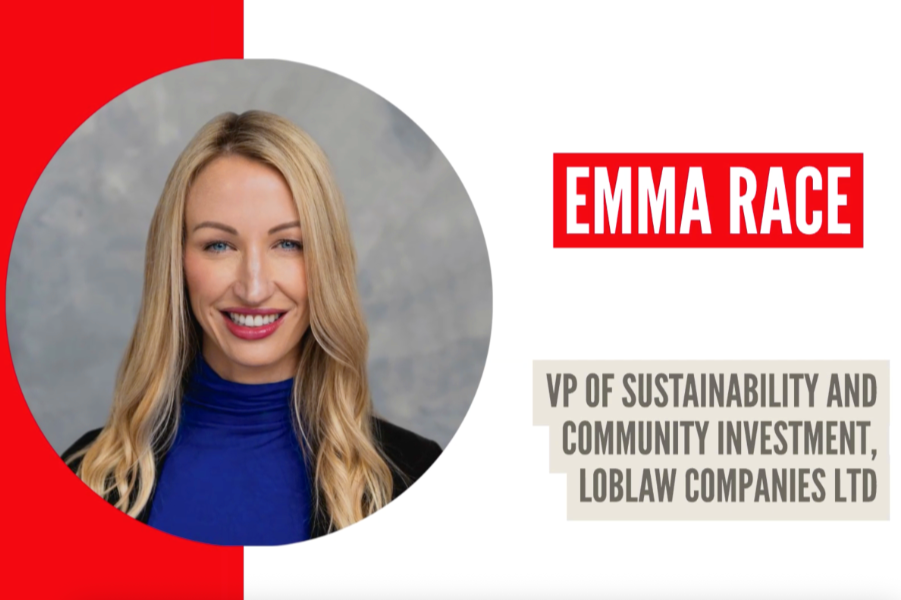
Emma Race has held the role of VP of Sustainability and Community Investment at Canada‘s Loblaw Companies Ltd since October 2025, and has worked with the retailer since 2022. She boasts around two decades’ worth of experience driving environmental and social impact across various sectors, at firms such as Rogers Communications and Mosaic North America.
How has Loblaw moved from ‘ambition to action’ in terms of turning sustainability into a core value driver – in other words, how have you made sustainability ‘good for business’?
At Loblaw, sustainability is fundamentally integrated into our business strategy, serving as a direct value driver. We’ve translated ambition into action by embedding measurable targets into our operations.
For example, we achieved our original goal of reducing corporate operating GHG emissions (Scope 1 and 2) a full decade early. As of 2024, we’ve delivered a 16% reduction from our 2020 baseline, even amidst significant store expansion. This commitment also drives operational efficiency, exemplified by our aim for zero food to landfill by 2030, which diverted over 80,200 metric tonnes of food waste in 2024.
Furthermore, our control brand plastic packaging is now over 90% compliant with the Golden Design Rules, mitigating waste and showing that change is possible at scale.
We’re now at the mid-point of the decade. What do you see as the single biggest barrier for businesses in moving from ambition to measurable action – and how can it be overcome?
The biggest barrier in moving from ambition to measurable action is effectively addressing our Scope 3 (value chain) emissions, which constitute approximately 97% of our total GHG footprint. The challenge lies in the sheer scale and indirect control over these emissions from purchased goods and services.
We are overcoming this by driving collective accountability across our supply chain. Through initiatives like our #JoinTheCarbonFight campaign, we are urging vendors to report emissions and have set a SBTi approved interim target: 70% of our suppliers (by volume/spend) must set Science Based Targets by 2027.
We’re making tangible progress, with 32% already achieved by 2024. Additionally, we’re working toward climate risk mitigation by supporting initiatives like the Canadian Alliance for Net-Zero Agri-food (CANZA), strengthening long-term resiliency of agriculture.
What role can (and should) leadership play in ensuring sustainability commitments actually deliver results, rather than remaining aspirational? And how can you ensure buy-in from all stakeholders?
Leadership is pivotal in transforming sustainability aspirations into measurable results by embedding robust ESG accountability throughout the organisation. Our Board of Directors and specialised committees, including the Risk and Compliance and Audit Committees, provide stringent oversight of our ESG strategy and disclosures.
Crucially, we’ve hardwired accountability through financial incentives: ESG performance constitutes a 10% criterion in our Short-Term Incentive Program (STIP) for all corporate colleagues, ensuring executive and organisational alignment. External stakeholder buy-in is secured through transparent reporting, backed by independent limited assurance on certain claims.
Within our supply chain, adherence to our Supplier Code of Conduct and access to our Integrity Action Line foster ethical engagement. Finally, leadership has cultivated a unified culture by training 198,000 colleagues on fundamental diversity, equity, and inclusion topics, ensuring broad commitment to our ESG objectives.
Learn more about Loblaw’s sustainability commitments at https://www.loblaw.ca/en/environment/