SustainabilityOnline recently published its inaugural ‘Ambition Into Action’ report, featuring interviews with senior leaders about how they are turning sustainability vision into business reality at the mid-point of the decade.
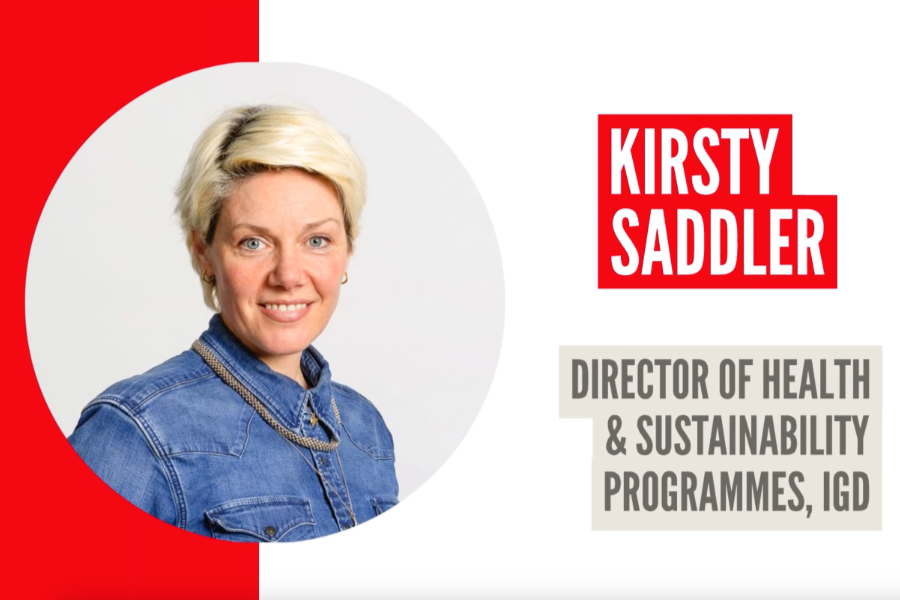
Kirsty Saddler has been Director of Health and Sustainability Programmes at IGD since May 2024, designing and leading programmes involving food industry businesses, academics, non-governmental organisations and government bodies. IGD is a member-based organisation serving the UK food and grocery sector, which brings together stakeholders from across the agrifood supply chain to address shared challenges.
How has IGD moved from ‘ambition to action’ in terms of turning sustainability into a core value driver – in other words, how have you made sustainability ‘good for business’?
IGD released A Net Zero Transition Plan for the UK Food System (NZTP) in November 2024, developed alongside WRAP and EY – the first national integrated system plan of its kind.
Evidence based, it had the pathways for how industry, government, and the wider system can deliver net zero by 2050 from supply and demand side actions. It highlighted two critical priorities: agriculture transition and population diet shift.
IGD delivered a Net Zero Training Programme for 25 senior commercial decision-makers from September to November. The programme was designed to helps leaders understand the importance of net zero, the key considerations for the agriculture transition and integrate them into everyday business decisions.
During 2025, IGD worked with a group of six manufacturers, to address the complexity of sustainability action and commitments in supplier and customer commercial relationships. From this, a Supply Chain Sustainability Framework was created. We worked with standard owners and expert organisations such as WWF and WRAP to identify the key actions to populate the framework.
IGD also developed a framework for population diet change, which identifies all of the levers available to support population diet change to move closer to the Eatwell Guide. The importance of the diet transition is key to Net Zero but also for improved health outcomes, as shown with the release of the new NDNS data last summer.
We’re now at the mid point of the decade. What do you see as the single biggest barrier for businesses in moving from ambition to measurable action – and how can it be overcome?
The greatest barrier to moving to measurable action is the failure to recognise the economic and commercial opportunity for the sustainable transition of the food system.
The food system is full of complexity, and businesses face fierce competitive pressures. At IGD, we represent the whole food system and take a system-wide view, recognising that meaningful change requires pre-competitive collective action across the entire value chain.
To overcome this, we must change the perception of sustainability as a cost to it being recognised as an investment and a driver of growth. Businesses need robust business casing that clearly quantifies value and costs, demonstrates improved resilience, and de-risks investment.
This means embedding sustainability into core strategy – by linking initiatives to efficiency, innovation, and long-term profitability, they become essential for competitiveness. The transition will require commercial investment and contribution from all stakeholders, but the rewards of more resilient supply chains, reduced risk, and future-proofed business models are clear.
What role can (and should) leadership play in ensuring sustainability commitments actually deliver results, rather than remaining aspirational? And how can you ensure buy-in from all stakeholders?
Leadership can be the inspiration and the catalyst for turning sustainability from aspiration into action. It needs to be progressed in the boardroom, through embedding sustainability KPIs at board level. This signals commitment and accountability, ensuring progress is measured and reported alongside financial and commercial performance.
Equally important is leadership across every function. Sustainability cannot sit in isolation, it requires cross-disciplinary teams from the outset to integrate goals into operations, supply chains, and commercial strategies.
This cultural shift positions sustainability as fundamental to resilience and long-term success, rather than a compliance exercise.
Beyond vision, leadership must deliver a robust, costed plan that drives collective action across all functions. Progress should be measured against broader metrics, such as resilience, efficiency, and good growth, ensuring that commitments translate into tangible results.
Learn more about IGD’s sustainability initiatives at www.igd.com/social-impact/sustainability.