Miya Knights on the role that technology can play in improving retailer efficiency and circularity
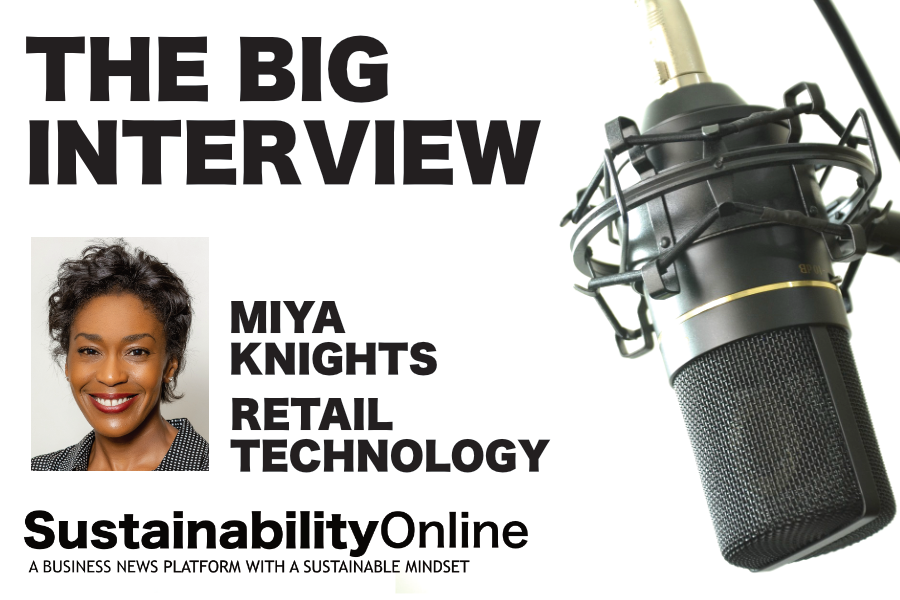
Miya Knights talks to SustainabilityOnline about the role that technology can play in improving retailer efficiency and circularity.

Miya Knights is widely recognised as a leading authority on retail technology, having co-authored books on Amazon (Amazon: How the World’s Most Relentless Retailer will Continue to Revolutionize Commerce, alongside Natalie Berg) and omnichannel strategy (Omnichannel Retail: How to Build Winning Stores in a Digital World, with Tim Mason).

Her latest book, The Future of Shopping – Using Digital, Data and AI to Win with Customers, is due for publication later this year, while she’s also the owner and publisher of Retail Technology magazine.

Following on from her recent interview with ESM: European Supermarket Magazine, in which she argued that retailers should continue to focus on their core principles, and use technology to support, rather than dictate, strategy, SustainablityOnline had the chance to speak to her about the role that technology can play in supporting retail sustainability.

“I’m seeing a lot of experimentation,” she explains, identifying improved efficiency as one of the most significant opportunities for retailers using AI to support sustainability goals. “AI can deliver immediate gains from an efficiency and productivity perspective. If you consider that machine learning is one of the earliest forms of AI, the supply chain is arguably the most mature area in this regard.”

AI-enabled technologies such as digital product passports are being utilised by high street retailers like Nobody’s Child to improve transparency and reporting, she notes.

“You feed all your data in one end, and it can be structured into a format that supports reporting and digital product passport requirements. However, the fashion sector still faces significant challenges when it comes to sustainability.”

Managing the trade-offs

While AI can improve efficiencies, it can also increase technology expenses, creating trade-offs rather than overall savings, Knights adds. She encourages retailers to focus on practical implementation of technology to achieve efficiencies.

“Right now, what we need to worry about is actually how to operationalise this and make it work for us, and get the efficiencies we need,” she says.

Sustainability in retail is increasingly tied to efficiency and operational resilience rather than being an abstract goal. However the market continues to evolve in line with consumer preferences, skewing some operators’ best-laid plans.

“I was recently in a meeting with James Sawley, head of lending for retail, travel, leisure and hospitality at HSBC in the UK, who has access to HSBC spending data,” says Knights. “He said that if you look at consumer card spending in the UK – across all HSBC debit and credit card users – and analyse non-food spending through 2025, around 50% of all growth in that category went to Chinese retailers; sites like Temu. So, there are lots of push and pull factors at play.”

Circular economy

Automation, she adds, is becoming increasingly important to enable retailers to sift through the noise and maintain consistent messaging for consumers, particularly when it comes encouraging circular economy behaviours.

“For example, the retailer that is able to operationalise buyback schemes on clothing – whether through points or other incentives – to drive more sustainable circularity within their business is likely to win more customers, particularly among Gen Alpha, and retain them for longer – potentially for a lifetime. That’s where technology plays a key role.”

She points to Goodwill in the United States, the social enterprise non-profit, which has employed AI to enable staff to better assess the products that they handle.

“They’ve just introduced an AI-based system that helps store associates, who are often volunteers, to price and identify the provenance of products. It’s a really interesting development – they’ve built the software in-house and are now making it available to other Goodwill locations across the US.”

Examples such as this demonstrate how technology and strategic incentives are reshaping resale and circular commerce, and as new players enter the market, more sophisticated, consumer-friendly approaches are likely to emerge, further accelerating sustainability opportunities for retailers.

“It’s definitely the direction of travel,” says Knights. “I hope we see more of it.”

The Future of Shopping: Using Digital, Data and AI to Win with Customers’ is due to be published in September. Miya Knights is an expert retail speaker with the Champions Speakers Agency; for more information, visit www.champions-speakers.co.uk.

Discover more from Sustainability Online

Subscribe now to keep reading and get access to the full archive.

Continue reading