Op-ed by Clemens Feigl, CEO and co-founder, everwave.
The global plastic crisis is often framed as a recycling problem. However, this perspective falls short.
It is, in fact, an infrastructure problem: in regions where basic systems for the collection, sorting, and processing of waste are lacking, plastic inevitably becomes an issue. It enters the environment via open dumps and river systems, ultimately reaching the oceans.
Stopping plastic in rivers interrupts this pathway at the last controllable point. Yet cleanups alone do not solve the problem.
The structural gap
Recycling is an important part of the solution – at least where functioning systems exist. However, this is what is missing in many emerging and developing markets: collection structures are fragmented, sorting is incomplete, and economic incentives for recovery are absent.
As recycled materials remain more expensive than new plastic, investment in waste management is limited. The result is systemic leakage: plastic enters the environment because it is not collected at scale. It is both an infrastructure gap and incentive gap.
Where waste has no value, neither collection systems nor infrastructure emerge. Closing this gap requires mechanisms that assign value to waste and translate it into operational systems.
What are Plastic Credits and how do they work?
This is where Plastic Credits come into play. They create economic value for waste and thereby form the basis for functioning waste management. The principle is simple: one credit represents a defined quantity of collected and processed plastic.
Companies finance corresponding projects and receive a verified unit documenting this achievement. At everwave, one credit equals one kilogram of collected plastic waste.
What matters is not just quantity, but traceability. Each Plastic Credit is linked to a specific project, geographically located, time-stamped, and traceable via weighbridge tickets and digital systems. This creates a continuous record of material flows – from collection to processing.
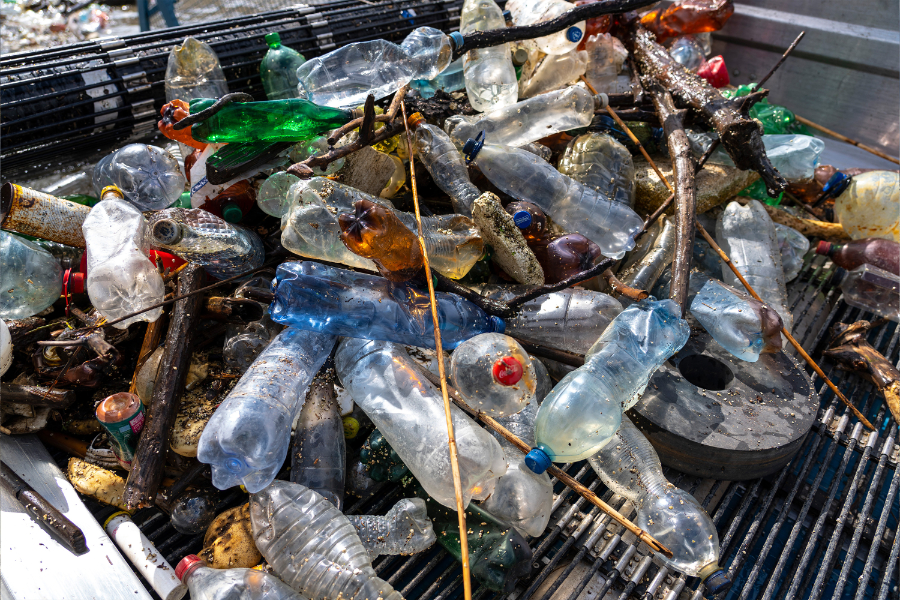
Waste is intercepted as far upstream as possible within river systems, before reaching the ocean. Collection boats remove the material; it is then sorted and transferred into regional processing systems. Recyclable plastics return to the material cycle, while other fractions are directed – where appropriate and compliant with standards – into further recovery pathways. The focus is not removal alone, but controlled integration into robust waste management.
Companies use Plastic Credits within sustainability and compliance strategies, such as ESG reporting or to address plastic footprints beyond their direct operations. This is particularly relevant for industries such as consumer goods, hospitality, and energy, where global supply chains and packaging volumes make full control over material flows difficult.
Why Plastic Credits are not simply offsetting
At first glance, Plastic Credits resemble CO₂ compensation models. However, their logic differs fundamentally. Carbon offsets rely on calculated balancing and are increasingly criticised, due to unclear measurability and reliance on assumptions.
Plastic Credits, by contrast, finance tangible processes: the collection, sorting, and processing of waste. A credit therefore does not represent an abstract counterbalance, but a verifiable action on the ground. The focus is not on accounting compensation, but on building operational capacity.
From cleanup to system logic
The real impact of Plastic Credits extends far beyond waste removal: they finance tangible infrastructure and enable stable and scalable collection and processing systems.
Individual measures evolve into repeatable systems with local structures, defined processes, and increasing efficiency. The focus shifts from one-off waste removal to long-term integration. This approach has several effects:
- Operational scalability: processes can be standardised and expanded
- Local value creation: jobs are created under defined safety and social standards
- Data-driven management: volumes, material types, and seasonal patterns become measurable
Plastic Credits do not replace the circular economy or producer responsibility. They close an operational gap, particularly where public systems are lacking.
Regulatory context – rising requirements in the UK and Europe
This distinction is becoming increasingly relevant from a regulatory perspective. Instruments such as Extended Producer Responsibility (EPR) and the Plastic Packaging Tax are making responsibility across the value chain more concrete.
At the same time, European frameworks such as the Corporate Sustainability Reporting Directive (CSRD), the planned Packaging and Packaging Waste Regulation (PPWR), and the Green Claims Directive are tightening requirements for transparency and verifiability.
For companies, this means environmental impact must be measurable, auditable, and clearly documented. Purely marketing-driven measures are losing legitimacy. Yet while regulatory pressure is increasing in Europe, waste volumes are growing elsewhere.
Here, the structural gap becomes evident: regulation operates primarily at a national level, whereas the plastic crisis is global. A significant share of environmental impact arises in regions without functioning waste infrastructure, beyond direct regulatory reach. This is where Plastic Credits realise their potential. They enable investment in operational solutions where public systems are absent, complementing regulation rather than replacing it.
Infrastructure instead of symbolism
Plastic Credits are not a silver bullet. However, they address a key weakness in the current debate. Viewing them solely as a cleanup tool underestimates their potential; classifying them as a compensation mechanism misunderstands their function. Their value lies in building systems and enabling a functioning circular economy.
The plastic crisis is not merely a waste issue. It is an infrastructure issue. And infrastructure emerges where financing, technology, and local implementation come together.
Learn more at www.everwave.de/en/.