NVIDIA’s Josh Parker on how AI can turn business efficiency into sustainable impact
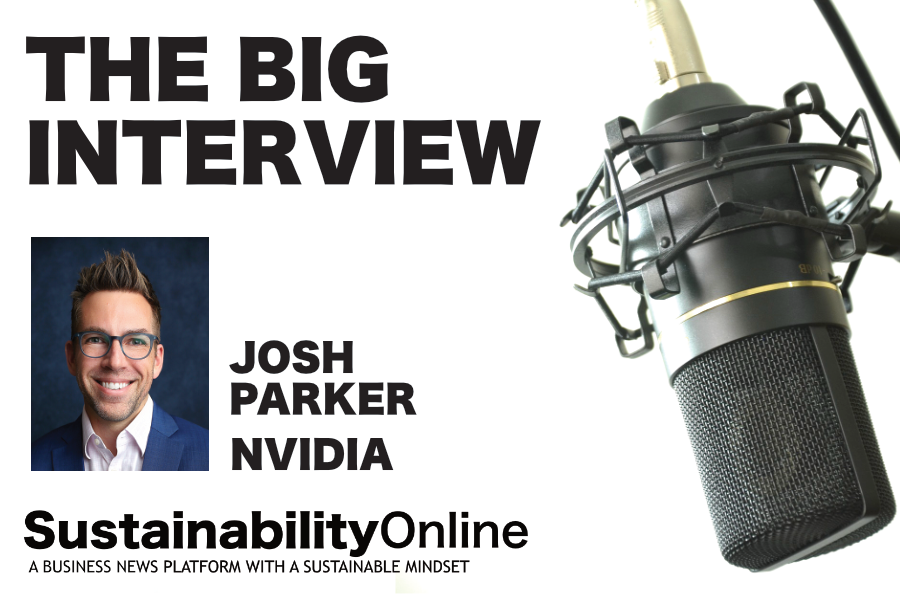
Josh Parker, head of sustainability at chipmaker Nvidia, talks to SustainabilityOnline about how AI can help transform business efficiency into sustainable impact.

In April of this year, NVIDIA surpassed a $5 trillion market capitalisation, becoming the world’s most valuable company. The chipmaker’s rapid growth in recent years has been driven by rising demand for data centres and advanced artificial intelligence capabilities – a trend that shows no signs of slowing as we head towards the second half of 2026.

As it has grown, NVIDIA has sought to embed sustainability across its operations. The company has achieved 100% renewable electricity usage across the offices and data centres under its operational control and is on track to deliver a 50% reduction in Scope 1 and 2 emissions by the end of the decade.

Scope 3 emissions, however – largely driven by customer-operated data centres run by companies such as AWS, Google, and Microsoft – present a more significant challenge. In response, NVIDIA has invested in new GPU architectures designed to power advanced AI and accelerated computing more efficiently. As the company notes, its Blackwell architecture, launched in 2024, delivers approximately 25 times greater energy efficiency for large-scale AI models compared with previous generations.

“We must design AI factories where extreme performance and energy efficiency aren’t a tradeoff,” CEO Jensen Huang noted in NVIDIA’s recent Sustainability report.

Finding a balance

At the recent Economist Impact Sustainability Week Summit in London, SustainabilityOnline caught up with Josh Parker, head of sustainability at NVIDIA, to discuss how the ‘backbone of the AI boom’, as the company has been dubbed, is balancing unprecedented growth with its sustainability commitments.

Parker joined the chipmaker in 2023 from Western Digital, where he played a central role in developing the firm’s sustainability programme – a task he has repeated at NVIDIA.

“I’ve been at NVIDIA for almost three years now, and I love it,” he says. “It’s a really exciting role, in part because I feel like we’re at a time now where there have been so many challenges around sustainability that it can seem overwhelming. But I think in the age of AI, we have more reason to be optimistic than ever about technological solutions to sustainability challenges.”

At the Economist Impact summit, Parker participated in a panel entitled ‘Decarbonising Data – AI’s energy footprint’, which weighed up whether the positive impacts of artificial intelligence – improved efficiency, greater transparency – will outweigh the negatives, such as the significant energy consumption required to power said technology. As you might expect, he’s optimistic about AI’s potential.

“We are seeing very significant near-term improvements in sustainability outcomes with AI, because one of the most accessible features of AI is optimisation,” he says.

“So, if you take that kind of low-hanging fruit superpower of AI and ask ‘how is this impacting the economy’, we’re seeing very significant energy efficiency improvements, not just in data centers, but in other sectors as well, like manufacturing, buildings and transportation. These are energy efficiency improvements in the range of 10% to 30%, which are very significant.

“It’s an obvious use case for AI, but it’s already having really profound impacts on energy and on efficiency.”

Energy efficiency

At NVIDIA, Parker says that fostering innovation to improve energy efficiency in AI is “fundamental” to its business, referencing a recent quote from the firm’s chief executive on performance per watt being the chipmaker’s ‘metric of success’.

“That’s not just because our customers really care about energy efficiency and the costs associated with energy efficiency,” he says. “In order to enable the next level of performance in AI, we need to be doing more with each watt, offering more tokens, and achieving more intelligence per watt, so that the hardware can deliver the ‘next big thing’ in AI innovation.”

He cites a 50,000-fold improvement in inference efficiency over the past decade, and a 97% reduction in inference energy use over the past two years, as NVIDIA migrated from Hopper to Blackwell architecture.

“That type of innovation has been very consistent and has had a dramatic effect in terms of enabling the next level of AI.”

In terms of addressing Scope 3, Parker notes that the transition to clean energy across NVIDIA’s upstream and downstream value chain represents the most immediate near-term opportunity, with many of its customers already making significant progress in that direction.

“Some of our largest customers have the most ambitious climate commitments, and have been the largest purchasers of renewable energy now for several years,” he says. “Also, a majority of our large suppliers, have strong climate commitments and are pursuing clean energy.

“For a lot of them, it’s a long term challenge, because of where manufacturing happens and availability of renewable energy. But those are problems that we know how to solve. So, the near term priority is transitioning the ecosystem upstream and downstream over to clean energy. And based on the modelling that we’ve done, that will have a very profound impact on the lifecycle emissions for AI.”

Additional benefits

Along with energy efficiency, materials efficiency is another potential benefit from AI, with digital modelling and tools such as digital twins reducing the need for physical production, lowering costs and resource use.

“As with energy efficiency, materials efficiency is very much aligned with business fundamentals, where you can drive sustainability at the same time as you’re driving business results.”

Allied to this, AI applications that support sustainability outcomes directly are becoming more commonplace, such as climate modelling and recycling systems. “It really empowers innovators in the sustainability landscape to do much more with fewer resources and fewer technical resources as well,” Parker adds.

Given its importance in powering the AI revolution, NVIDIA also has a role to play in engaging with governments and policymakers. As Parker explains, this engagement typically involves education about AI, including its requirements, benefits, and broader societal impacts – including its potential for powering sustainability.

“AI is not a good substitute for policy,” he says. “It’s a good complement to policy. And it can enable policy goals, because it’s a powerful tool.”

Read NVIDIA’s latest Sustainability Report here.

Read More: National Grid trial showcases power adjustment capabilities of data centres

Discover more from Sustainability Online

Subscribe now to keep reading and get access to the full archive.

Continue reading