‘Stand Up and Fight’ is more than just a slogan at Munster Rugby – it is embedded in the club’s day-to-day operations, both on and off the pitch.
That commitment extends to sustainability initiatives, with Munster Rugby appointed as an SDG Champion for 2025–2027 as part of Ireland’s national SDG Champions Programme. Elsewhere, the club’s new Cork Centre of Excellence, which opened last October, received the Best Climate Resilience Award at the 2025 Cork Better Building Awards.
More recently, Munster Rugby was shortlisted in the Best Initiative to Promote Sustainability in Sport category at the 2026 Federation of Irish Sport Industry Awards.
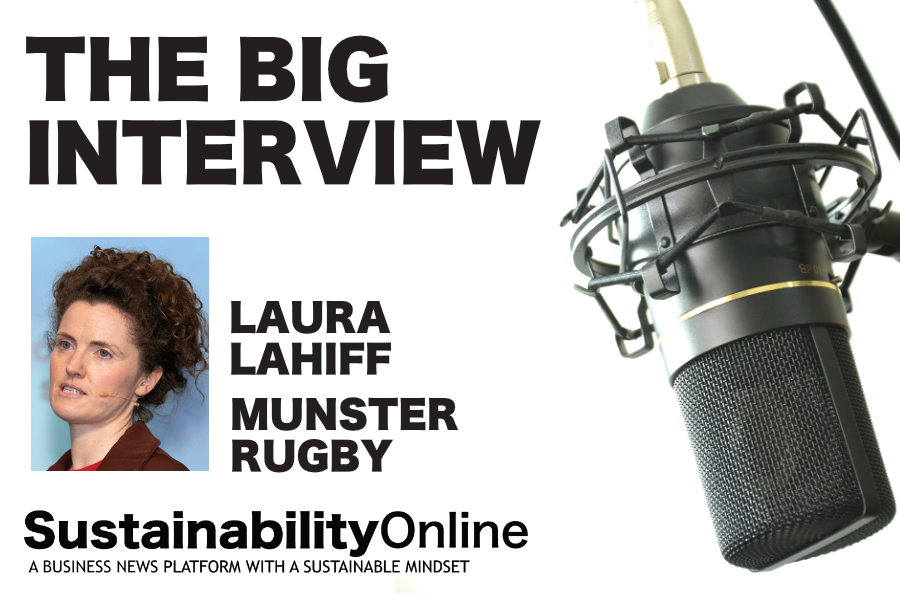
For Laura Lahiff, sustainability lead at Munster Rugby, embedding climate action into the club’s culture, operations, and decision-making depends on engagement, collaboration, and practical action. At the recent Business Post ESG & Sustainable Business Summit in Dublin, Lahiff spoke on the topic of ‘Building buy-in: communicating sustainability so it sticks’, focusing on how sport can connect sustainability with community identity and purpose through storytelling and shared action.
SustainabilityOnline caught up with her at the summit, and started by asking how Munster Rugby defines sustainability in a tangible, relatable context.
“It’s tricky, because people don’t like to be educated or told what to do, whether in sport or outside of sport,” she says. “It’s a question of how do you engage with it in such a way that people feel like it’s something they can do. Often in sustainability, we try and tackle the big challenges, but you have to break it down into small steps, where people can participate easily.”
Climate commitment
With a background in engineering, environmental policy and international project management, Lahiff joined Munster Rugby in 2022, and set to work developing and implementing the club’s Climate Transition Action Plan, through which it is committed to halving carbon emissions by 2030 and reaching net-zero by 2040, in line with the UN Sports for Climate Action Framework.
“We started where everybody else starts, which was with the data, and knowing where we were at,” she says. “When we signed up to the UN Sports for Climate Action Framework, that network opened us up to other sports organisations, and a very collaborative way of understanding the role sport can play in sustainability.
“The main area where sport can have an impact is through the ripple effect — how we bring others with us. The massive public profile that we have, and the influence that we have – that’s the power of sport. So, how do you tap into that? How do you use that?
“Of course we have to lead by example and try to reduce our own emissions, but it’s really not just about that. It’s about using our influence well. That’s where the real power of sport is.”
Practical engagement
Consumers – whether Munster supporters or otherwise – don’t want to be lectured when it comes to sustainability, so engagement, where it occurs, needs to be practical and measured. Player-led content, such as out-half Jack Crowley’s role as brand ambassador for Pinergy, can play a role, as can Munster’s deep-rooted sense of community.
“Most people think about Munster as the men’s professional team, but we’re also a branch of the IRFU (Irish Rugby Football Union), which means we are across 67 clubs, and 300 schools,” says Lahiff. “We have a massive network. And that’s where we can help to make it real.
“We have rugby development officers and coaches working alongside volunteers, and that’s where it becomes much more community-led and community-focused. How do we help clubs to help themselves? How do we build pathways not just for young players coming through, but for people to engage more deeply within their own communities? That’s all part of sustainability.”
Sustainability storytelling
As was discussed previously in our interview with Liverpool Football Club’s Rishi Jain, effective sustainability storytelling in sport depends on using accessible language, outlining practical actions, and openly discussing challenges and setbacks. This mindset has also been adopted at Munster Rugby, as Lahiff explains.
“Language is important, and there’s also the visual piece,” she says. “People will engage with visuals before they’ll read anything, so showing people what the action is that you want them to take immediately gets attention.
“There is an element of showing people what you have done in terms of best practice, but there needs to be that storytelling aspect behind it – here’s what we’ve done, here’s what we’re trying to do, and being honest that it’s hard. Not everything went to plan – here’s what didn’t work. That actually makes it a little bit more real for people, that it doesn’t have to be perfect.
“And that’s the essence of sport itself. You don’t win every match. You don’t win every tournament. It’s about picking yourself up and going again. That’s what sustainability is too – there are going to be setbacks, and you need to pick yourself up and keep going.”
On public expectations, she adds that some supporters already see sustainability as a requirement for sports organisations, while others remain less engaged.
“It’s not always the same message for everybody, and no one story will be able to reach everyone,” she says. “So it’s about changing it up across what we do, and how we engage, because there’s science that suggests that if you can get to 25% of people, they will bring the rest of the 75% with them.
“If we focus on who is interested, or who we can reach, or who we can engage with, it will build outward from there.”
Munster March
Travel is the largest contributor to Munster Rugby’s emissions, with supporter travel to matches accounting for the majority of emissions – “when you fill up Thomond Park (Munster’s home ground) every few weeks, that’s a lot of cars on the road,” says Lahiff.
The club has reduced Scope 1 emissions by transitioning much of its in-house vehicle fleet to electric cars – electrifying more than 800,000 kilometres in a single season – particularly for rugby development officers who travel extensively across the province.
In terms of supporter engagement, low-cost initiatives such as the ‘Munster March’ campaign with Adidas, which encouraged supporters to walk to matches, helped reduce travel emissions while also engendering community behaviour.
“That started in the 2023/24 season, we had our supporters walking out from the centre of Limerick to the stadium – about a half hour walk,” says Lahiff. “When we showed others what we were doing, they thought it was a great idea – the Red Army all on the move together.
“That has grown organically – this season, the players also walked to the stadium in Bath and Toulon. The supporters love when the player connection is there, and the players feed off the energy of that.”
Measured impact
Elsewhere, Munster Rugby’s Cork Centre of Excellence reflects the club’s community-first approach, acting as both a high-performance rugby centre, but also as a shared resource for schools, soccer academies, GAA clubs and wider community sport initiatives.
“That’s very Munster Rugby – that’s what we’re all about,” says Lahiff. “Sport is very good at taking these sort of actions – the social impact and community work that goes on in sport is off the charts. And when you think of the outcomes that are there across society: you’re tackling inactivity, you’re getting kids off their devices, you’re allowing them to make friends, you’re building communities.”
While this is undoubtedly a positive, she adds that sport, in general, isn’t very good at measuring this impact.
“We don’t always showcase it well enough, and we don’t always engage our partners in that way. That’s really the next step for sport,” she adds. “It’s about delivering impact within communities and working alongside partners, as well as public sector bodies and government departments. How do we bring the power of sport down to community level? That’s where the real opportunity lies.”
Learn more about Munster Rugby’s sustainability commitments at www.munsterrugby.ie/the-club/sustainability/