SustainabilityOnline recently published its inaugural ‘Ambition Into Action’ report, featuring interviews with senior leaders about how they are turning sustainability vision into business reality at the mid-point of the decade.
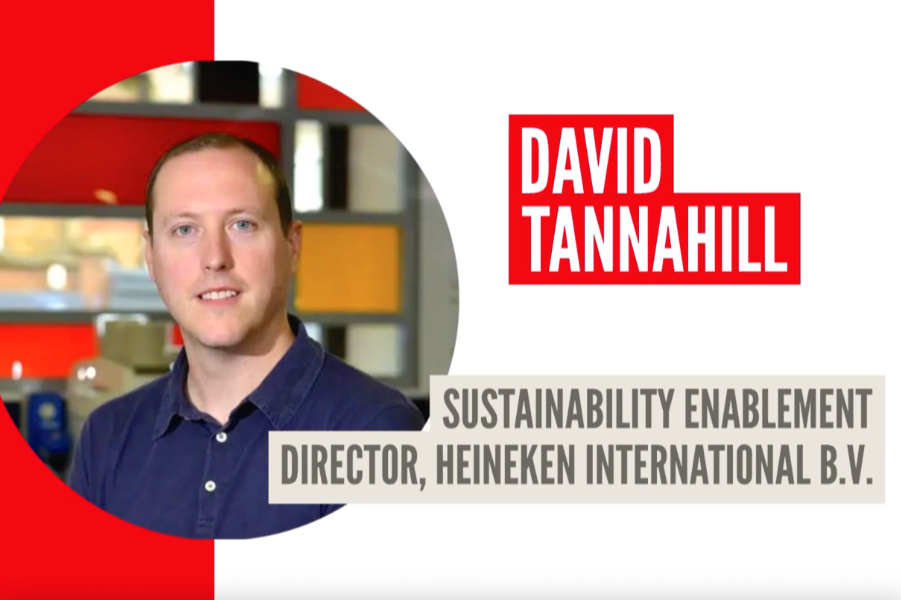
David Tannahill has held the role of Sustainability Enablement Director at Heineken International since October 2022, focusing on driving sustainability through business and digital transformation. A chartered accountant, his career has seen him work across finance, corporate restructuring, corporate finance, and transaction services.
He has worked with Heineken for 12 years in various roles, where he has led large-scale ERP and S/4HANA deployments, supported acquisitions and integrations, and overseen end-to-end design of European finance and performance management solutions.
How has Heineken International’s business moved from ‘ambition to action’ in terms of turning sustainability into a core value driver – in other words, how have you made sustainability ‘good for business’?
Our sustainability strategy, which we call Brew a Better World (BaBW), is embedded in our balanced growth strategy, EverGreen 2030. Our BaBW approach has three pillars – responsible, social and environmental – each of which have ambitions and goals. Over the past five years, we’ve transformed complex challenges into measurable actions that deliver business value.
Brew a Better World is Heineken’s approach to doing business the right way, to ensure we’re fit for the future and support growth and productivity.
We’re now at the midpoint of the decade. What do you see as the single biggest barrier for businesses in moving from ambition to measurable action – and how can it be overcome?
We recognise that progress is never linear, and it’s clear that there is no single barrier preventing businesses from moving from ambition to measurable action. Instead, progress is constrained by a combination of interconnected challenges – technical, financial, regulatory, and market-specific – that play out differently across geographies and value chains.
For instance, for Scope 1 and 2, the key challenge is the limited availability and economic viability of solutions, particularly for renewable thermal energy, alongside inconsistent enabling policies across markets. For Scope 3, where the majority of emissions sit, the barrier is the complexity of influencing and aligning extended value chains. Achieving progress requires deep, long-term collaboration with suppliers, customers, and partners – systems and relationships that take time to build and scale.
The 2026 update to our strategy acknowledges these realities. We have learned that overcoming such barriers demands continuous learning, adaptation, and – most importantly – collaboration. Our approach is to work closely with suppliers, customers, peers, communities, and regulators to co-create scalable solutions and drive systemic change.
For example, our regenerative agriculture projects, like Project Transitions in France, have helped more than 400 farmers adopt practices that improve soil health, water retention, and carbon sequestration, covering 70,000 hectares by 2025.
Transparency and accountability are essential. We report on our progress, benchmark against industry standards, and engage stakeholders at every level. This openness helps maintain momentum and trust, even when the path forward is complex.
What role can (and should) leadership play in ensuring sustainability commitments actually deliver results, rather than remaining aspirational? And how can you ensure buy-in from all stakeholders?
Leadership is pivotal in ensuring that sustainability goals deliver results first and foremost by putting robust governance in place. Strong governance shapes both the direction of the strategy and the discipline of delivery, ensuring that senior leaders across the business are involved in the right way, at the right moments.
At the top, sustainability is anchored through formal governance bodies, including the Supervisory Board Sustainability & Responsibility Committee and the Executive Sustainability & Responsibility Committee, chaired by the CEO and comprising senior Executive Team members from across the business. These forums provide strategic oversight, set priorities, and hold the organisation accountable for progress.
Execution is then driven through operational working groups across the three sustainability pillars, ensuring cross-functional ownership and day-to-day delivery. This is further reinforced through a clearly defined sustainability operating model, where roles and responsibilities for all Brew a Better World KPIs are explicitly assigned at Global, Regional, and OpCo levels. This clarity ensures accountability is embedded throughout the organisation – not concentrated at the centre.
Driving buy-in requires both formal incentives and continuous engagement. From the top, leadership commitment is reinforced through long-term incentive plans (LTIPs), with three sustainability KPIs (Carbon, Water and Gender) directly linked to executive remuneration – sending a clear signal that sustainability performance is as important as business performance.
Equally important is the way buy-in is built across the organisation. Rather than cascading targets in isolation, we focus on co-creating delivery plans with regions and OpCos, reflecting local realities while staying aligned to global ambition. Progress is assessed together, enabling shared ownership, course correction, and collective problem-solving.
In combination, strong governance, clear accountability, aligned incentives, and continuous engagement ensure sustainability commitments are not only credible – but deliverable. Our ‘Together We Can’ ethos reflects a culture of collective action, mobilising global teams, suppliers, customers, and consumers to champion change.
Sustainability is not a side initiative – it is integrated into performance, culture, and growth. At Heineken, we are proud of the progress we have made, but we know that the journey from ambition to action is ongoing. By embedding sustainability into our business, collaborating across our value chain, and engaging stakeholders at every level, we are brewing a better world – one that is good for business, people, and the planet.
Learn more about Heineken’s sustainability strategy at www.theheinekencompany.com/sustainability-and-responsibility.