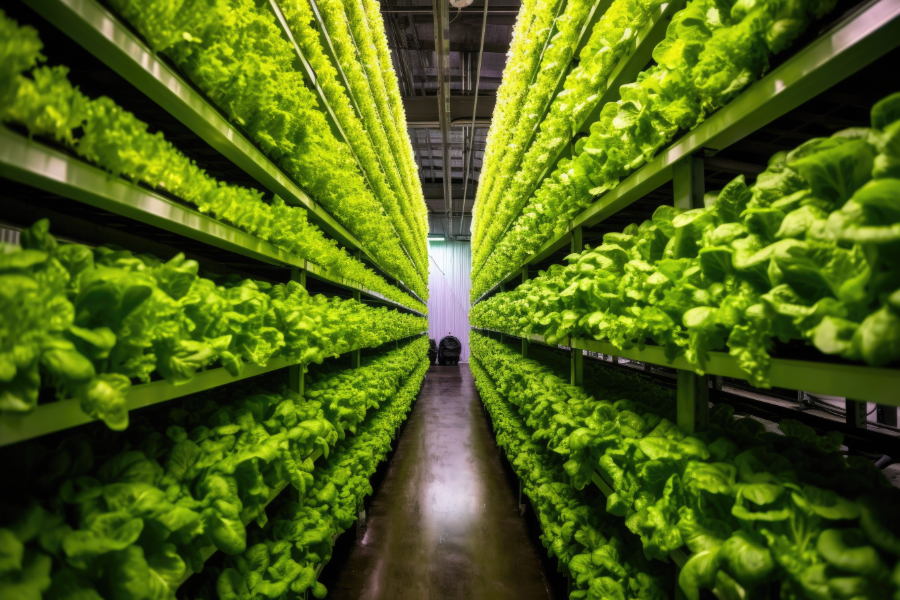
Is vertical farming really a sustainable alternative to field-grown crops? That’s the subject of a new study led by the University of Surrey, which examined the carbon footprint of lettuce production in both vertical and field-based farms in the UK and Spain.
The study, A Comparative LCA of Field Grown Lettuce Versus Vertically Farmed Lettuce, which was published in the Food and Energy Security journal, found that vertical farms can ‘dramatically increase lettuce yields’, producing as much as 97 kilograms of lettuce per square metre (compared with 3.3 kilograms from field farms), while water use is also as much as eight times lower.
Higher emissions
At the same time, however, greenhouse gas emissions associated with vertical farming remain higher than traditional farms. Even when powered by renewable electricity, vertically farmed lettuce produced about 0.93 kilograms of greenhouse gases for every kilogram grown, compared with 0.57 kilograms for traditional field-based farms, the study found.
Much of this impact was linked to the energy requirements of vertical systems and the use of fibrous blocks made from jute stems as a growing material. According to the researchers, switching to alternative growing materials, such as coconut coir, could cut the land-related footprint of vertical farms by more than 95%, enabling said farms to significantly reduce their environmental impact.
‘Potential to transform’
“Vertical farming has the potential to transform food security in the UK, particularly as climate change and seasonal drought place growing pressure on traditional agriculture,” commented Michael Gargaro, postgraduate research student.
“Our research shows that while the technology can bring far higher yields and reduce water use, it currently comes with a higher carbon cost. The challenge now is to make vertical farming more energy-efficient and better integrated with renewable systems, so that it can become a truly sustainable solution.”
Elsewhere, Dr Zoe Harris, co-director of the Institute for Sustainability at Surrey, suggested that vertical farming can play an increasingly important role in UK food security in the future, given that 95% of lettuce is imported from Spain during the winter months.
“But to viably compete with field farming, vertical farms must cut their energy use and rethink the materials they rely on,” she said.
The research was funded by the Biotechnology and Biological Sciences Research Council and the Engineering and Physical Sciences Research Council. Read more here.