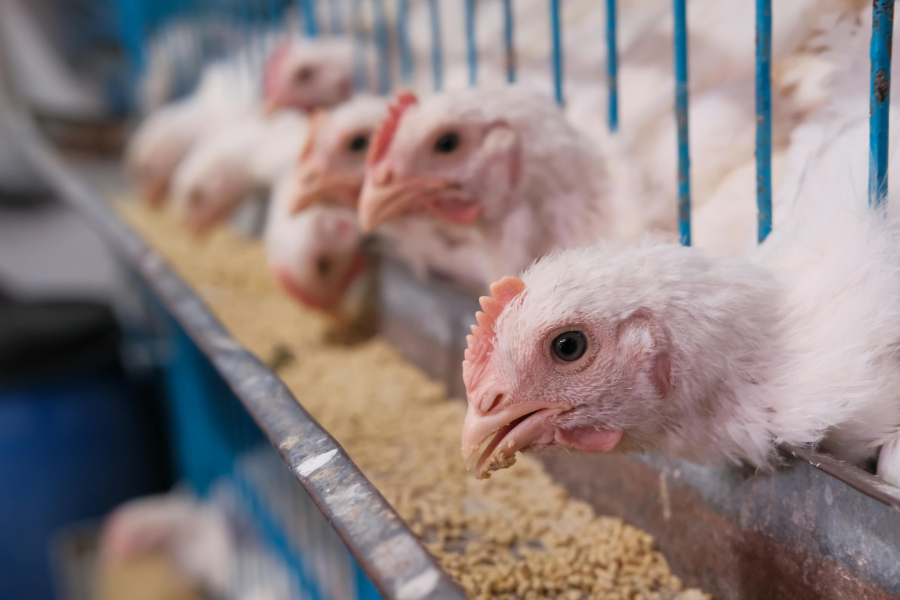
Factory farming contributes the most to global food waste, ahead of households, foodservice or retail, a new report by Compassion in World Farming to coincide with World Food Day (16 October) has claimed.
According to Compassion in World Farming, an extra two billion people could be fed each, year, while an area almost the size of Mexico would be freed up to grow food, if the feeding of grain to factory-farmed animals was ceased.
Its report, Food not Feed: How to stop the world’s biggest form of food waste, highlights what it describes as the ‘inefficiency’ of feeding grain to animals to produce meat or dairy, claiming that for every 100 calories of human-edible grain fed to animals, between 3 and 25 calories of meat are produced.
Improving food security
‘If we reduced this waste by switching to regenerative farming, with animals fed on products humans cannot eat – such as pasture, by-products and properly treated, unavoidable food waste or scraps – global food security would be vastly improved,’ Compassion in World Farming noted.
“It is simply scandalous that while hundreds of millions of people go hungry and we face a triple planetary crisis, we are allowing hundreds of millions of tonnes of food to be wasted every year by being fed to factory farmed animals,” commented Peter Stevenson, chief policy advisor at Compassion in World Farming.
“As well as being the world’s biggest form of animal cruelty, fuelling climate change and killing nature, factory farming wastes food on a colossal scale, undermining global food security.”
Food waste
Findings from the study indicate that at a a global level, some 766 million tonnes of grain is ‘wasted’ by being fed to farmed animals each year. Conversely, households waste around 631 million tonnes of food each year, with foodservice and retail wasting 290 million tonnes and 131 million tonnes respectively.
It added that close to 15 million hectares of arable land could be released to grow food for people in the EU, if the use of grain to feed factory-farmed animals was halted, while in the US, some 7 million hectares would be released.
“Governments must stop propping up wasteful grain-based factory farming with public money through subsidies and adopt fair policies that prioritise food over feed,” Stevenson added, “If we fed crops directly to people instead of to animals used to produce meat or dairy, we could feed an astonishing 2 billion extra people every year.” Read more here.