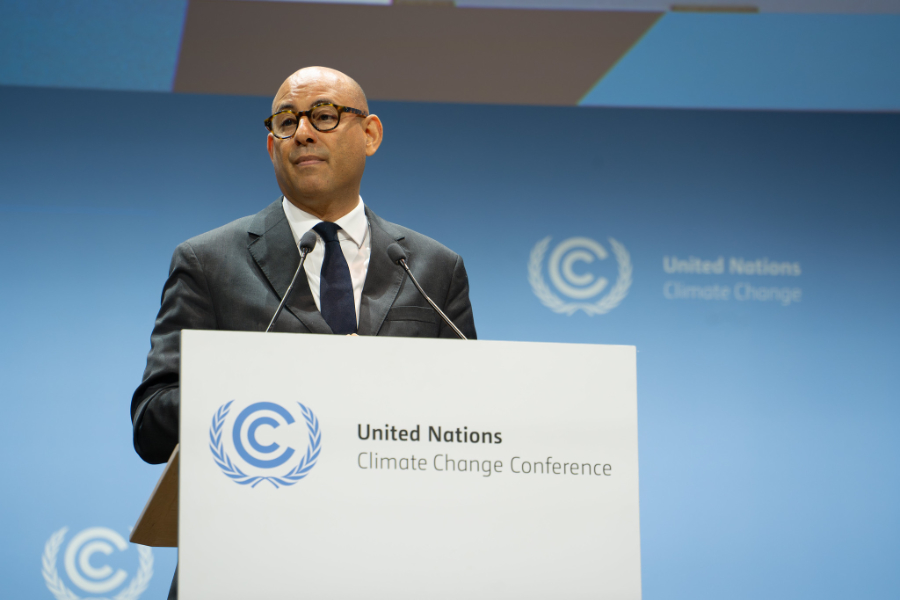
A continued dependancy on fossil fuels means “continuing to import inflation and economic instability, while exporting energy security, sovereignty and policy autonomy”, UN climate chief Simon Stiell has told the opening of the UN June Climate Meetings (SB64) in Bonn, Germany.
Speaking at the meetings, which run until 18 June and are expected to welcome more than 7,000 participants, including government negotiators, businesses, investors and civil society organisations, Stiell said that the ongoing war in the Middle East has led to a “fossil fuel cost crisis that’s strangling economies”.
In addition, he referenced the growing impacts from El Niño, which, “supercharged by the climate crisis, promise further suffering and inflationary shocks.”
He also called for greater coordination to help nations most affected by climate change, adding that “leaving economies and communities exposed to climate disasters will take a wrecking ball to lives and prosperity everywhere”.
Key priorities
Among the key priorities for the Bonn talks are negotiations on the Global Goal on Adaptation, the development of adaptation indicators agreed at COP30 in Belém, measures to elevate the Global Climate Action Agenda, and the implementation of the outcomes of the first Global Stocktake under the Paris Agreement.
Financing the transition is set to be another core discussion point – “from the climate finance work programme to the Adaptation Fund,” said Stiell – with more focus needed on reducing the reporting burden on countries.
Discussions taking place in Germany will also help to shape the agenda for COP31, which is due to take place in Antalya, Türkiye, later this year.
Climate Action Network
Elsewhere, Climate Action Network (CAN) has called on those in attendance at the Bonn climate talks to move beyond political posturing and deliver concrete action on the just transition, adaptation finance and the global shift away from fossil fuels.
The network, which represents more than 2,500 civil society organisations, noted that the negotiations are taking place against a backdrop of global crises, adding that the talks represent an opportunity to ‘bed down’ on several core commitments.
“We need climate action that working people can actually believe in and benefit from,” commented Anabella Rosenberg, senior advisor on just transition at Climate Action Network International. “At COP30, governments finally acknowledged what trade unions, Indigenous Peoples, social movements, and frontline communities have been demanding for years: climate action will not succeed if it deepens inequality or leaves workers and communities to absorb the costs alone.
“Now the fight moves to Bonn where governments need to show that they are serious about lives and livelihoods – and that means delivering a mechanism that puts resources to support people at the heart of the transition, not just in the footnotes.” Read more here. [Photo: UN Climate Change | Lara Murillo]