Just under half (49%) of new city buses introduced in the European Union last year were zero-emission vehicles, new data from Transport & Environment (T&E) has revealed.
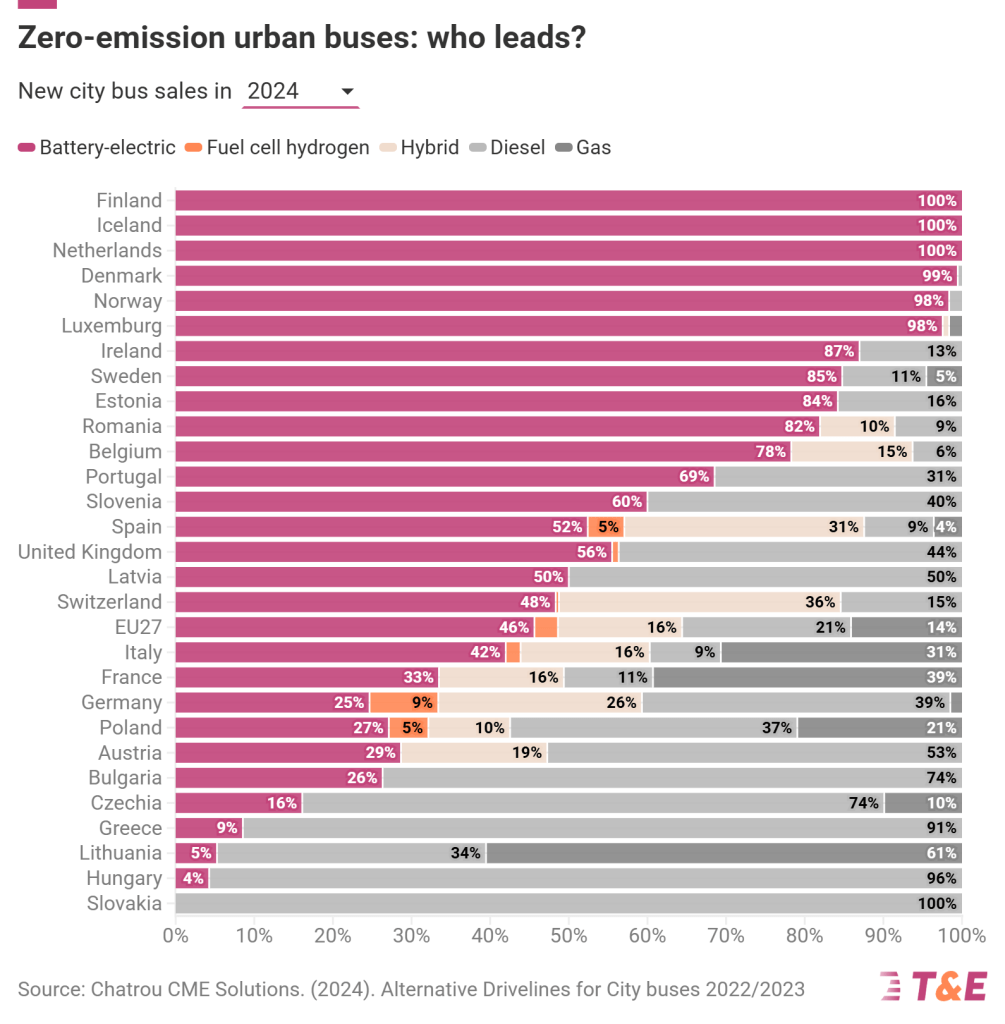
According to T&E’s data, some 46% of new city buses introduced last year were battery-electric vehicles, while 3% were hydrogen-powered fuel cell buses, with the latter technology seeing a faster-than-expected uptake.
Describing the adoption of electric buses as one of the ‘early success stories of the European Green Deal‘, T&E said that the rollout was both due to ‘new European regulation last year sending a clear market signal that the days of diesel buses are numbered, but also thanks to city-level policies such as zero-emission zones and fleet targets.
Ahead of targets
If the current growth rate is maintained, all new city buses would be zero-emission by 2027, which would be eight years ahead of target, with the transition progressing faster than EU requirements under the Clean Vehicle Directive and CO₂ standards for trucks and buses.
Some European countries – including the Netherlands, Finland, and Iceland – have already achieved 100% battery-electric bus sales, while among Europe’s largest markets, Spain leads with 57% ZE bus sales, surpassing the UK (56%), followed by Italy (44%), France, and Germany, which each have a one-third share.
Other countries have seen a rapid ramping up of sustainable transport methods, offering a ‘glimpse of what is possible’, according to T&E.
For example, Estonia registered no zero-emission city buses in 2023, however in 2024, 84% of new Estonian city buses were battery-electric.
Leading the transition
Commenting on the transition to zero-emission buses, Max Molliere, e-mobility data analyst at T&E, said, “The Netherlands clearly lead the transition: less than 1% of new city buses have been diesel since 2021. Close behind are Nordic countries as well as a few East and South European countries. Since 2021, roughly two-thirds of new city buses have been battery-electric in Bulgaria, Romania, and Greece.
“However, most show (sometimes timid) signs of improvement in recent years. If, as we predict, 2025 marks the turning point where more than half of new city buses are zero-emission, we should see the transition accelerate accordingly in trailing countries.” Read more here.