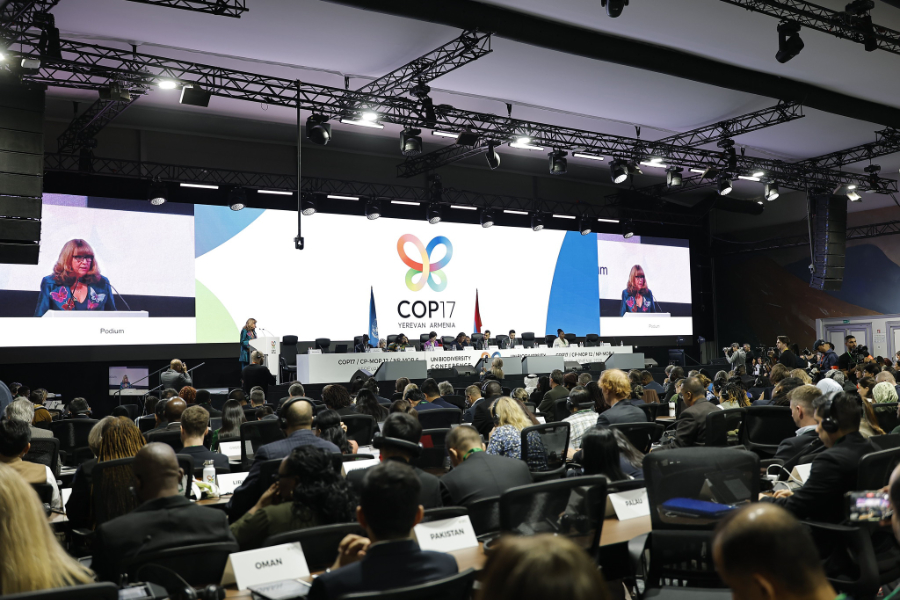
Protecting and restoring nature isn’t just case of spending money, it’s an investment in natural capital, resilience and “future prosperity”, European Central Bank (ECB) executive board member Frank Elderson has told the COP17 biodiversity summit in Armenia.
Elderson, who is also vice-chair of the ECB’s supervisory board, made his comments at the opening of the Finance and Biodiversity Day at COP17, where he argued that the degradation of natural systems creates financial risks, meaning that governments “need to get the economics right” when it comes to investing in nature and biodiversity.
Natural capital
“Let me start with a fundamental question: why is nature so important to the economy?” he commented. “We tend to think of roads, bridges and electricity grids as critical assets that serve as the foundation of a modern economy.
“But there is another kind of infrastructure that we often take for granted: natural capital. Nature provides services without which large parts of our economies could not function.”
Elderson cited the ECB‘s own research, which showed that 72% of companies operating in the euro area depend on at least one ecosystem service, while three quarters (75%) of euro area corporate lending goes to companies that are highly dependent on at least one ecosystem service.
“The message is clear: nature is not peripheral to economic activity. It is fundamental to it,” he added. “But even as we speak, the foundations of our economies are being depleted at an alarming rate.
“When ecosystems deteriorate, firms face higher costs, lower productivity and supply chain disruptions. For far too long, we have treated nature as though it were free and inexhaustible. It is neither. We have mistaken the depletion of natural capital for economic prosperity.”
Environmental risks
The ECB incorporates environmental risks into its financial-stability and banking-supervision work, with Elderson adding that banks are expected to “identify and manage not only material climate risks, but also nature-related risks” as part of their day-to-day operations.
In addition, nature risks are featuring “more explicitly” in the ECB’s monetary policy assessment and communication in recent quarters.
“Nature is not becoming a feature of central banking because central banks are becoming environmental policymakers,” said Elderson. “Quite the contrary: we are – and will remain – climate and nature policy takers.
“Nature is becoming a feature of central banking because the consequences of its degradation are affecting our mandate.” Read more here.