Despite a backlash from some quarters, environmental, social, and governance (ESG) investing continues to grow, with ESG funds outperforming traditional funds and exchange-traded funds (ETFs).
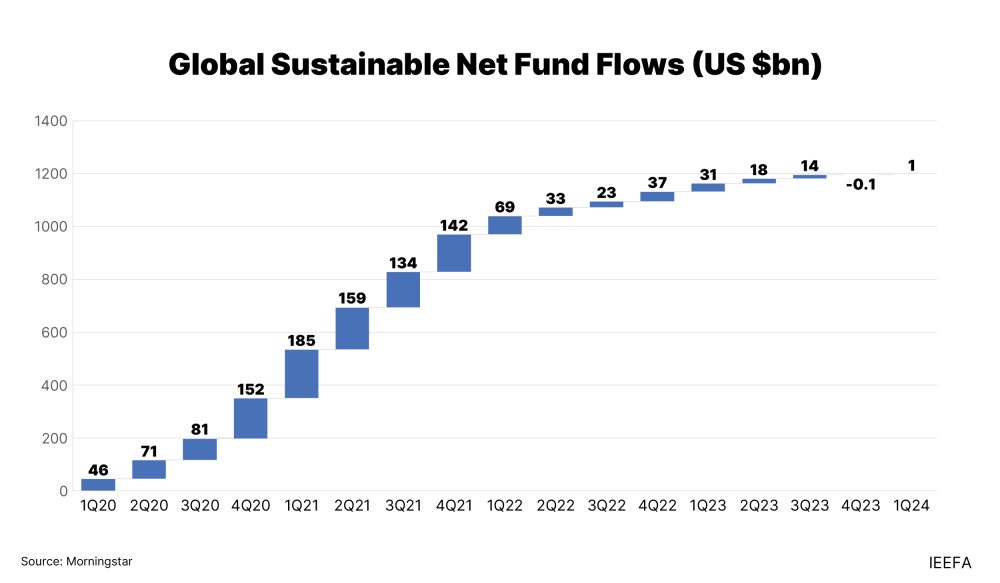
According to the Institute for Energy Economics and Financial Analysis (IEEFA), ESG investing grew rapidly between 2017 and 2022, and yielded positive results in 2023.
“Sustainable funds generated better returns than traditional funds in 2023, with a median return of 12.6% versus 8.6% for traditional funds, commented Ramnath N Iyer, sustainable finance lead, Asia, at IEEFA and author of the report. “This outperformance was extended across both equity and fixed-income fund asset classes.”
Surpassing traditional funds
According to IEEFA, ESG funds continue to show growth and remain highly relevant for investors, matching or surpassing traditional funds over most time periods, amidst a market environment in which climate change is receiving significant focus from regulators.
At the same time, there are clear regional differences between the US and Europe when it comes to the flow of sustainable funds.
Compared to an outflow of S$8.8 billion from the U.S., Europe saw an inflow of almost $11 billion into this asset class, more than double that of the previous quarter.
Europe a ‘standard bearer’
“Europe has been the standard bearer for ESG since the beginning,” Iyer added. “With 84% of sustainable assets under management, the region is home to some of the largest and most significant ESG investors.”
The improved inflow in Europe is linked to the introduction of the Corporate Sustainability Reporting Directive, which requires businesses to report their environmental and social impacts, as well as how their ESG actions affect their operations, IEEFA said.
Asia also saw an inflow, of $622 million in the first quarter of 2024, after an outflow in the previous quarter – the region has also seen an uptick in regulatory activity recently.
“The increasing regulatory support and enhanced regulatory developments signal the mainstream adoption of climate, sustainability, and ESG policies,” said Iyer. “It remains important to evaluate, gauge, and mitigate climate change risks when making investment decisions.
“Even the less stringent U.S. Securities and Exchange Commission’s climate disclosure requirements can be viewed as a first step.”