Extreme heat could reduce the GDP of the European Union by around 1% this year, or €180 billion, according to a new report by Triodos Bank.
The Dutch bank’s report, Hot Summer Economics, suggests that the ‘record heat and prolonged drought‘ impacting Europe this summer could effectively erase the growth previously forecast for the year.
‘Just a taster’
“This summer shows that climate change is not a distant economic risk,” commented Hans Stegeman, chief economist at Triodos Bank. “The extreme heat we all experience today shows concretely how climate change will affect lives, workers and prosperity across Europe.
“For this year, the loss of 1% of GDP would mean stagnation. That is a real cost, but no catastrophe. Yet the extreme heat this year is just a taster of what’s coming if we do not act quickly and forcefully on climate change.”
The report explored the economic effect of extreme heat across four areas: food and agriculture, energy production, transport and logistics, and labour productivity.
Labour productivity was identified as the most significant economic effect, according to the study, with the average loss equivalent to around 0.6% of EU GDP.
A fall in agricultural output – of between 3% and 7% – as well as constraints on power generation and disruption to roads, railways and inland waterways are also cited as potential impacts.
Regional impact
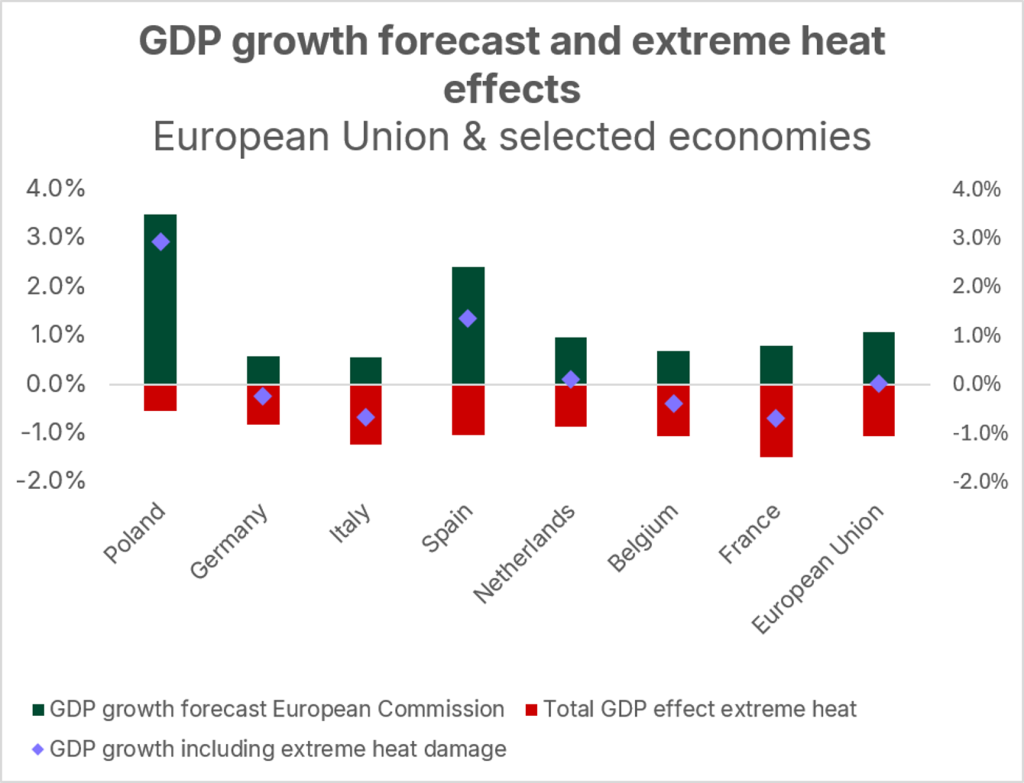
Some parts of Europe are expected to be more heavily impacted than others – France could see its economic growth curtailed by 1.4 percentage points, leading to a 0.6% contraction in GDP. In the Netherlands, a potential 0.8% contraction in GDP could leave the economy ‘broadly stagnant’, Triodos Bank noted.
Elsewhere, Italy, Spain, and Belgium could also face ‘substantial losses’, however Poland is likely to be less affected, because it is forecast to experience fewer exceptionally hot days.
Triodos Bank has called for greater investment in adaptation measures, as well as rapid decarbonisation policies aimed at reducing energy and material consumption.
“The most powerful thing we can do to lower these costs is to mitigate climate change,” Stegeman added. “That means changing our lifestyles and transforming our economies so that we use less energy and resources.” Read more here.