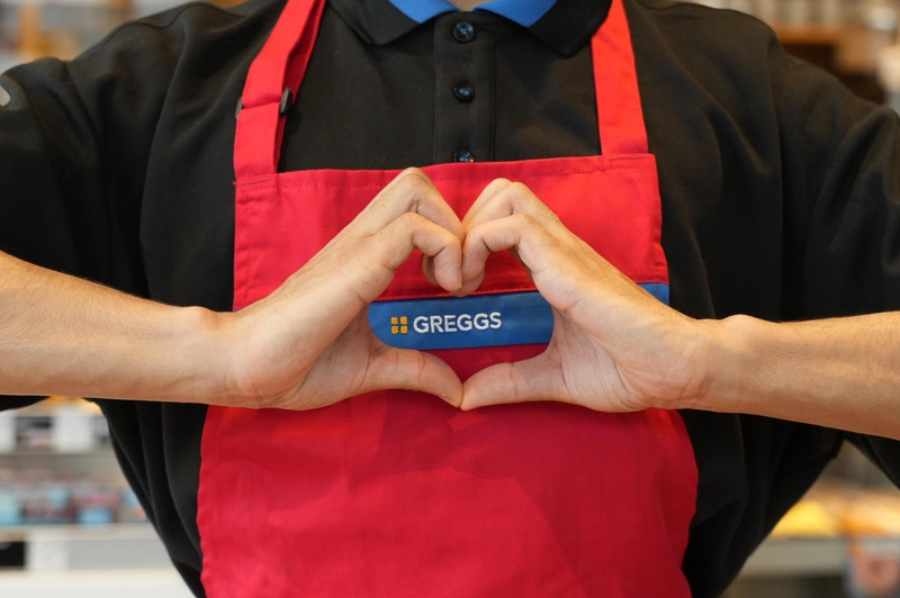
High street bakery chain Greggs has reported a 40% reduction in food waste across its operations, and a 56% reduction in emissions intensity, in its latest Sustainability Report.
In the report, entitled The Greggs Pledge, the chain said that it made ‘significant progress’ against the targets it established in 2021, and set out a refined set of targets to take it up to the end of the decade.
As well as announcing a food waste reduction, which was against a 2018 baseline, Greggs also increased the proportion of unsold food redistributed to 45%, and increased the range of healthier options (30% of existing items and 40% of all new products) on its shelves.
Its emissions intensity reduction, against a 2019 baseline, was backed by a significant uptake of renewable energy across its operations, with 97% of the electricity, 47% of the gas, and 28% of the vehicle fuel it uses now coming from renewable sources.
Elsewhere, almost all the packaging it uses across its portfolio is now fully recyclable (with the exception of hot drink cups); 100% of the declared soy used in its operations is certified sustainable; it achieved 10 out of 10 in the Roundtable on Sustainable Palm Oil Shared Responsibility Scorecard; and it was recently confirmed as one of the UK’s top four companies in the Business Benchmark on Farm Animal Welfare.
The Greggs Pledge
“I am very proud of what we have achieved since we created The Greggs Pledge, shining a spotlight on the sustainability areas where we felt we could drive the most meaningful change and deliver a measurable benefit,” commented Roisin Currie, chief executive.
Looking ahead, the company is seeking to increase its redistribution of unsold to at least 50% by the end of the decade; achieve net zero for Scope 2 emissions within the same timeframe; and maintain a longer-term trajectory for full value chain decarbonisation by 2040.
Alongside this, it intends to strengthen its approach to animal welfare and sustainable sourcing, as well as building on existing certifications and benchmarking performance.
‘A complex world’
“The next iteration of The Greggs Pledge allows us to keep adapting to an ever-changing and more complex world,” Currie added. “However, our commitment to make the world a better place remains the same, and we pledge to continue to make the most positive impact on our communities and continue doing good.”
In the short term, for 2026, the group has announced a partnership with Nesta, the research and innovation foundation, to develop a method for measuring the healthiness of food sales, report performance against this measure and set a target to deliver improvement by the end of 2030. Read more here.