
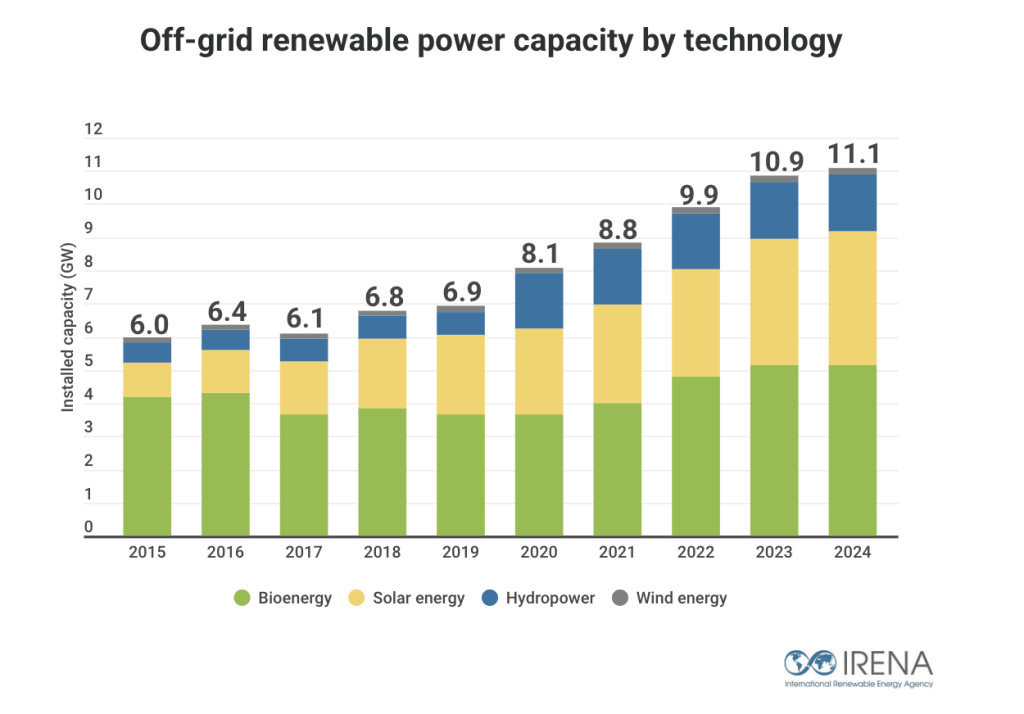
While global off-grid renewable power capacity reached 11.1 gigawatts in 2024, providing electricity to 86 million people, more effort needs to be made to connect such systems to remote areas, particularly in Africa, the International Renewable Energy Agency (IRENA) has said.
According to IRENA’s Off-grid Renewable Energy Statistics report, Africa accounted for three quarters of overall off-grid energy access in 2024, largely through solar, mini-hydro, and other decentralised renewable energy (DRE) solutions that operate independently of national grids.
Globally, some two million off-grid systems supply energy services to agriculture, health, education, public lighting, tourism, and communication sectors, however, many households relying on off-grid services receive less than eight hours of electricity per day.
Electricity-deprived communities
As IRENA noted, more than 66 million people around the world have no access to electricity, with this electricity-deprived population more likely to live in remote areas and have lower incomes.
‘This indicates that many off-grid households still lack access to sufficient energy services that can enhance their livelihoods,’ it said, adding that off-grid renewable energy not only provides electricity and lighting, but can also increase access to clean water and sanitation, improve education and digital learning, and create local jobs and business opportunities, meeting the needs of several of the UN Sustainable Development Goals (SDGs).
Off-grid solutions in action
IRENA cited a number of examples of where off-grid renewable energy is supporting communities – in Kenya, a coastal fishing community in Kwale County has utilised solar power to operate cold storage facilities for seafood, while in Rwanda’s Eastern Province, local women in Bugesera have installed a solar-powered irrigation system on their farm.
Elsewhere, in Epworth, Zimbabwe, a solar powered borehole is helping to provide clean water to a school and surrounding community, while in Papua New Guinea, a mini-hydropower solution is helping to provide electricity to schools in Hogave. Read more here.